 If you reuse this image, please credit and link back to historicracer.com.
The vast expanse of Elvington’s aircraft parking area seems like a desert as we stand, blinking in the reflected glare of white 1960’s concrete, sweat dripping onto my shades. It’s one month before the Goodwood Festival of Speed and there’s some practising to be done. Here to do that practising are the owners of two icons of French rallying history. More than twenty five ago, the cars you see here were at the forefront of motorsport technology. Group B was at it’s height and we were all wide eyed and open mouthed as these machines barked, popped and flamed their way through the UK’s forests at speeds never seen before, making a Group4 Escort look like a Prius. Watching Sebastian Loeb’s dominance in WRC this past decade, it’s become easy to forget the last time French rally cars and drivers enjoyed such success.
Then, of course, they were banned. And for twenty years, with the exception of the Metro 6R4’s UK success, they’ve been sitting at the back of workshops across the world, pretty much disappeared from view.
But they’ve been coming back. In recent years, owners of these machines are getting them out onto the stages again. They can’t compete – they’re still banned, don’t forget. But as a demonstration class before the main event, they make a superb warm up act.
Such is the strength of feeling for the genre that the organisers at Goodwood created a special forest stage a few years ago to re-create Group B cars driven in anger for maximum effect. Having been to the press day and seen how close the trees were, Adam Keeler, the owner of the Renault, has decided some practise is required on gravel. Especially as he’s going to be sharing his car with none other than Jean Ragnotti, the greatest Maxi Turbo driver of all.
Joining him is Dave Woodall, his Peugeot 205 T16 is one of several Group B cars he’s owned in recent years. With the likes of Ragnotti, Mikkola, Munari and other legends expected at Goodwood, they both decided it was a good idea to get some rare gravel testing done and have recruited driver coach McKenna for an impartial view on how to get the best from the cars.
[quote]What we have here are two cars at opposite ends of the Group B development period[/quote]
So here we are, looking at the differences between the two cars as their interiors cook in the sunshine. What we have here are two cars at opposite ends of the Group B development period. The Maxi Turbo was developed alongside the Renault factory’s Formula 1 cars, using turbo technology from that team and sharing advanced composite materials which were only just arriving in motorsport at the time. The Peugeot, however, was developed as Group B was at it’s zenith, designed from scratch to beat the Audi Quattro and win the world championship on all surfaces, which it duly did.
As time goes by, competition car histories often become clouded as cars change owners, have accidents, are rebuilt and generally have the rigours of competition inflicted upon them to the point where actual cars’ real identities can become somewhat dubious. Take Audi’s famous decision to switch the doors of Michelle Mouton’s Quattro mid-event as an example. Which car really won that rally….?
[quote]It always fails noise. But as it’s not competing, they kind of turn a blind eye[/quote]
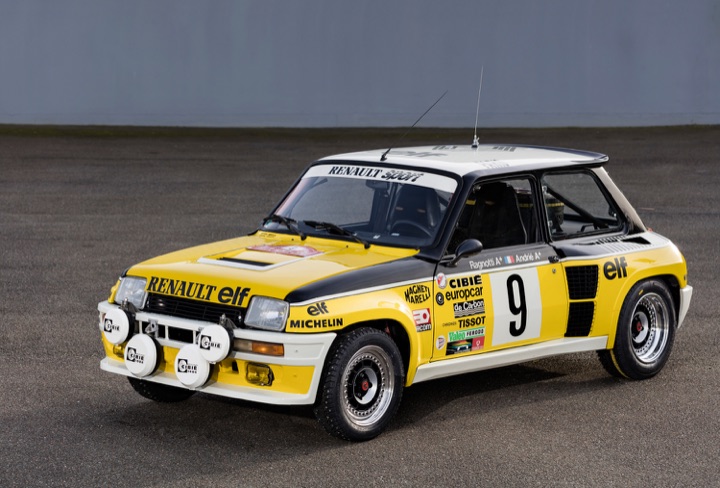
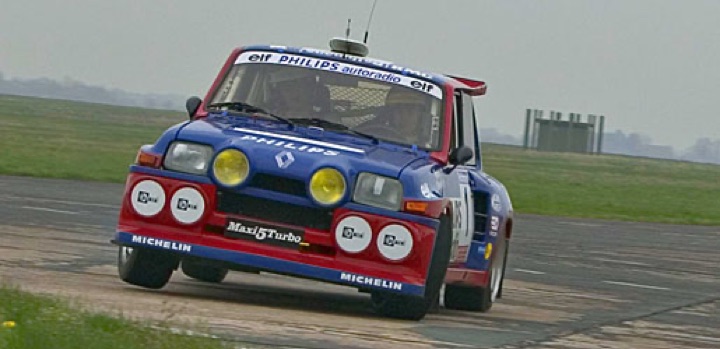
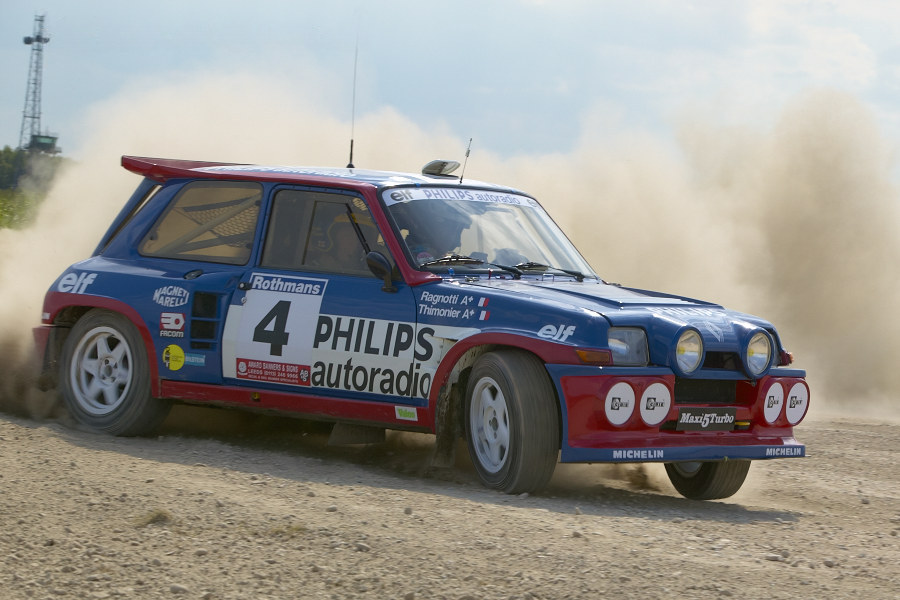
These two, however, are the real deal. Adam’s car came from the factory direct to John Price who campaigned the car in a leery yellow colour scheme with great success all over the UK from 1983 for several years with factory support, winning several tarmac championships until selling it in around 1987, at which point it disappeared for a few years. Adam discovered the car in 1998 literally as a box of parts scattered around the workshop of a local Renault service specialist. It had been completely stripped for a rebuild, but that was as far as it got. After 12 months of persuading, Adam bought the car, complete but totally dismantled. Evidence of it’s life as a hard working rally car was everywhere, yellow paint in the wiring harness and several local repairs showing that this car had seen plenty of action. Everything was there, though, including the horribly expensive and rare carbon tailgate, alloy panels, the works engine and ECU and all the other difficult to obtain Group B parts. Adam rebuilt the car from scratch, back to bare metal, repairing the knocks and dents, spending hours removing yellow paint with aircraft spec paint remover. Rebuilding the car, he decided that there was only one colour scheme it could possibly be – the Phillips Car Stereo scheme of the car Ragnotti won the Monte in. Hours were spent researching photos and having graphics replicated before the car was painted as authentically as possible. “It always fails noise” says Adam, “ But as it’s not competing, they kind of turn a blind eye, though I could silence it if I really had to – we carry an exhaust can amongst the spares.”
[quote]A racing car on gravel, comments McKenna[/quote]
Dave’s Peugeot sitting beside the Maxi Turbo illustrates just how quickly these cars were progressing at that time. Though they’re both mid-engined, there’s a huge amount of development gone into the T16 in just a few short years. Dave’s car was built in 1985, one of only 50 rally versions of the two hundred vehicles produced for homologation. Less than three years separate the two, but the advances are dramatic. The Renault is mid-engined, rear wheel drive, whereas the T16 is obviously permanent four wheel drive. The Peugeot is built from a race car style tub, with engine, suspension etc all bolted to it for minimum weight and maximum stiffness. “A racing car on gravel” comments McKenna.The twin cam, 16 Valve engine is a generation on from the Renault and has a far smoother power delivery, whereas the smaller 1398cc unit in the Maxi Turbo harks back to the days of early F1 thinking with a power band like a flourescent light bulb.
Dave bought the T16 direct from a contact in France after looking around for some time. He knew the car had been used in both the Belgian and French national championships, it wore French Kodak colours when he bought it. The Belga colour scheme on the car is authentic and Dave decided upon it when he was stuck at a French airport wandering around the shops and saw a model of it. The hardest part of owning the Peugeot is spare parts – the cars were never really owned by private teams so spares support was never given consideration. The engine was rebuilt by rallycross expert Will Gollop, to Group B specification, though it’s now ‘international’ spec giving around 430 Bhp. Suspension, bodywork and other components are hard to find and jealously guarded by anyone who has a supply.
These cars can be heavy on maintenance, yet despite their rarity and the spares issue, neither owner holds back when it comes to driving. “They were built to be driven by the world champions of the time” says Adam. “A bit of a handful on the limit, but I don’t hold back. It’s a rally car, not a museum piece and I drive it as I hope people expect”. Indeed Adam proved that point by wiping out a rear corner on the Isle of Man last year …..
[quote]So what is it like inside a genuine, ex-works Group B rally car from 20 years ago?[/quote]
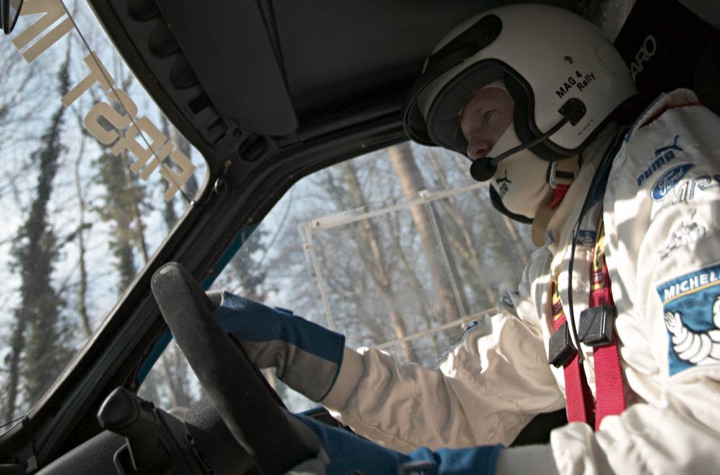
So what is it like inside a genuine, ex-works Group B rally car from 20 years ago? Starting up, the Renault’s early turbo technology and small capacity is obvious. It come to life with a spluttering bark, the old ECU hunts up and down as it warms through, looking for a tickover it’s happy with from the highly stressed little motor, all the time the evil, burbling hiss from the turbo coming straight out of the unsilenced exhaust. 350 Bhp from a 1.4 litre engine, using 20 year old technology – no wonder Adam says it has an appetite for head gaskets. McKenna tries both cars on tarmac first, so he jumps into the Maxi Turbo and heads off for a few laps. I pick up a helmet and jump in the co-drivers seat for some first impressions. Four laps later, we pull in, Andy sweating and Adam laughing through the open door. “Well?” “What an evil little bitch! It goes from off-boost understeer to full boost oversteer instantly. Getting it balanced on the sweet spot is like driving a flick knife,” is Andy’s first comment. “Absolutely brilliant, I love it!”
Dave’s T16 is warmed through and he’s been for a run to warm the transmission, so we jump in to get an immediate comparison. The lower noise level and smoother power delivery are immediately apparent, the 16 valve engine delivering power more along the lines of the latest generation of engines, though the 430 Bhp in the 950Kg car makes for stunning acceleration off the line. The engine in the Peugeot is mounted transversely, right behind the bulkhead, with no heat protection or soundproofing. The cockpit temparature is incredible and with no air conditioning or power steering, an event like Greece or San Remo must have been a marathon. Those Group B world champions certainly earned their trophies. On the loose surface, the T16’s advantages become obvious. The grip from the transmission, the smoother power delivery meaning that the workload is a lot lower initially, with the stiff tub and more advanced suspension soaking up the rough surface surprisingly well, so that you certainly arrive at the next corner at a high velocity.
The Maxi Turbo’s passionate power delivery and two wheel drive mean that there’s a lot going on for the driver to stay ahead of the car. If the engine falls off boost, the speed just dies away, leaving you scrambling for gears, getting ready for the boost coming back in and steeling yourself for the opposite lock that you just know is about to be needed. That boy Ragnotti must have been a very busy chap when he was trying.
So which is best? Well that’s not a fair question. Though only three years separate the two cars, that is a lifetime in motorsport. The Peugeot’s four wheel drive, later generation ECU and engine means it’s a whole load quicker on the loose. On tarmac, however, with a man of Ragnotti’s bravery and skill, the little Maxi Turbo was something else.
So you have a choice – two lovely French mistresses. One will seduce you and encourage you into believing you’re a hero, the other will fight you with a passion and fury making you earn your prize. But that on-boost, tyre drifting sweet spot you constantly quest for in the Renault is worth the struggle.
Thanks to Yorkshire Air Museum for the use of the Mirage III Fighter.
Words and photography copyright Neill Watson
Driver Andrew McKenna