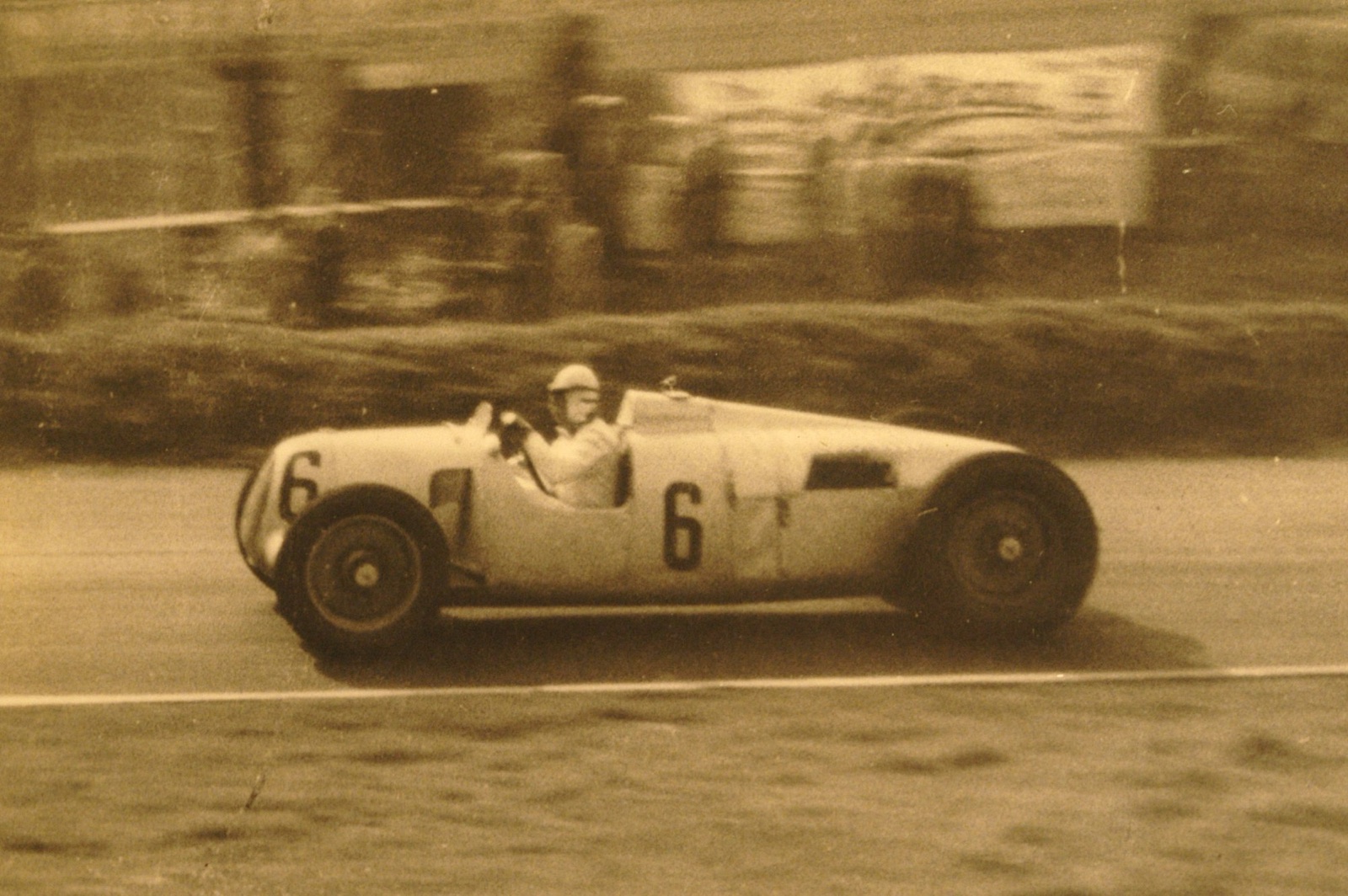
The Auto Union Type C is the Grand Prix car Auto Union raced in 1936 and 1937: Ferdinand Porsche's design, with a supercharged V16 engine of about six litres mounted behind the driver. The Auto Union Type C won six of the 12 races the team entered in 1936, five of them with Bernd Rosemeyer, who became European champion, by Motor Sport's 2021 history of the Auto Union V16. In streamlined form the Auto Union Type C reached 252.47 mph over the flying kilometre on the Frankfurt to Darmstadt autobahn in October 1937, with Rosemeyer driving, by Motor Sport's report of November 1937.
Who designed the Auto Union Type C, and why?
The Auto Union Type C grew out of the racing car Ferdinand Porsche's design office drew for the 750 kg Grand Prix formula of 1934. Auto Union built that car in a racing department at the Horch works in Zwickau, where Porsche supervised its construction and testing from March 1933, according to Audi's 2009 history of the Silver Arrows. The Type C of 1936 was the third version of that design: "As the names of successive model generations progressed through the alphabet, the Type C made its appearance," in the words of Audi Tradition's account of the Silver Arrow years.
The 750 kg formula
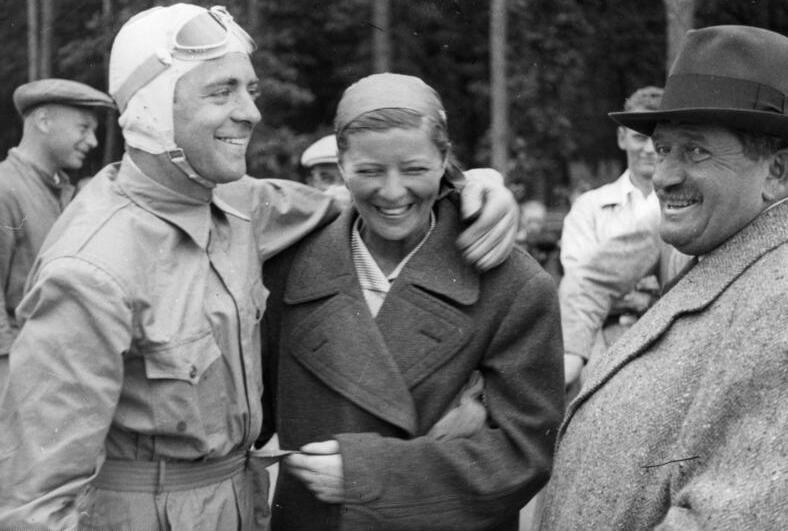
The formula, announced in autumn 1932 (Audi Tradition), limited a Grand Prix car to 750 kg without tyres, oil, fuel and water, with bodywork at least 85 cm wide, as Denis Jenkinson summarised it in Motor Sport in October 1980. It put no limit on engine size, and it was meant to run from 1934 to 1936; it was then held over for 1937, according to Motor Sport in September 2000. The rule-makers assumed the weight limit would rule out large, powerful engines, Lawrence Butcher wrote in Motor Sport's 2021 history; "It didn't."
Porsche's P-Wagen
Porsche, whose car designs went back to the Lohner-Porsche Semper Vivus hybrid of 1901, led a team (engine designer Josef Kales, Karl Rabe, his son Ferry and Adolf Rosenberger, an amateur racing driver) that drew a mid-engined car with independent suspension at every wheel and a V16 of about 300 bhp before any company had agreed to pay for it (Butcher). Auto Union, formed in 1932 by the merger of Audi, DKW, Horch and Wanderer, bought the design from Porsche's studio in Stuttgart and kept him as consultant chief engineer to its racing department, working with engineers from Horch, Audi and DKW (Jenkinson, 1980). After Auto Union's chairman Klaus von Oertzen and the driver Hans Stuck put the case to Hitler, the government's racing subsidy of 500,000 Reichsmarks was shared between Auto Union and Mercedes-Benz (Butcher). Approval of the design depended on the engine giving at least 250 hp at 4,500 rpm (Audi, 2009).
Auto Union Types A and B, 1934 and 1935
The Type A first appeared in competition on the Avus circuit in Berlin on 27 May 1934, by Audi's account. It had a 4,358 cc V16 (68 × 75 mm) giving 295 bhp at 4,500 rpm, and the Type B of 1935 a 4,951 cc engine (bore 72.5 mm) giving 375 bhp at 4,800 rpm, according to Motor Sport in 2000. Stuck won the German, Swiss and Czechoslovakian Grands Prix with the Type A in 1934, by the Motor Sport report of July 2002 on Crosthwaite & Gardiner's recreation of it. In 1935 Mercedes-Benz won nine races to Auto Union's four, by the season's score in Motor Sport's review of October 1940, which ended the year with Auto Union having "contrived to use 5½-litre engines" within the weight limit. In February 1935 Stuck drove a streamlined Auto Union, the Lucca car, to a class record of 320.267 km/h for the flying mile near Lucca, in Italy, as Audi Tradition's release on its 2026 recreation of that car records.
Auto Union Type C design and engineering
The Auto Union Type C kept the layout Porsche drew in 1933, which Jenkinson described in 1980: the driver sat with his feet between the front wheels, a single fuel tank sat behind him, and the V16 sat ahead of the rear axle with the gearbox behind it. Its engine was bored and stroked to 75 × 85 mm, 6,005 cc, and gave 520 bhp at 5,000 rpm, by Motor Sport's 2000 figures; apart from a change of rear springing after the first season, Jenkinson wrote, the basic conception of the car did not change.
Why was the Auto Union Type C's engine behind the driver?
With the engine behind the driver, the Auto Union Type C needed no propeller shaft, and the driver could sit lower, which helped the aerodynamics and lowered the centre of gravity (Audi Tradition). Jenkinson wrote in 1980 that the Auto Union engine did not match the Mercedes-Benz for sheer power but had far better torque, and that the rearward weight distribution gave the car "much better traction and acceleration". He also noted that the P-Wagen was not the first to use the layout, pointing to a Benz racing car of similar layout designed with Edmund Rumpler in 1922.
The Type C's V16 engine
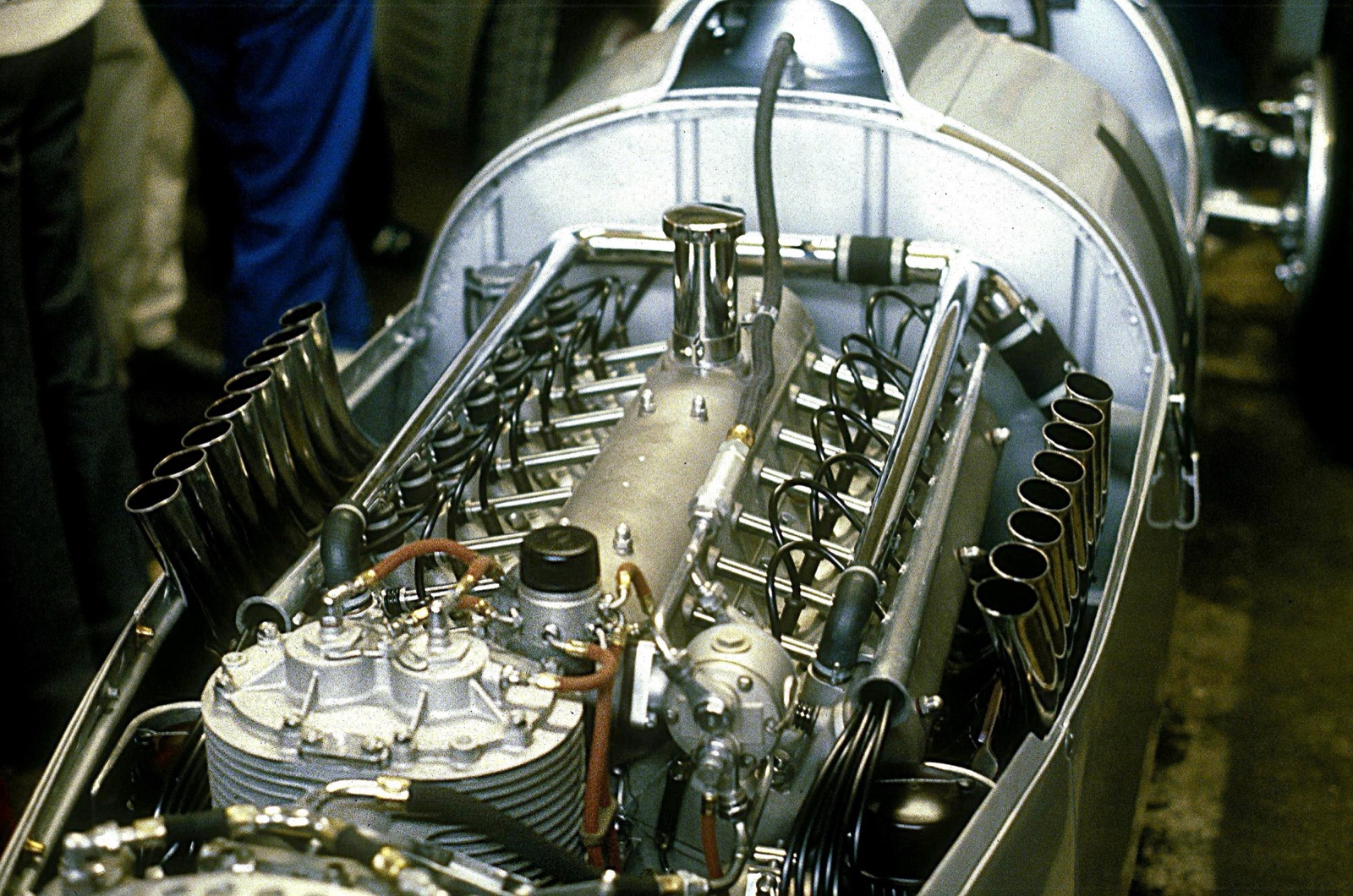
In Jenkinson's description the two banks of eight cylinders were set at an angle of 45 degrees, with a single camshaft in the vee working the inlet valves through followers and the exhaust valves through transverse pushrods and small rockers, and a single supercharger of the Roots type stood vertically at the back of the engine. Porsche chose sixteen small cylinders for packaging: the narrow vee and small bores made an engine narrow and short enough to fit the regulation width of the cockpit, and it was never meant to rev high. Porsche wanted pulling power at low engine speed, and the first engine gave its peak power at only 4,500 rpm, so two valves per cylinder were enough and heavy twin-overhead-camshaft cylinder heads could be avoided; the block was cast in silicon-aluminium with wet liners, and the sump carried no load. It was designed so that its capacity could be enlarged, and it grew through two seasons of development to six litres in 1936 (Butcher). As power rose, the main bearings changed from plain to roller bearings, and the crankshaft, at first one piece, was replaced by a built-up shaft designed by Hirth, its segments bolted together through splined couplings. In its final form the engine gave 87 mkg of torque at 2,500 rpm, which meant only a four-speed gearbox was needed, according to Audi's 2009 history.
Chassis, suspension and gearbox
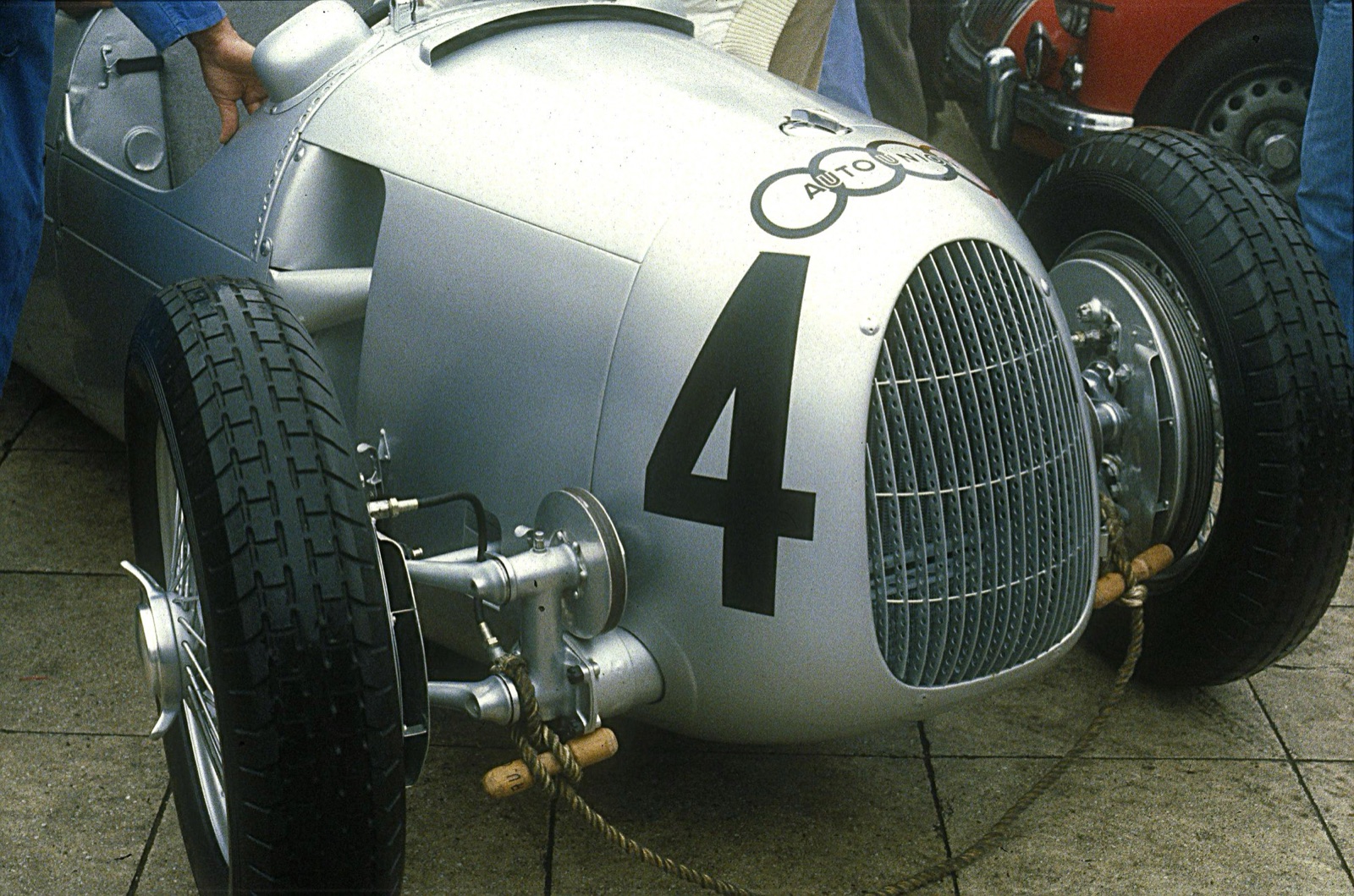
Jenkinson's 1980 account gives the frame as two large-diameter tubes running side by side with tubular cross-members, with electron and magnesium used to keep the car's weight within the limit as the engine grew. At the front, Porsche used trailing arms and transverse torsion bars; at the rear, a swing axle on each side, sprung by a transverse leaf spring in 1934 and by longitudinal torsion bars from the following season. For 1936 the cars were reported to have better brakes as well as the 6-litre engine (Motor Sport, October 1940). The P-Wagen had a five-speed gearbox (transmission) behind the rear axle, and the Type C went to four speeds in place of five for 1937, by Motor Sport's review of the 1937 season, published in September 1941.
How did the Auto Union Type C handle?
The Auto Union Type C took the forward driving position and mid-engine layout "to extremes", Jenkinson wrote in Motor Sport in December 1982, so that the cars were not easy to drive and were "very prone to extreme over-steer, or 'tail-happiness'". Audi Tradition says the unfamiliar handling demanded "a Herculean effort" from the driver, and that the tyres of the day could not use all of the layout's traction. For the Type D of 1938 the fuel went into pontoon tanks so that the driver could sit further back (Jenkinson, 1982).
Auto Union Type C specifications
The Auto Union Type C was a Grand Prix car of the 750 kg formula, with a supercharged 6-litre V16 behind the driver. Period reports gave its capacity as anything from 5.8 to 6½ litres, and its power as about 480 bhp before it first raced.
| Item | Type C | Source |
|---|---|---|
| Raced | 1936 and 1937 | Motor Sport, February 2025 |
| Designer | Ferdinand Porsche's design office | Audi, 2009 |
| Built by | Auto Union racing department, Horch works, Zwickau | Audi, 2009 |
| Layout | Driver ahead of the fuel tank, engine ahead of the rear axle, gearbox behind it | Jenkinson, 1980 |
| Engine | V16 at 45 degrees, one central camshaft for all 32 valves, Roots supercharger | Jenkinson, 1980; Audi, 2009 |
| Bore × stroke, displacement | 75 × 85 mm, 6,005 cc | Motor Sport, 2000 |
| Power | 520 bhp at 5,000 rpm | Motor Sport, 2000 |
| Torque | 87 mkg at 2,500 rpm | Audi, 2009 |
| Crankshaft | Built up in segments with Hirth couplings | Audi, 2009 |
| Gearbox (transmission) | Four speeds in final form (five on the 1934 car) | Audi, 2009; Jenkinson, 1980 |
| Frame | Two large-diameter tubes with tubular cross-members | Jenkinson, 1980 |
| Front suspension | Trailing arms, transverse torsion bars | Jenkinson, 1980 |
| Rear suspension | Swing axles, longitudinal torsion bars | Jenkinson, 1980 |
| Tyres | 22 × 7 covers at Tripoli, 1936 | Motor Sport, January 1941 |
| Weight limit | 750 kg without tyres, oil, fuel and water | Jenkinson, 1980 |
| Top speed | 340 km/h, stated for the Avus bodywork | Audi Tradition |
How much horsepower did the Auto Union Type C have?
About 520 bhp from a displacement of six litres: Audi gives the Type C's output as 520 PS in its company history, and Motor Sport gave 520 bhp at 5,000 rpm in 2000. A period report put it lower, and the record cars ran larger or more powerful engines.
| Source | Capacity | Power |
|---|---|---|
| Motor Sport, October 1940 (news of late 1935) | 6 litres | About 480 bhp at 5,000 rpm |
| Motor Sport, January 1941 (reports of the 1936 races) | 6½ litres at Tripoli, 5.8 litres at the Eifelrennen | Not given |
| Jenkinson, Motor Sport, October 1980 | 6.1 litres | Not given |
| Motor Sport, September 2000 | 6,005 cc | 520 bhp at 5,000 rpm |
| Audi, 2009 and company history | 6 litres | 520 bhp (520 PS) |
| Boddy, Motor Sport, August 1990 (record car, October 1937) | 6.3 litres | 545 bhp |
| Audi Tradition (record car, January 1938) | Not given | 560 hp |
The Mercedes-Benz W125 of 1937 had more: Butcher puts the V16 "some 100bhp down" on the W125's 600-plus bhp.
How fast was the Auto Union Type C?
The Auto Union Type C had a top speed of 340 km/h (211 mph), Audi Tradition states, adding "in the AVUS bodywork, otherwise also over 400 km/h"; Latvian public broadcasting repeated the 340 km/h in 2026 without the qualifier. Jenkinson wrote in 1980 that in Grand Prix form the cars were "undoubtedly capable of 175 m.p.h." At Pescara in 1936 Varzi's Type C was timed at 183.64 mph over a kilometre.
| Occasion | Speed | Source |
|---|---|---|
| Coppa Acerbo, Pescara, August 1936: Varzi over a timed kilometre | 183.64 mph | Motor Sport, January 1941 |
| Avusrennen, May 1937: Rosemeyer's fastest lap, first heat, streamlined car | 171.78 mph (4 min 11.2 sec) | Motor Sport, 100 Greatest Grands Prix |
| Avusrennen, May 1937: Rosemeyer on the straights | 380 km/h | Audi, 2012 |
| Autobahn records, June 1937: flying mile | 242.09 mph | Motor Sport, September 2000 |
| Autobahn records, June 1937: flying mile and kilometre | 242.5 and 243.5 mph | Motor Sport, September 1941 |
| Record week, October 1937: flying kilometre and mile | 252.47 and 252.45 mph | Motor Sport, November 1937 |
| Record week, October 1937: flying mile and kilometre | 253.708 and 252.487 mph | Motor Sport, February 1938 |
Auto Union Type C racing history
The Auto Union Type C won six races in 1936 and six in 1937, by the race results in the Motor Sport database. Motor Sport's own summary of the car counts four wins in nine European Championship races and eight wins outside the championship, in its profile of a Type C in February 2025.
1936: six wins and the European Championship
The season began badly. At Monaco in April, in heavy rain on an oiled road, Rosemeyer "crashed tail first through the brick wall" and Caracciola's Mercedes won from the Type Cs of Varzi and Stuck, by Motor Sport's review of the 1936 season, published in January 1941. Varzi won at Tripoli in May from Stuck; a week later, at Tunis, Rosemeyer's car caught fire and Varzi was thrown out when his went out of control at 180 mph. Tazio Nuvolari's Alfa Romeo then beat the Type Cs at Barcelona, Budapest and Milan.
The Eifelrennen in fog
On 14 June 1936, in rain and patches of mist at the Nürburgring, Rosemeyer passed Nuvolari on the sixth of ten laps and won by 2 min 13 sec, at 72.76 mph (January 1941 review). Visibility fell to 20 metres in places, and from then on he lapped half a minute faster than Nuvolari, by Motor Sport's account in its 100 Greatest Grands Prix. At the same meeting Ernst Henne won the race for unsupercharged sports cars of up to two litres in the first prototype BMW 328, the car's first race.
German, Swiss and Italian Grands Prix
Rosemeyer won the German Grand Prix on 26 July with Stuck second, and Mercedes-Benz then paused its racing to rework its cars (Doug Nye, Motor Sport, October 2016). He won the Coppa Acerbo at Pescara, then the Swiss Grand Prix at Bremgarten with Varzi second and Stuck third, after a lap record at 105.42 mph. After the Swiss race the Mercedes engineer Rudolf Uhlenhaut reported that "the power of the Auto Union car in the middle and upper speed ranges is far superior", and Mercedes-Benz cancelled its entries for the Italian Grand Prix (Nye). Rosemeyer won that race too, at Monza on 13 September, with von Delius third. The January 1941 review scored Auto Union's season as six firsts, seven seconds and five thirds.
The three championship wins made him European champion, by the Motor Sport database's 1936 championship overview. Audi's caption to a 1936 photograph of him says he also became German road-racing and German hill-climb champion that year.
1937: against the Mercedes W125
The Type C raced on in 1937, while Mercedes-Benz brought the new W125, and the Type Cs won six races to the Mercedes team's seven, counting the database's results. Von Delius won the Grosvenor Grand Prix in South Africa on 16 January. Rosemeyer won the Eifelrennen on 13 June, the Vanderbilt Cup at Roosevelt Raceway on Long Island on 5 July, by 51 seconds from Dick Seaman's Mercedes, and the Coppa Acerbo on 15 August. Rudolf Hasse won the Belgian Grand Prix at Spa on 11 July with Stuck second, while Rosemeyer was in America, by the database's 1937 championship overview. Von Delius died after crashing in the German Grand Prix in July. The September 1941 review scored Auto Union's year as five firsts, three seconds and seven thirds.
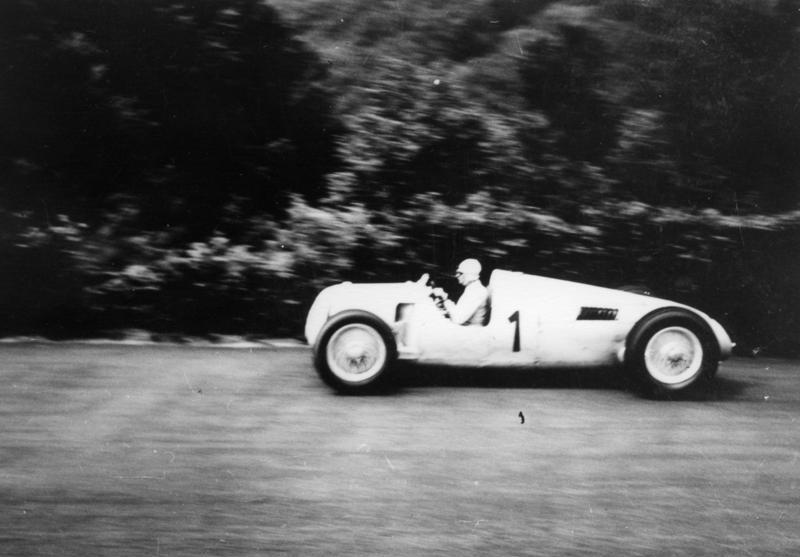
Donington
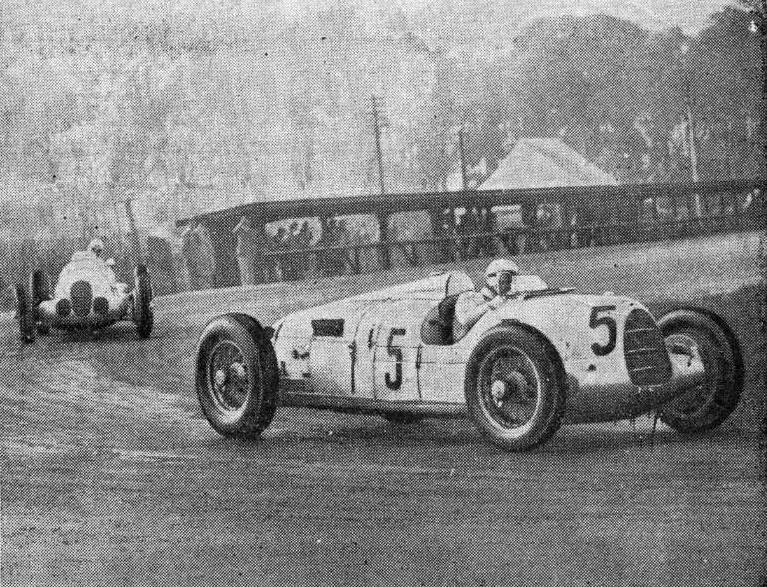
The last race of the 750 kg formula, at Donington Park on 2 October 1937, was won by an Auto Union Type C (Jenkinson, 1980). Rosemeyer, whose car carried the number 5, beat von Brauchitsch's Mercedes by 37.8 seconds at 82.86 mph before a record crowd that lined the course, 38,000 to 40,000 strong by the first reports, and, "according to the dailies", toasted the win in lemonade because the champagne had been lost (Motor Sport, October 1937). The same report has the British spectators cheering him as he was flagged. He and von Brauchitsch shared the fastest lap, at 85.62 mph, by the September 1941 review.
| Date | Race | Best Type C results |
|---|---|---|
| 13 April 1936 | Monaco Grand Prix (EC) | Varzi 2nd, Stuck 3rd |
| 10 May 1936 | Tripoli Grand Prix | Varzi 1st, Stuck 2nd |
| 14 June 1936 | Eifelrennen, Nürburgring | Rosemeyer 1st |
| 26 July 1936 | German Grand Prix, Nürburgring (EC) | Rosemeyer 1st, Stuck 2nd |
| 15 August 1936 | Coppa Acerbo, Pescara | Rosemeyer 1st, von Delius 2nd, Varzi 3rd |
| 23 August 1936 | Swiss Grand Prix, Bremgarten (EC) | Rosemeyer 1st, Varzi 2nd, Stuck 3rd |
| 13 September 1936 | Italian Grand Prix, Monza (EC) | Rosemeyer 1st, von Delius 3rd |
| 16 January 1937 | Grosvenor Grand Prix, South Africa | von Delius 1st |
| 13 June 1937 | Eifelrennen, Nürburgring | Rosemeyer 1st |
| 5 July 1937 | Vanderbilt Cup, Roosevelt Raceway | Rosemeyer 1st |
| 11 July 1937 | Belgian Grand Prix, Spa (EC) | Hasse 1st, Stuck 2nd |
| 25 July 1937 | German Grand Prix, Nürburgring (EC) | Rosemeyer 3rd |
| 8 August 1937 | Monaco Grand Prix (EC) | Stuck and Rosemeyer 4th, sharing a car |
| 15 August 1937 | Coppa Acerbo, Pescara | Rosemeyer 1st, Müller 3rd |
| 22 August 1937 | Swiss Grand Prix, Bremgarten (EC) | Stuck 4th |
| 12 September 1937 | Italian Grand Prix, Livorno (EC) | Rosemeyer 3rd |
| 2 October 1937 | Donington Grand Prix | Rosemeyer 1st, Müller 4th |
Dates, places and placings are from the Motor Sport database's race pages; the database marks the championship rounds.
Who drove the Auto Union Type C?
Bernd Rosemeyer, Hans Stuck, Achille Varzi, Ernst von Delius, Rudolf Hasse and Hermann Paul Müller are the drivers Audi names, and Luigi Fagioli and Tazio Nuvolari also drove Type Cs in 1937, by the Motor Sport database. Rosemeyer won nine of the Auto Union Type C's 12 wins, counting the database's results.
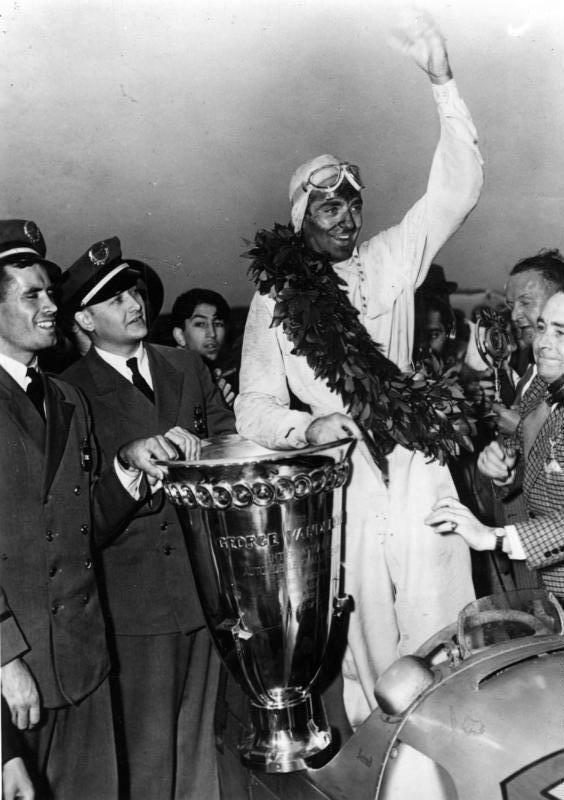
Bernd Rosemeyer
The son of a garage owner at Lingen, Rosemeyer raced motorcycles for Auto Union's DKW team in 1934, had a trial in the racing cars at the Nürburgring at the end of that season, and first raced one at the Avus in 1935, by Motor Sport's obituary of February 1938. He won the Masaryk Grand Prix in Czechoslovakia that year, and in 1936 he married the aviator Elly Beinhorn. Audi Tradition says he was reputed to drive as fast in fog as in clear weather, and that his popularity was "comparable only to that of the boxer Max Schmeling".
Hans Stuck
Stuck was at first Auto Union's only leading driver (Audi Tradition), and he won all three of its Grand Prix victories of 1934 (Motor Sport, 2002). In 1936 he finished the Swiss Grand Prix third with his arm in bandages, having hit a chicane with his elbow at Pescara, and had to be lifted from the car (January 1941 review). He missed the 1937 Eifelrennen because he was in South America (September 1941 review).
Achille Varzi
Varzi won the 1936 Tripoli Grand Prix in a Type C after he and Stuck were ordered to ease up in their duel, finishing 24.4 seconds ahead of "the more obedient Stuck" (January 1941 review). In 1937 he drove a Type C in the Italian Grand Prix and was sixth (database).
Ernst von Delius, Rudolf Hasse and Hermann Paul Müller
Von Delius gave Auto Union its first win of 1937, the Grosvenor Grand Prix in South Africa on 16 January, and died after his crash in that year's German Grand Prix (Motor Sport, February 1938). Hasse's Belgian Grand Prix win came at 104.43 mph, by the September 1941 review. Müller shared his third place at Brno in 1937 with Rosemeyer (September 1941 review).
Luigi Fagioli and Tazio Nuvolari
Fagioli moved from Mercedes-Benz to Auto Union for 1937 (September 1941 review), was fifth at Tripoli and drove one of the two streamliners at the Avus (database; Motor Sport, 2000). Nuvolari, the Italian who was still an Alfa Romeo driver, is listed with Rosemeyer in fifth place, sharing one Type C, in the 1937 Swiss Grand Prix (database). His Auto Union wins came in the Type D, at Monza and Donington in 1938 (Audi Tradition).
Auto Union Type C streamliners and speed records
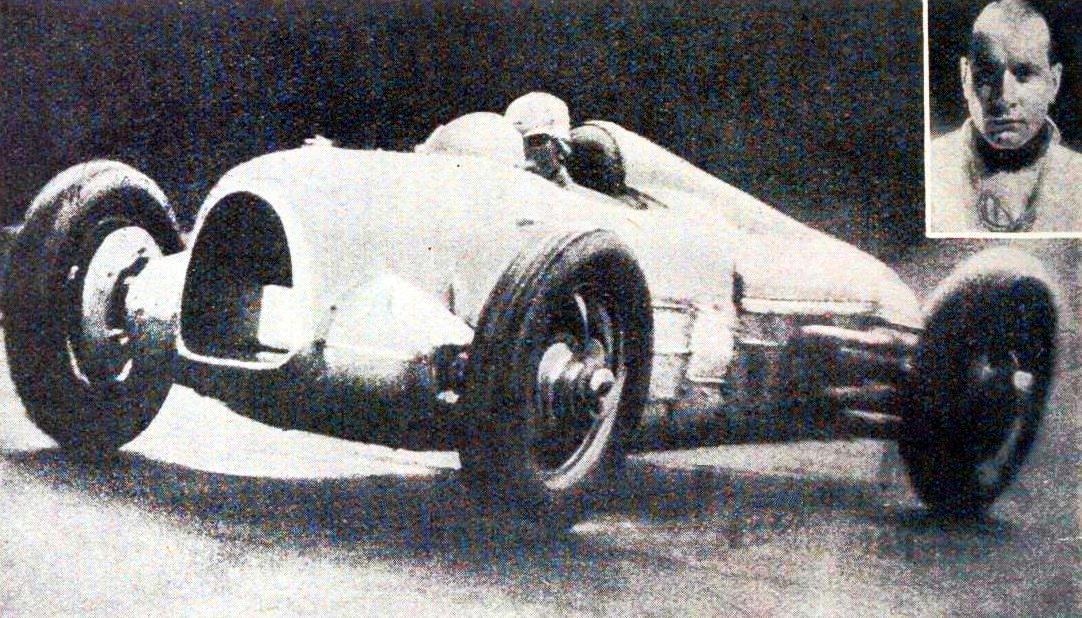
Auto Union built two streamliners on C-type chassis, each with a fully enclosed body, for the Avusrennen of May 1937, and Rosemeyer later used them for records on the autobahn (Motor Sport, 2000). Both disappeared "somewhere in Russia" after the war, and no drawings or photographs of their construction survived (Motor Sport, 2000).
The Avus streamliners
Tested in the wind tunnel of the Deutsche Versuchsanstalt für Luftfahrt in Berlin, the streamliners gave a drag coefficient of 0.237, and they were mechanically the same as the open Type Cs that von Delius and Hasse drove in the race (Motor Sport, 2000). Rosemeyer set the fastest race lap in his heat at 171.78 mph, 4 min 11.2 sec (Motor Sport, 100 Greatest Grands Prix), and Audi says his car was timed at 380 km/h on the straights. In the final he stopped with low oil pressure and finished fourth; Hermann Lang's Mercedes won from the open Type Cs of von Delius and Hasse (September 1941 review; database).
The records of June and October 1937
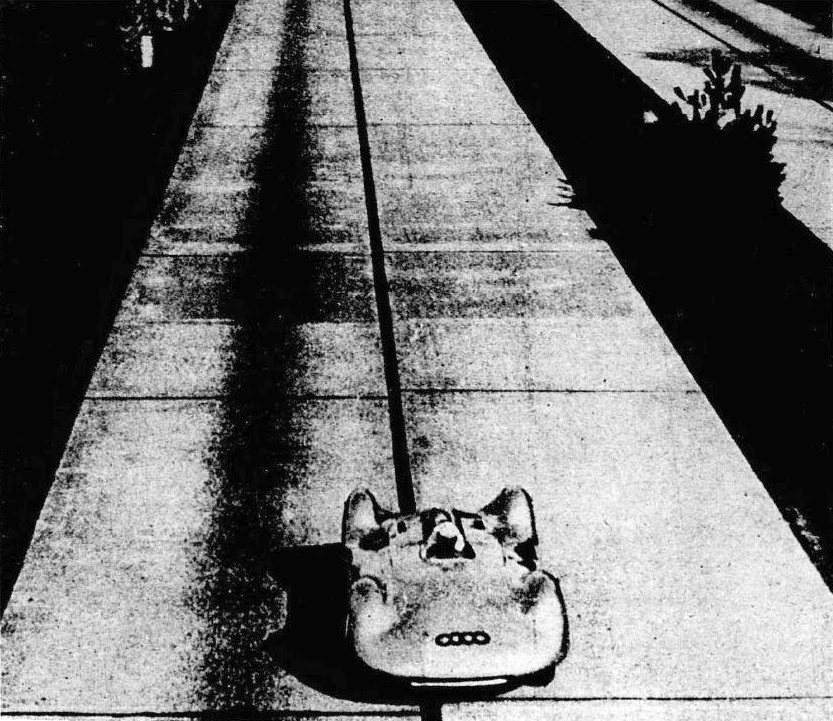
Three days after winning the 1937 Eifelrennen, Rosemeyer set records on the autobahn in a streamliner; Motor Sport counted six in 2000, with a flying mile at 242.09 mph, and eight in its September 1941 review, which gives the mile as 242.5 mph in one paragraph and 243.6 mph in another. In the record week on the Frankfurt to Darmstadt autobahn in October 1937 he took the Class B standing-start mile at 138.674 mph, the flying kilometre at 252.47 mph and the flying mile at 252.45 mph (Motor Sport, November 1937), the first time 250 mph had been exceeded on a road (Bill Boddy, Motor Sport, August 1990). Motor Sport's obituary of February 1938 gave the flying mile as 253.708 mph and the kilometre as 252.487 mph. Audi records the October runs as the first time anyone drove a car on a public motorway at more than 400 km/h.
How did Bernd Rosemeyer die?
On 28 January 1938 Caracciola's Mercedes record car beat Rosemeyer's October figures on the same autobahn, at up to 271.311 mph over the flying kilometre, and he went out to win the record back (Motor Sport, 1938). Audi says the car, now giving 560 hp, left the road on its second run in a cutting near Mörfelden, and that he was thrown into the trees and killed instantly. Motor Sport blamed "a treacherous gust of wind" and reported that the car hit the parapet of a bridge over the autobahn.
Auto Union hill-climb cars
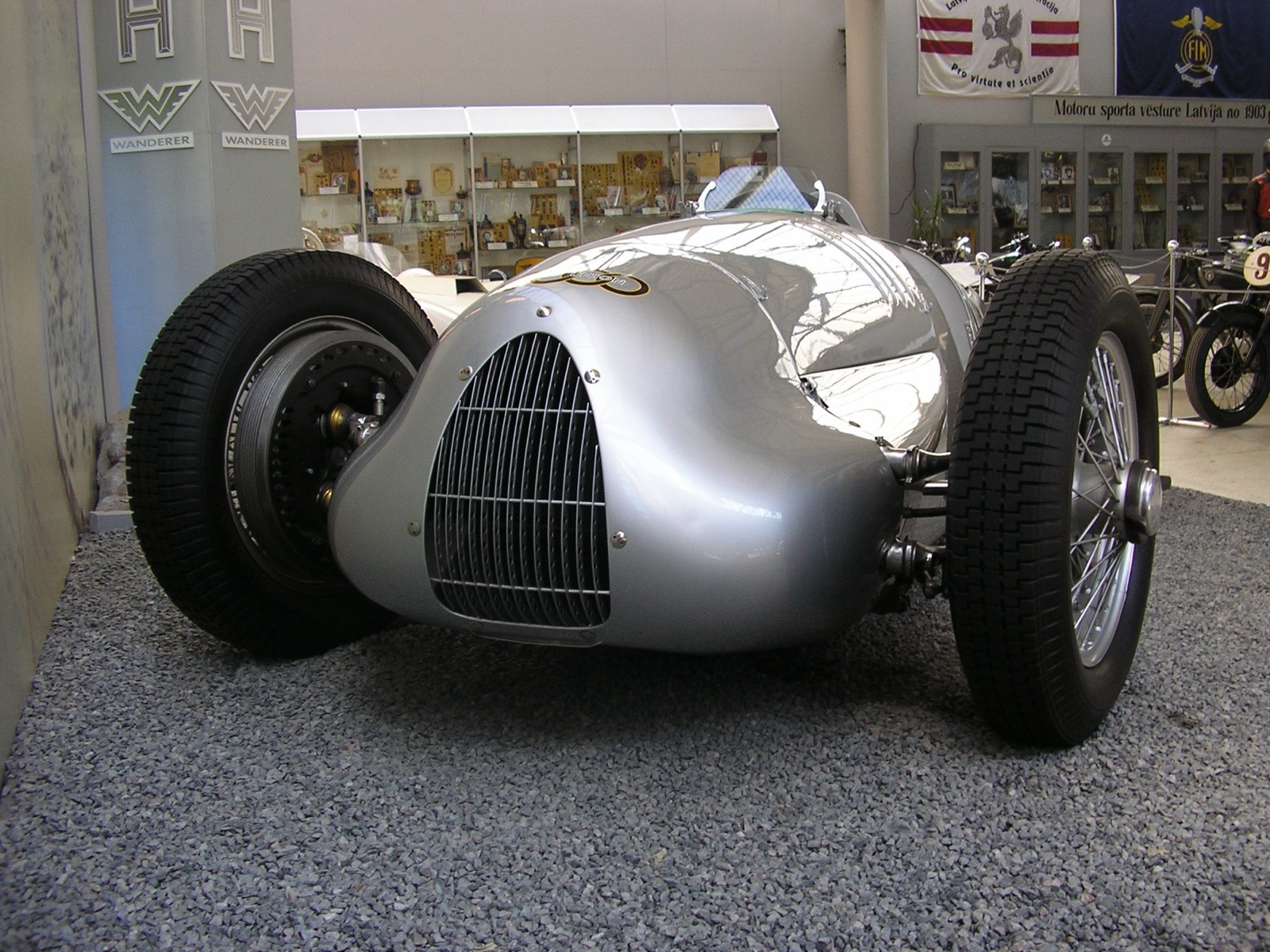
For hill climbs Auto Union ran short-chassis cars with twin rear wheels, and the one that survives is the Type C/D. Stuck won the La Turbie climb in 1936 with "the special short chassis Auto-Union", breaking the record by 3.4 seconds, and that summer brought a 5.3-litre car with a wide rear axle and twin rear wheels to Shelsley Walsh, in England, where it climbed in 45.2 seconds on a wet afternoon and won its class (Motor Sport, January 1941). The same review has Rosemeyer winning the Grosser Bergpreis hill climb in 1936, from von Delius. The V16 hill-climb car that survives was last driven by Müller on the Grossglockner in August 1939, rebuilt for that event around a D-type chassis with de Dion rear suspension; its engine and gearbox carry 1937 date stamps (Clive Richardson, Audi AG's UK spokesman, in a letter to Motor Sport, July 1997). When the car appeared at a rally in Latvia in 1977, Motor Sport judged it a "special short-chassis hill-climb Auto-Union with 6.1-litre V16 supercharged engine, developed from the components of the 1936 C-type Grand Prix car by the factory", with a shorter wheelbase than the Grand Prix car and no large fuel tank between cockpit and engine (Motor Sport, November 1977). Audi itself calls this Type C/D "the famous hillclimb car driven by Hans Stuck" (Audi, 2012).
How many Auto Union Type Cs survive, and where are they?
Jenkinson (1982) records two V16 Auto Unions known after the war: the Type C that Auto Union gave to the Deutsches Museum in Munich, for years "the only Auto Union racing car known to exist", and the V16 hill-climb car, now called the Type C/D, that appeared in Latvia after its years in Moscow. At the end of World War II the Soviet Army occupied Zwickau, found the Auto Union racing cars stored in a mine building and took them to the Soviet Union as reparations, and in 2012 Audi said it owned three of the five Auto Union racing cars "that can claim to be original", the Type C/D among them (Audi, 2012).
The Deutsches Museum car
Richardson wrote that Auto Union built this car as a cutaway showpiece around the remains of the C-type Stuck crashed in 1936, and presented it to the Deutsches Museum in 1937; Jenkinson (1980) dated it as a show exhibit built before the 1936 season. It was damaged in a bombing raid on the museum (Audi), shown as a bare chassis at the Nürburgring in 1952, and rebuilt and completed by Audi at the old NSU factory at Neckarsulm, which had to make all the missing parts and finished the work in spring 1980 (Jenkinson, 1980). Paul Pietsch, then the only surviving driver of the V16 Auto Union, drove it at the Nürburgring on 17 August 1980 (Jenkinson, 1980), and it was rebodied in polished aluminium in about 1995 (Richardson, 1997).
The Type C/D hill-climb car
The car was saved a few hours before it was to be cut up at the ZIL factory in Moscow in 1976, and it became the central exhibit of the Riga Motor Museum, according to the museum's 30th-anniversary history of 2019; Latvian public broadcasting credits the rescue to Viktors Kulbergs, whom the museum names as the first head of the Latvian Antique Automobile Club. The museum says an offer from the West to build it a new museum in exchange for the car was blocked by Soviet officials, who found money for the building in 1985. Audi acquired it from the museum and had Crosthwaite & Gardiner restore it, and Richardson wrote that it would make its post-restoration debut at the Goodwood Festival of Speed in 1997, driven by Hans Stuck Jnr. The Riga museum calls it the 1938 Auto Union CD V16 and Richardson the 1939 mountain-climb car. Audi shows it at its museum mobile in Ingolstadt.
Auto Union Type C replicas and recreations
Crosthwaite & Gardiner, in East Sussex, build the recreations, starting with a programme Audi commissioned in 1997: a new Type C/D to replace the original in Riga, and two new Type Cs, one open-wheeled and one streamliner, for Audi's museum in Ingolstadt, with some original components in the new cars (Richardson, 1997). The firm had recreated or restored 11 Auto Unions by 2002 (Motor Sport, July 2002).
- The streamliner, built with the bodywork specialist Keith Roach, ran on the banked track at Montlhéry on 24 and 25 June 2000, driven by Emanuele Pirro and Frank Biela, with Rosemeyer's son Bernd as Audi's guest (Chris Nixon, Motor Sport, August 2000).
- Motor Sport profiled Bernie Ecclestone's Type C, built by Crosthwaite & Gardiner, in February 2025.
- Audi Tradition brought a Type C to Riga for a parade on 15 August 2026, with Dindo Capello driving, and the new Type C/D that Crosthwaite & Gardiner built to replace the original has been the Riga Motor Museum's star exhibit since 1997, as Latvian public broadcasting reported.
- Audi's 2026 recreation of the 1935 Lucca record car, built for its historic vehicle collection, has the 6-litre engine of the Type C, which looks the same as the 5-litre unit and fits any car of the family (Audi Tradition, 2026).
Auto Union Type C rivals and successor
The Auto Union Type C's rivals were the Mercedes-Benz W25 of 1936, the Mercedes-Benz W125 of 1937 and the Alfa Romeos of Scuderia Ferrari, driven above all by Nuvolari; its successor was the 3-litre Type D of 1938.
Mercedes-Benz W25 and W125
Mercedes-Benz's short-wheelbase 1936 cars had a 4,470 cc straight-eight and handled badly, and the team won only two races that year, at Monaco and Tunis (Nye, 2016). Its answer for 1937 was the W125, with a 5.66-litre supercharged straight-eight that Nye calls the most powerful Grand Prix engine before the turbocharged era of the early 1980s. Mercedes-Benz won seven races in 1937 and Caracciola took the European title back.
Alfa Romeo and Bugatti
Nuvolari beat the Auto Unions in 1936 at the Penya Rhin race in Barcelona, in Budapest by 14 seconds from Rosemeyer, in Milan by 9 seconds from Varzi, and in the Coppa Ciano at Livorno, where he took over Pintacuda's car after his own broke in the first lap (January 1941 review). Motor Sport's account of the 1936 Eifelrennen gives his Alfa Romeo 60 bhp less than the Auto Union. French organisers turned away from the formula: the Automobile Club de France ran its 1936 Grand Prix for sports cars "to avoid inevitable defeat to the Germans", and Jean-Pierre Wimille and Raymond Sommer won it in a Bugatti, by the database's 1936 overview.
The Auto Union Type D
For 1938 the formula limited supercharged engines to 3 litres. Porsche's contract with Auto Union had ended, and Robert Eberan von Eberhorst designed the Type D with a V12 (Audi, 2009), of 485 hp by Audi's History of the Four Rings. Rosemeyer never drove it: he was killed in January 1938, and Nuvolari joined the team (Jenkinson, 1982).
Questions and answers
What does Type C mean in Auto Union Type C?
It is the third version of Auto Union's Grand Prix car: the Type A raced in 1934, the Type B in 1935 and the Type C in 1936 and 1937. Audi Tradition says the names of the model generations "progressed through the alphabet".
Was the Auto Union the first mid-engined racing car?
No. Denis Jenkinson wrote in Motor Sport in October 1980 that a Benz racing car of similar layout had been designed with Edmund Rumpler in 1922, and Audi Tradition says the layout "was not completely new".
Why were the Auto Unions called Silver Arrows?
Auto Union's racing cars had a silver paint finish from their first race, on the Avus in Berlin on 27 May 1934, and the German racing cars "were soon to acquire the nickname Silver Arrow", according to Audi's 2009 history.
How much did an Auto Union Grand Prix car cost?
About 50,000 Reichsmarks in 1935, rising to about 70,000 four years later, according to Audi, which says the racing department employed about 60 people, mechanics included.
Did the Auto Union Type C race in Britain?
Yes. Rosemeyer won the Donington Grand Prix on 2 October 1937, the first race in which the Mercedes-Benz and Auto Union teams met in Britain (Motor Sport, October 1937). Hans Stuck had taken an Auto Union hill-climb car to Shelsley Walsh in 1936 (Motor Sport, January 1941).
Is Auto Union the same company as Audi?
Auto Union was formed in 1932 by the merger of Audi, DKW, Horch and Wanderer, and today's AUDI AG grew from the Auto Union GmbH founded in Ingolstadt in 1949, according to Audi. Audi owns the surviving Type C/D hill-climb car.
Sources
- Audi, How the "Silver Arrow" legend was born, press release, 2009: Porsche's role and the Zwickau racing department, the 250 hp requirement, the three versions and their power, the 6-litre engine's torque, the Hirth crankshaft, the four-speed gearbox, the drivers, Porsche's departure, costs.
- Audi Tradition, The age of the Silver Arrows, undated: the 1932 announcement of the formula, the mid-engine layout and its handling, the Type C's name, top speed and torque, Rosemeyer's reputation, the 560 hp record car and Rosemeyer's death, the Type D, Nuvolari's wins.
- Audi, Company history, undated: 295 PS to 520 PS; the October 1937 record run at more than 400 km/h.
- Audi, History of the Four Rings, 2014: the 485 hp V12 of the Type D.
- Audi, Home again: the last Auto Union Type D twin-supercharger Silver Arrow returns to Audi, press release, 2012: 380 km/h at the Avus in 1937; the cars taken to the Soviet Union; the Deutsches Museum car; the Type C/D at the Audi museum mobile; three of five original cars.
- Audi, Photo caption: Rosemeyer's titles of 1936, undated: European, German road-racing and German hill-climb champion, 1936.
- Audi Tradition, Audi Tradition unveils record-breaking car in Italy: Auto Union Lucca joins the Silver Arrow family, press release, 2026: Stuck's 1935 Lucca record; the Type C engine in the recreated Lucca car.
- Motor Sport, Remarkable records, November 1937: Rosemeyer's records of October 1937.
- Motor Sport, The Germans' Grand Prix at Donington, October 1937: the Donington Grand Prix of 2 October 1937.
- Motor Sport, Achievement and tragedy, February 1938: Rosemeyer's death and career; Caracciola's record; the October 1937 figures as then reported.
- Motor Sport, Mercedes-Benz versus Auto-Union, October 1940: the 1934 and 1935 seasons; the 6-litre engine reported at about 480 bhp.
- Motor Sport, Mercedes-Benz versus Auto-Union, January 1941: the 1936 season race by race, the engine sizes reported, Varzi's timed kilometre, the hill climbs and Shelsley Walsh, Auto Union's 1936 score.
- Motor Sport, Mercedes-Benz versus Auto-Union, September 1941: the 1937 season, the four-speed gearbox, the June 1937 records, the 1937 scores.
- Denis Jenkinson, Motor Sport, Auto Union, October 1980: the formula, the P-Wagen layout, engine, frame and suspension, engine sizes, the Deutsches Museum car and its 1980 rebuild.
- Denis Jenkinson, Motor Sport, Historic Grand Prix Cars, December 1982: the C-type's handling, the Type D, the car found in Latvia.
- Bill Boddy, Motor Sport, A study in record breaking, August 1990: the October 1937 record car's engine; 250 mph on a road.
- Motor Sport, That V16 Auto-Union, a hillclimb special, November 1977: the hill-climb car seen in Latvia in 1977.
- Clive Richardson, letter to Motor Sport, Those new Auto Unions, July 1997: the Riga hill-climb car, the Deutsches Museum car, Audi's recreation programme.
- Motor Sport, Auto Union: low-drag racer for carriageway duels, September 2000: engine sizes and outputs of the Types A, B and C; the Avus streamliners and their records.
- Chris Nixon, Motor Sport, Auto Union streamliner on the banking again, August 2000: the recreated streamliner at Montlhéry.
- Motor Sport, Another new old Auto Union, July 2002: Stuck's 1934 wins; Crosthwaite & Gardiner's 11 Auto Unions.
- Doug Nye, Motor Sport, From the archives with Doug Nye, October 2016: Mercedes-Benz in 1936 and Uhlenhaut's report; the W125 engine.
- Lawrence Butcher, Motor Sport, Porsche's first grand prix car: the Auto Union V16, 1 December 2021: the P-Wagen team, the subsidy, the V16's design, the 1936 wins, the W125's power.
- Motor Sport, 1937 Auto Union Type-C V16, February 2025: the Type C's years and win counts; Ecclestone's Crosthwaite & Gardiner car.
- Motor Sport, 100 Greatest Grands Prix: 1936 Eifelrennen, undated: the 1936 Eifelrennen in fog.
- Motor Sport, 100 Greatest Grands Prix: 1937 Avusrennen, undated: Rosemeyer's 171.78 mph lap.
- Motor Sport database, 1936 European Championship and 1937 European Championship overviews, and the race page for each race in the results table (for example 1937 Donington Grand Prix), read 30 October 2026: dates, circuits, placings and car numbers.
- Riga Motor Museum, via LV portāls, Rīgas Motormuzejs atzīmē 30 gadu jubileju (in Latvian), 2019: the hill-climb car's rescue in 1976 and the offer of a museum in exchange.
- LSM (Latvian public broadcasting), Rare chance to see historic Audi on the road in Rīga, 12 August 2026: the Type C's visit to Riga; Kulbergs; the Type C/D in Riga since 1997.