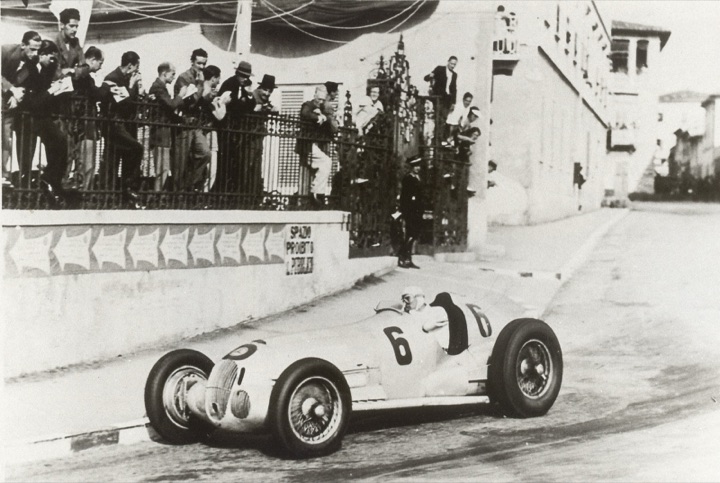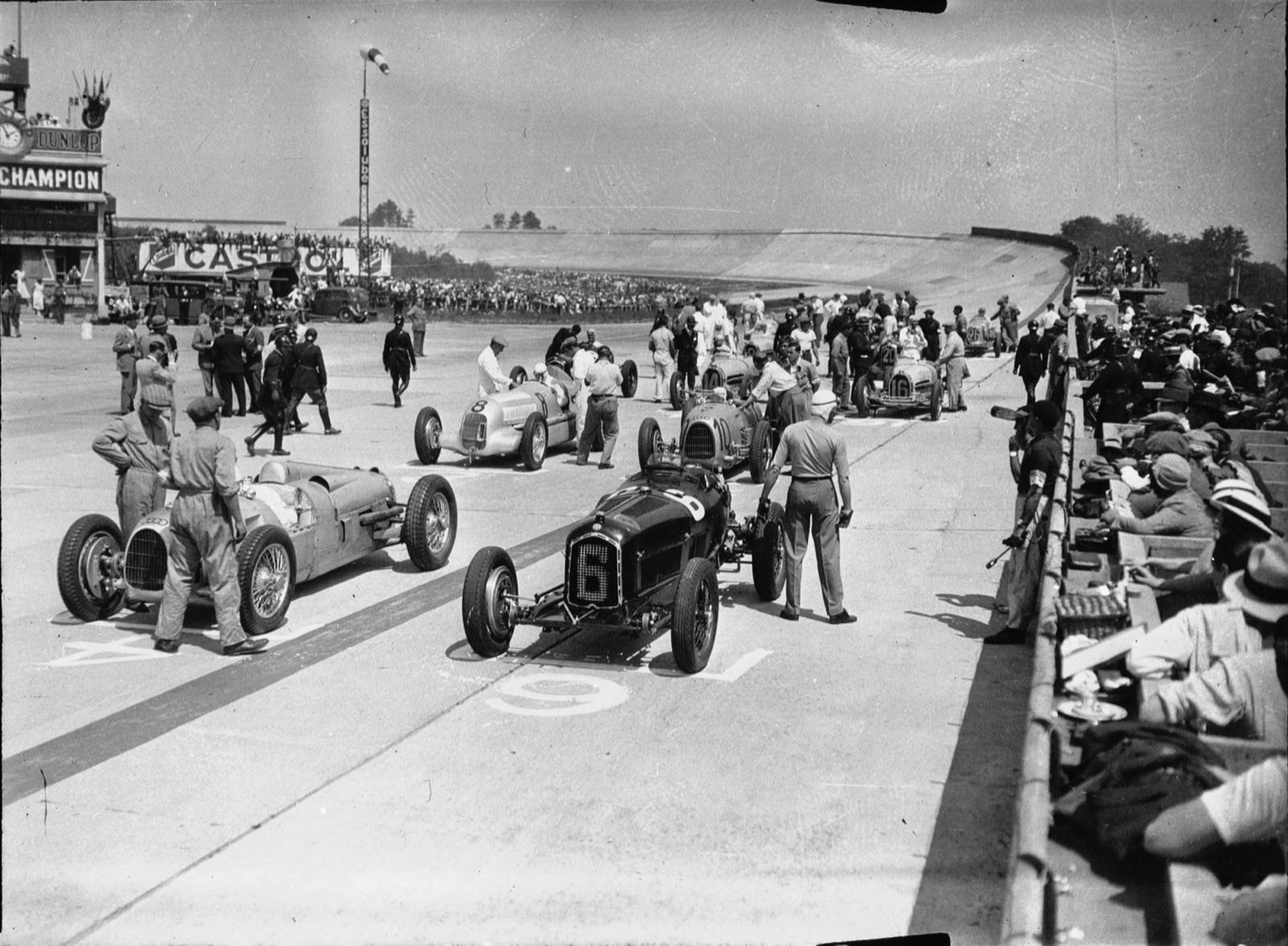
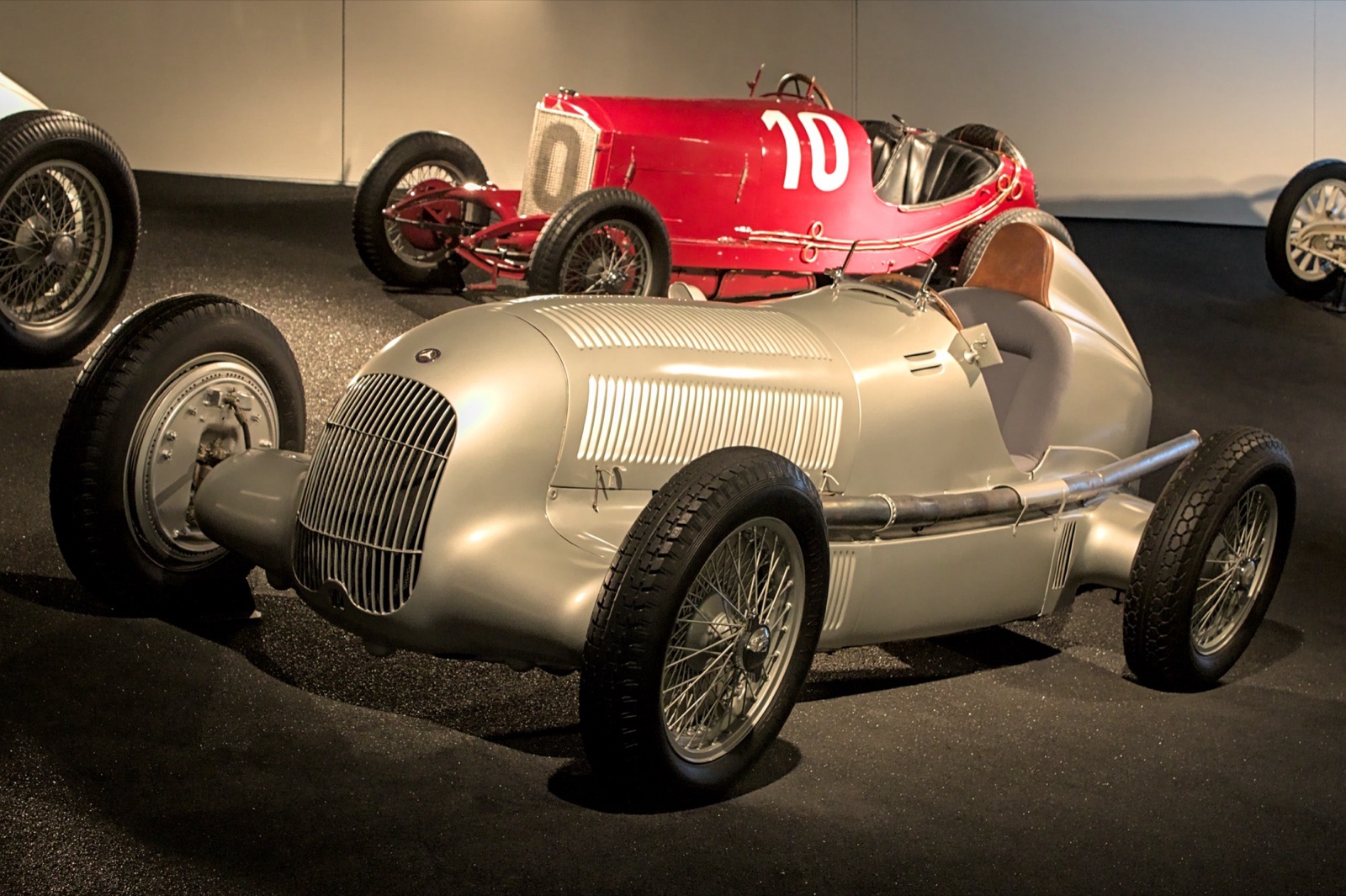
The Mercedes W25 (Mercedes-Benz W25) is the single-seat Grand Prix racing car Daimler-Benz built for the 750 kg formula and raced in Grands Prix from June 1934 to August 1936, with a supercharged straight-eight whose capacity grew from 3.4 to 4.7 litres in that time, according to Mercedes-Benz Classic's archive entries for the W 25. It won on its debut, the Eifelrennen at the Nürburgring on 3 June 1934, and in 1935 Rudolf Caracciola drove it to the European Championship. Mercedes-Benz calls the W25 its first Silver Arrow; the story that its white paint was scraped off overnight to bring it under the weight limit is disputed.
Who designed the Mercedes W25, and why?
The Mercedes W25 was designed by Hans Nibel, chief engineer of Daimler-Benz, and his development engineers for the Grand Prix formula that came into force in 1934, and work on it began in the spring of 1933 (Mercedes-Benz Classic). Wilhelm Kissel, chairman of the board, held that racing at the highest level was essential to the company's name abroad. The SSKL sports car, in which Caracciola had won the Mille Miglia, the Avus race and the European hill-climb championship for sports cars in 1931, could no longer achieve much against the Alfa Romeo P3 and Bugatti's Types 35 B, 51 and 54, which Mercedes-Benz Classic says set the standard.
The 750 kg formula
The AIACR, the governing body of the time, adopted the new formula in the autumn of 1932. It set two main limits: a weight of no more than 750 kg without fuel, oil, coolant and tyres, and a body at least 850 mm wide; there was no limit on engine size (Mercedes-Benz Classic's archive). Looking back in Motor Sport in September 1940, the magazine wrote that the AIACR hoped to cut the "dangerous maxima of 150 m.p.h." the leading cars were then reaching. The archive calls the assumption that a weight limit would hold down speeds "illusory".
State money and a new German rival
Kissel and Nibel asked the Reich Ministry of Transport for a subsidy in the spring of 1932 and were refused. After the National Socialists took power in 1933, both Daimler-Benz and Auto Union, formed in mid-1932, received state payments, which Mercedes-Benz Classic describes as a fraction of what the two companies spent themselves. Doug Nye, writing in Motor Sport's July 2014 issue, gives the fund as 450,000 Reichsmarks a year, with bonuses of 20,000, 10,000 and 5,000 Reichsmarks for the first three places, and says Kissel had wanted all of it for Daimler-Benz.
To see how its rivals built their cars, Daimler-Benz bought the damaged Alfa Romeo 8C 2300 in which Caracciola had crashed in practice at Monaco in April 1933, according to the archive. Testing of the first finished W25 began in January 1934 on the autostrada between Milan and Varese, because the Avus in Berlin was icebound, Motor Sport's 1940 review adds. Its next instalment, on 1935, opens with Nibel's death at Stuttgart, aged 54; he had been with Benz since 1904.
Mercedes W25 design and engineering
The Mercedes W25 has a supercharged straight-eight mounted ahead of the driver in a light ladder frame, independent suspension at all four wheels and hydraulic brakes. Mercedes-Benz Classic singles out the suspension and the brakes as the places where it was ahead of its rivals, some of which still used mechanical, mostly cable-worked brakes.
The M25 supercharged straight-eight
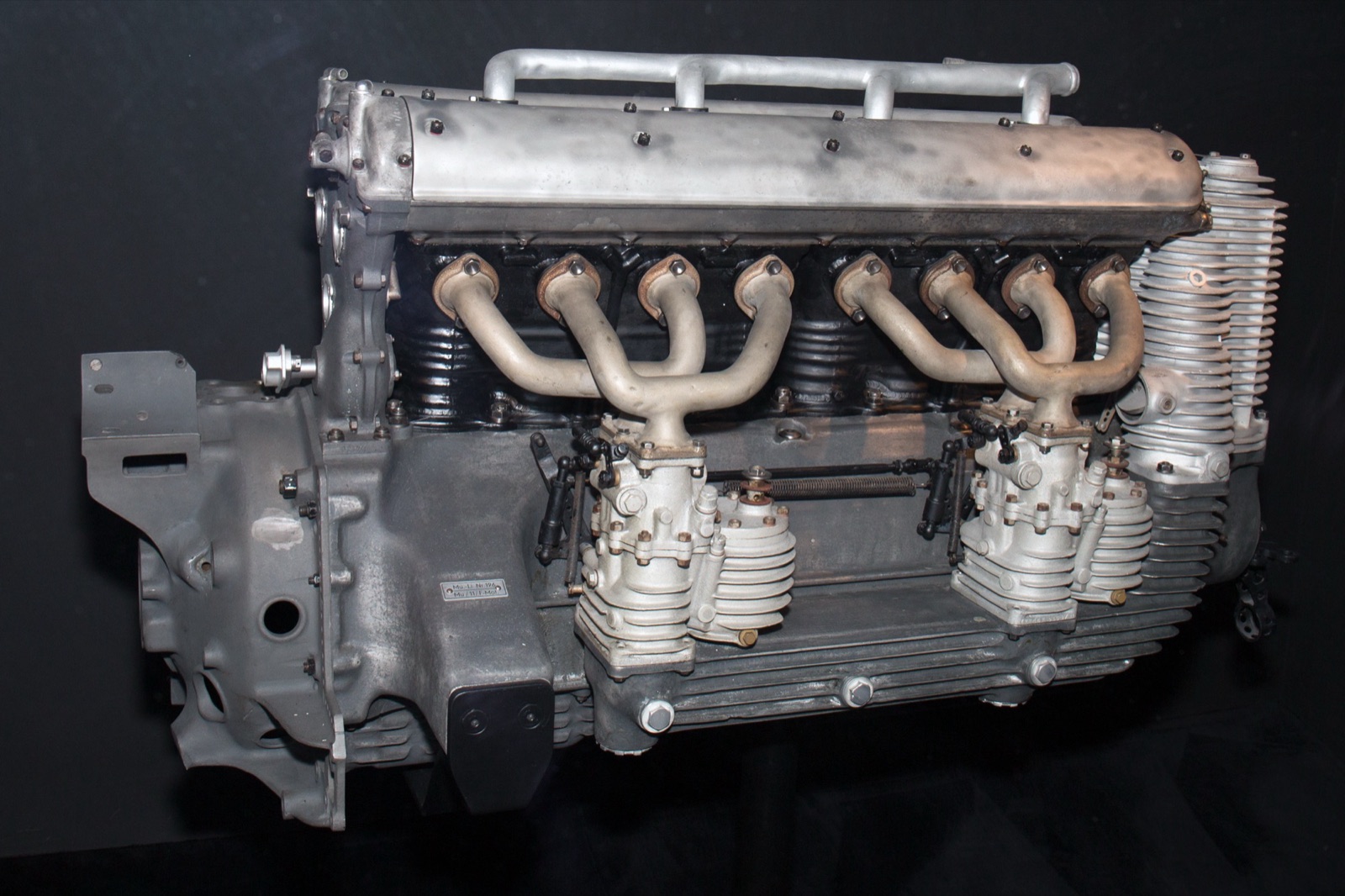
The first engine, the M 25 A, has a bore and stroke of 78 × 88 mm and a displacement of 3,364 cc (3,360 cc in the archive's technical data). Its aluminium crankcase carries two blocks of four forged-steel cylinders with welded-on steel water jackets, and each cylinder is welded to its head, so there is no head gasket. Two overhead camshafts, driven by gears at the rear of the engine, work four valves per cylinder through forked rockers; all the valves are 34 mm across and the exhaust valves are sodium-cooled. The crankshaft runs in five bearings and lubrication is by dry sump.
A Roots supercharger at the front of the engine, always engaged, blows air through two sealed pressure carburettors, so that it compresses air and not mixture: what Mercedes-Benz Classic calls dry supercharging. The engine weighs 211 kg, according to the archive's technical data for the 1934 car.
Chassis, suspension and brakes
The pressed steel frame has two U-section side members, cross-braced and drilled with hundreds of lightening holes, as the SSKL's frame was. At the front, two T-shaped transverse arms on each side work a coil spring housed in the front axle tube through a toggle lever, with a friction damper for each wheel; at the rear is a swing axle on a quarter-elliptic spring. The archive counts seven different suspension layouts tried during development and the first season.
The propeller shaft, turning at engine speed, runs to a four-speed gearbox at the rear axle, which drives the differential from below through a bevel gear. That put the shaft 9 cm lower and seated the driver lower in the car. The hydraulic brakes work in heavily ribbed light-alloy drums of 400 mm.
Body
The light-alloy body has fairings over the suspension at both ends and, on the race cars, a headrest that runs back into the tail; the radiator opening came in different sizes for races and for record runs (archive). The W25 in the Mercedes-Benz Museum has holes drilled in its gear lever, its pedals and even the straps that hold the exhaust, and a bonnet with quick-release catches that opens in seconds without tools, according to a Mercedes-Benz press release of 28 May 2024.
Mercedes W25 specifications
The Mercedes W25 is a single-seater 4,040 mm long on a 2,725 mm wheelbase in its 1934 and 1935 form, weighing 847 kg with tyres, oil and coolant, by Mercedes-Benz Classic's technical data; the formula's 750 kg was measured without them.
| Item | 1934 and 1935 | 1936 (short wheelbase) |
|---|---|---|
| Engine | Supercharged straight-eight: M 25 A, M 25 B, M 25 C | Supercharged straight-eight: ME 25 |
| Displacement | 3,364 to 4,309 cc | 4,740 cc |
| Power | 314 to 462 hp at 5,800 rpm, by fuel (archive text; the technical data give 354 hp for 1934 and 462 hp for 1935) | 494 hp at 5,800 rpm |
| Gearbox | Four speeds, in unit with the differential, below the rear axle | Four speeds, mounted across the car below the rear axle |
| Front suspension | Double wishbones, coil springs in the axle tube, friction dampers | Double wishbones, coil springs, hydraulic dampers |
| Rear suspension | Swing axle, transverse cantilever springs, friction dampers | De Dion axle, cantilever springs, hydraulic dampers |
| Brakes | Hydraulic, finned light-alloy drums, 400 mm | Hydraulic, finned light-alloy drums, 400 mm |
| Wheelbase | 2,725 mm (2,715 mm in the archive's text) | 2,460 mm (2,505 mm in the archive's text) |
| Track, front and rear | 1,473 mm and 1,412 mm | 1,473 mm and 1,412 mm |
| Length, width, height | 4,040 mm, 1,770 mm, 1,160 mm | 4,040 mm, 1,770 mm, 1,160 mm |
| Weight | 847 kg with tyres, oil and coolant | 847 kg with tyres, oil and coolant |
| Tyres, front and rear | 5.25 × 17 and 5.25 × 19 (1934); 5.50 × 19 and 7.00 × 19 (1935) | 5.50 × 19 and 7.00 × 19 |
| Fuel tank | 215 litres | 215 litres |
| Top speed | About 300 km/h | About 300 km/h with suitable gearing |
Source: Mercedes-Benz Classic's technical data for the W 25 of 1934, 1935 and 1936 (SWB), with the wheelbases also given as its model texts state them.
How much horsepower did the Mercedes W25 have?
The Mercedes W25's engine gave 314 to 354 hp at 5,800 rpm in its first form in 1934 and 494 hp in its last, the ME 25 of 1936, by the test-bed figures Mercedes-Benz Classic gives; each version's output depended on the fuel mixture. A fourth version, the M 25 AB, never raced in a W25 as far as the factory records show.
| Engine | Used | Bore × stroke | Displacement | Power at 5,800 rpm |
|---|---|---|---|---|
| M 25 A | 1934 | 78 × 88 mm | 3,364 cc | 314 to 354 hp |
| M 25 AB | Not raced | 82 × 88 mm | 3,718 cc | 348 to 398 hp |
| M 25 B | From August 1934 | 82 × 94.5 mm | 3,992 cc | 370 to 430 hp; 500 Nm |
| M 25 C | From July 1935 | 82 × 102 mm | 4,309 cc | 398 to 462 hp |
| ME 25 | 1936 | 86 × 102 mm | 4,740 cc | 494 hp |
Source: Mercedes-Benz Classic's archive entries for the W 25 of 1934, 1935 and 1936; ranges depend on the fuel used. Motor Sport's review of 1935, published in October 1940, reports that the figures released early that year gave the normal Grand Prix car 81.77 × 94 mm (3,946 cc) and the Gyón record car 82 × 94.5 mm (3,992 cc).
For comparison, the archive gives Auto Union's first V16 of 1934, of 4.4 litres, 295 hp at 4,500 rpm, and its 5-litre engine of 1935 375 hp. For 1936 Auto Union enlarged the V16 to just over 6 litres and 485 to 520 hp, and the archive says the Mercedes engine's deficit of a good 1,200 cc then showed both in outright power and in how the power was delivered.
How fast was the Mercedes W25?
The Mercedes W25 could reach about 300 km/h (186 mph) with suitable gearing, by the archive's technical data. Motor Sport's 1940 reviews give speeds timed over a kilometre in races: 179.6 mph for Caracciola in the 1934 Coppa Acerbo, 137 mph for Fagioli at San Sebastián that year "when the cars were still accelerating", and 190 mph for Fagioli at the Avus in 1935. With the low gearing fitted for Monaco in 1936, the archive says, the short-wheelbase car's maximum was 184 km/h.
Why is the Mercedes W25 called the Silver Arrow?
The Mercedes W25 raced in silver aluminium instead of Germany's white racing colour, and Mercedes-Benz dates its Silver Arrows, the name its racing cars still carry, from the W25's first win, in the Eifelrennen of 3 June 1934. How the cars came to be silver is told two ways.
The paint-scraping story
The story comes from the memoirs of Alfred Neubauer, the team's racing manager, and from statements by Manfred von Brauchitsch, as Mercedes-Benz Classic's archive entry for the 1934 car says. On the eve of the Eifelrennen the new car, painted white, was "apparently" one kilogram over the 750 kg limit; every saving had already been made, so Neubauer and von Brauchitsch had the idea of sanding the paint off overnight, and the "now shiny silver cars took to the grid". The 2024 press release also tells it as Neubauer's story, and hedges it in the same way. Alan Henry's profile of von Brauchitsch, then 94, in Motor Sport in March 2000 tells it differently: "someone cleverly suggested" stripping the paint, and "Neubauer later claimed the credit".
Why historians doubt it
Doug Nye, in his Motor Sport column of October 2019, calls the story "simply untrue" on the contemporary evidence. The Eifelrennen was run to Formule Libre rules, not the 750 kg formula, so there was no weight limit to meet; only two W25s raced, for von Brauchitsch and Luigi Fagioli; and photographs show the W25s in bare aluminium "even in practice". At the Avus a week earlier, he writes, at most one of the three W25s that practised was painted white. He quotes the works mechanic Eugen Reichle: "The cars never had been painted white, so there was no paint to grind off…". Nye took part in a symposium at Daimler-Benz in Fellbach in 2007 that "pretty much debunked the whole thing", where Neubauer's ghost writer, Harvey T Rowe, defended Neubauer but admitted he had only taken notes as Neubauer told his stories.
Mercedes-Benz's own press release for the 2012 Goodwood Revival agrees that the Eifelrennen was not run to the 750 kg formula, though it says the team wanted a car that already met the new rules. It says Mercedes-Benz had decided on silver as a new colour for the W25, calls the paint story a legend, and says the name "Silver Arrow" was coined later and caught on gradually. At the first race the W25 started under the formula, the French Grand Prix at Montlhéry on 1 July 1934, the three Mercedes weighed 739.5, 739 and 737 kg, according to Motor Sport's 1940 review.
A silver arrow in 1932
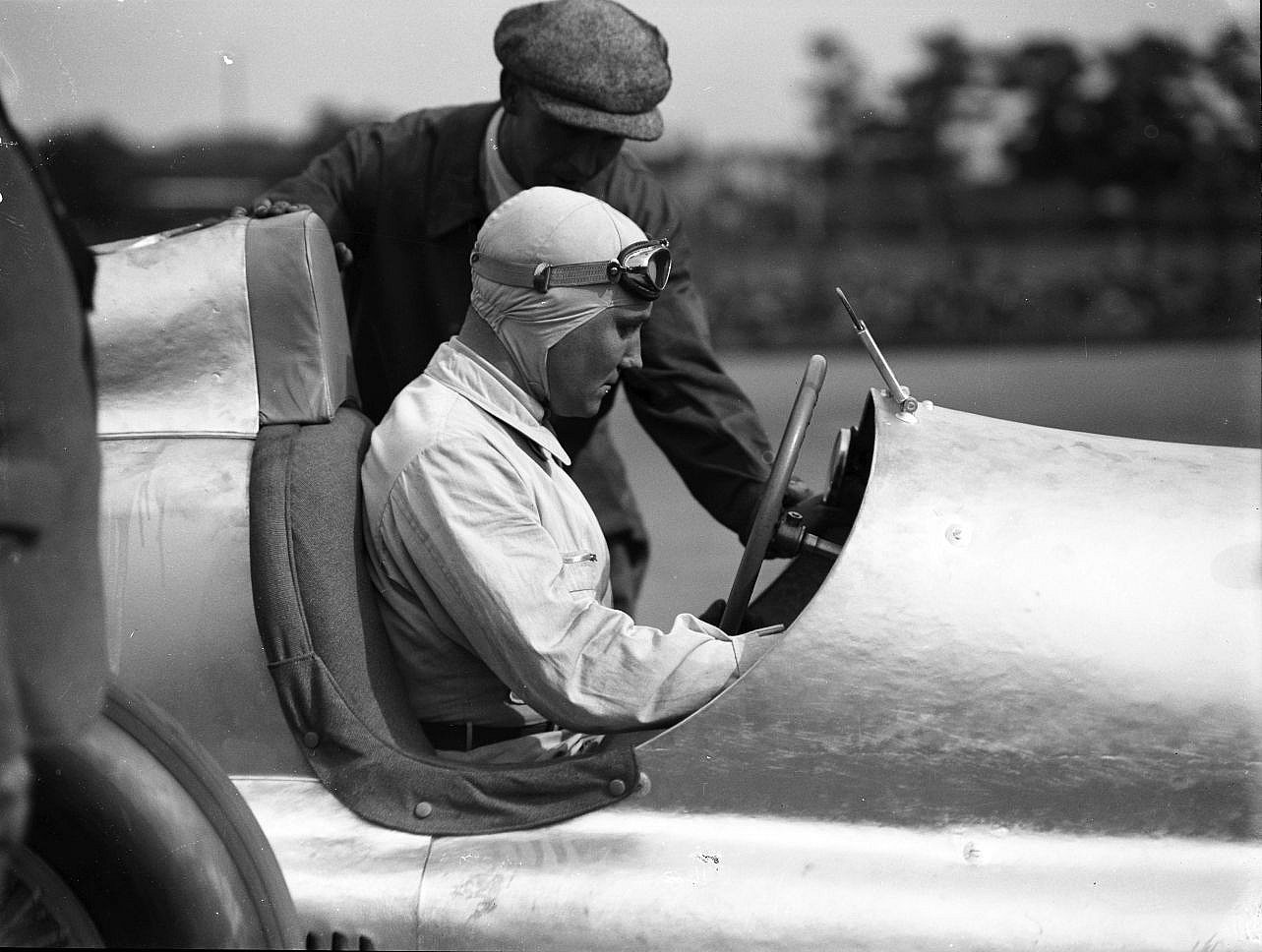
The words were broadcast two years before the W25 raced. At the Avus in May 1932 von Brauchitsch won in an SSKL with a streamlined aluminium body designed by Reinhard von Koenig-Fachsenfeld, and the radio reporter Paul Laven called it a "silver arrow" in his commentary, according to Mercedes-Benz Classic's entry for the SSKL streamliner. Nye (2014) quotes the surviving wire recording: "Here comes the silver arrow!"
Mercedes W25 racing history
The Mercedes W25 won 15 races in its three seasons as a Grand Prix car, four in 1934, nine in 1935 and two in 1936, and Caracciola also won the Klausen hill climb with it in 1934. The totals for 1934 and 1935 are those of Motor Sport's season reviews of 1940; every win is in the table.
| Date | Race | Winner | Other W25 placings |
|---|---|---|---|
| 3 June 1934 | Eifelrennen, Nürburgring | Manfred von Brauchitsch | None |
| 15 August 1934 | Coppa Acerbo, Pescara | Luigi Fagioli | Henne 6th |
| 9 September 1934 | Italian Grand Prix, Monza | Rudolf Caracciola and Fagioli (shared) | None |
| 23 September 1934 | Spanish Grand Prix, Lasarte | Fagioli | Caracciola 2nd |
| 22 April 1935 | Monaco Grand Prix | Fagioli | None |
| 12 May 1935 | Tripoli Grand Prix | Caracciola | Fagioli 3rd |
| 26 May 1935 | Avusrennen, Berlin | Fagioli | Von Brauchitsch 5th |
| 16 June 1935 | Eifelrennen, Nürburgring | Caracciola | Fagioli 4th, Lang 5th |
| 23 June 1935 | French Grand Prix, Montlhéry | Caracciola | Von Brauchitsch 2nd, Fagioli 4th |
| 30 June 1935 | Penya Rhin Grand Prix, Barcelona | Fagioli | Caracciola 2nd |
| 14 July 1935 | Belgian Grand Prix, Spa-Francorchamps | Caracciola | Fagioli and von Brauchitsch (shared) 2nd |
| 25 August 1935 | Swiss Grand Prix, Bremgarten | Caracciola | Fagioli 2nd, Lang 6th |
| 22 September 1935 | Spanish Grand Prix, Lasarte | Caracciola | Fagioli 2nd, von Brauchitsch 3rd |
| 13 April 1936 | Monaco Grand Prix | Caracciola | None |
| 17 May 1936 | Tunis Grand Prix, Carthage | Caracciola | None |
Dates, winners and placings from the Motor Sport database and its race pages.
1934: the first season
The Mercedes W25 was due to make its debut at the Avus in Berlin on 27 May 1934, but Mercedes withdrew its cars after practice, in which Caracciola, driving for the first time since his Monaco accident, had lapped at 143 mph (Motor Sport, 1940). Nye (2014) puts the withdrawal down to blocked fuel filters: the team's fuel had dissolved the lining of the cars' fuel pipes.
A week later, on 3 June, von Brauchitsch won the Eifelrennen at an average of 122.5 km/h, which the 2024 release calls a track record, 1 min 19.4 sec ahead of Hans Stuck's Auto Union (Motor Sport database). Fagioli, who had led, was signalled to let his German team-mate by. Motor Sport's 1940 review says he did so reluctantly, argued at his refuelling stop and then parked his car by the roadside; the Motor Sport database records his retirement as a misfire.
At the French Grand Prix on 1 July all three W25s retired, with gearbox, brake and supercharger failures, and Alfa Romeo took the first three places. Fagioli was second to Stuck in the German Grand Prix on 15 July, 2 min 7 sec behind. Neither German team ran in the Belgian Grand Prix: Motor Sport's review says customs demanded 180,000 francs duty on 3,000 litres of special German fuel, and Mercedes wired that it was not ready.
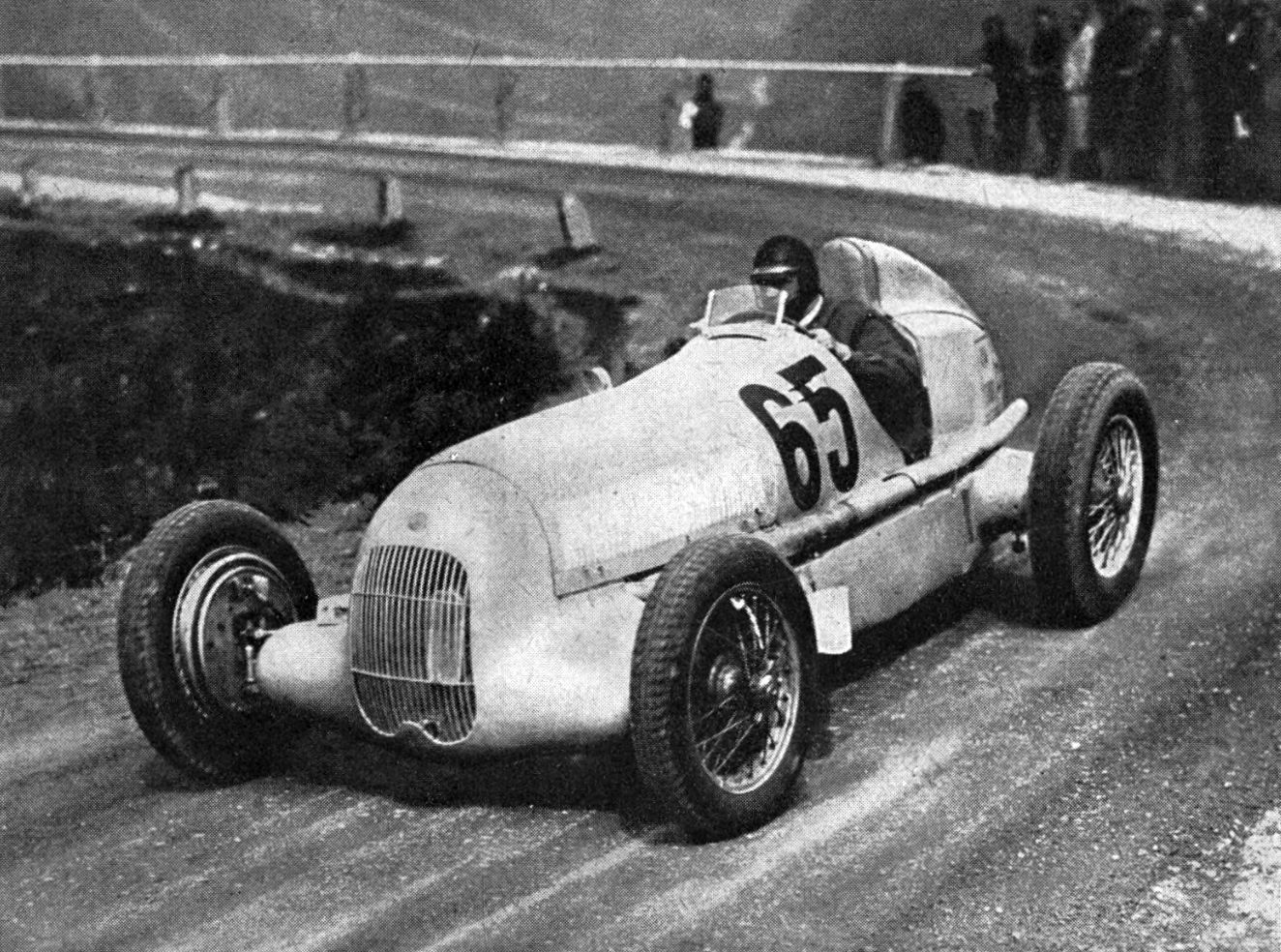
The longer-stroke M 25 B engine arrived in August. Caracciola won the Klausen hill climb in 15 min 22.2 sec, a record for the hill, and Fagioli won the Coppa Acerbo at Pescara, where Caracciola crashed out of the lead after seven laps; Guy Moll was killed in the same race when his Alfa Romeo hit a house (Motor Sport, 1940). Caracciola and Fagioli shared the winning car in the Italian Grand Prix at Monza, 1 min 38.2 sec ahead of the Auto Union shared by Stuck and Hermann Leiningen by Motor Sport's 1940 review (the Motor Sport database has that car a lap down), and Fagioli beat Caracciola in the Spanish Grand Prix at Lasarte. Motor Sport's score for the season was four wins and three second places for Mercedes-Benz, three wins, three seconds and a third for Auto Union.
1935: Caracciola's European Championship
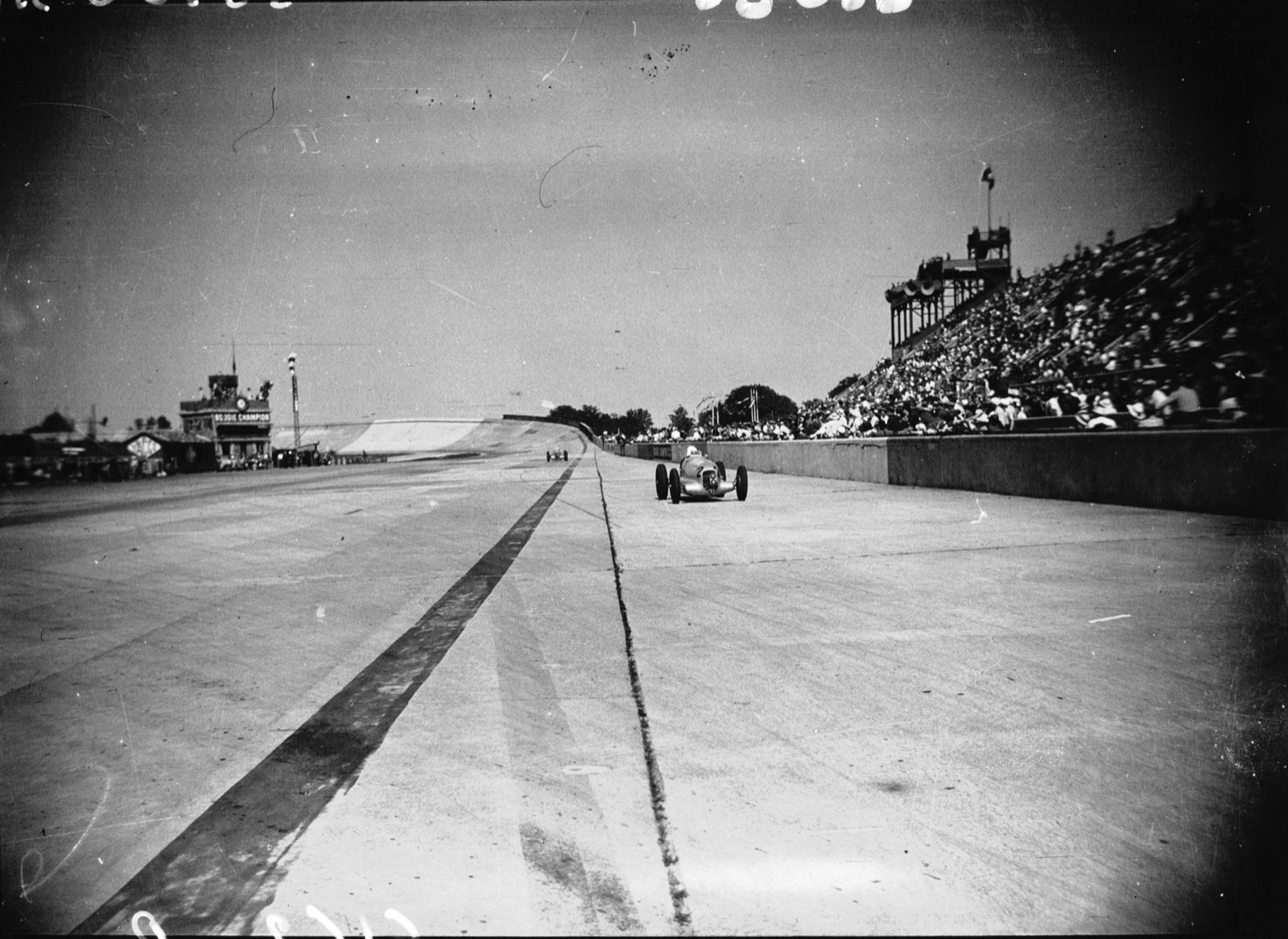
The Mercedes W25 won nine races in 1935, and Caracciola won the first European Championship the AIACR awarded, with Fagioli second (Mercedes-Benz Classic's entry for the 1935 W 25). Luigi Fagioli led the Monaco Grand Prix for all 100 laps, as Paul Fearnley wrote in Motor Sport in 2013. Caracciola won at Tripoli by 67 seconds after Achille Varzi's leading Auto Union had two tyre failures in the closing laps, and Fagioli won the Avus race at 148.2 mph (Motor Sport, October 1940).
Caracciola beat Bernd Rosemeyer's Auto Union by 1.9 seconds in the Eifelrennen and led von Brauchitsch home in the French Grand Prix. At Spa, Fagioli ignored Neubauer's signals to stay behind Caracciola, was called in, and von Brauchitsch took over his car to finish second (Motor Sport, 1940); the database says Fagioli parked the car and stormed off. The German Grand Prix on 28 July was lost on the last lap, when von Brauchitsch, leading, had a puncture and Tazio Nuvolari won in an Alfa Romeo P3 (database). It was also the first race for the M 25 C engine, in Caracciola's car, which finished third.
Caracciola won the Swiss Grand Prix from Fagioli, all four W25s retired from the Italian Grand Prix at Monza, which Stuck won, and the season ended with Caracciola, Fagioli and von Brauchitsch first, second and third in the Spanish Grand Prix. Motor Sport's count for the year, of races in which either German team ran, was nine wins, five seconds and three thirds for Mercedes-Benz against four wins, four seconds and three thirds for Auto Union.
1936: the short-wheelbase car
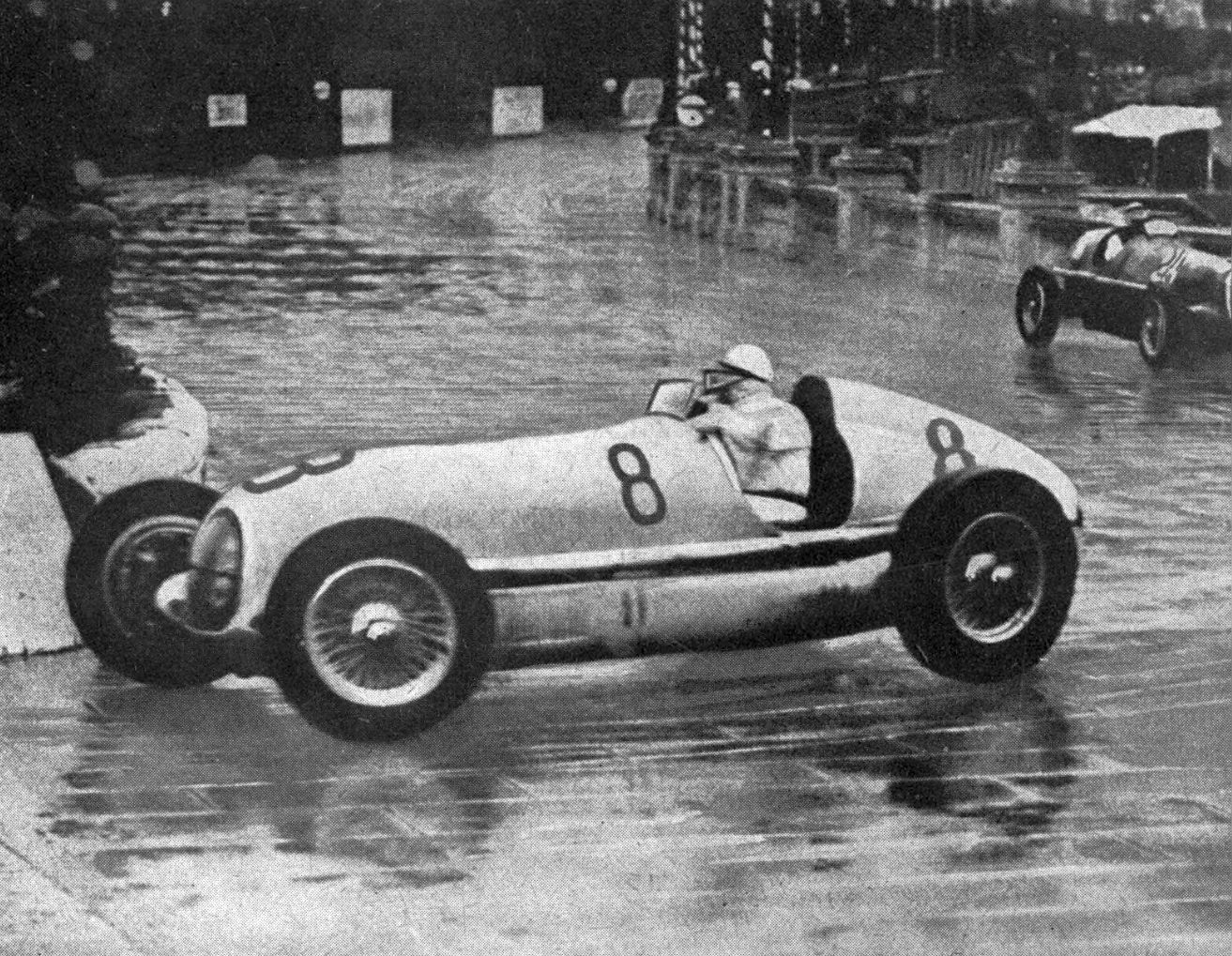
The Mercedes W25 won twice in 1936, both times with Caracciola: the Monaco Grand Prix on 13 April, in rain, ahead of the Auto Unions of Varzi and Stuck, and the Tunis Grand Prix on 17 May (Motor Sport database). At Monaco oil from a broken Alfa Romeo pipe put Louis Chiron and von Brauchitsch out at the chicane onto the quay on the second lap, and Fagioli crashed there on lap 10, as Motor Sport's review of 1936, published in January 1941, recounts.
From June the W25 was outpaced. Nuvolari's Alfa Romeo beat Caracciola by three seconds at Barcelona, the best W25s were fifth and sixth in the Eifelrennen, all three retired in Hungary, and in the German Grand Prix the best Mercedes, shared by Fagioli and Caracciola, was fifth, a lap down. In the Swiss Grand Prix on 23 August the only W25 to finish was fourth: Motor Sport's review and its database say Fagioli took over Hermann Lang's car, Mercedes-Benz Classic that Caracciola did. Daimler-Benz then withdrew from the rest of the season, according to Mercedes-Benz Classic's entry for the 1936 car.
Mercedes W25 versions and record cars
The Mercedes W25 kept the same chassis through 1934 and 1935 while its engines grew, was rebuilt with a shorter wheelbase for 1936, and served as a record car in 1934 and 1936 and as a streamliner at the Avus in 1937. The Motor Sport database labels the Grand Prix cars of the three seasons W25A, W25B and W25C.
The short-wheelbase W25 of 1936
For 1936 Mercedes-Benz shortened the wheelbase from 2,715 mm to 2,505 mm, and the team called the car the "W 25 short". The new aluminium body had a round cross-section in place of an oval one and a pointed tail reaching well past the frame, and its cockpit was too small for the tall von Brauchitsch. The gearbox was turned across the car below the differential, which it drove through spur gears, and a de Dion axle replaced the swing axle. The engine was the ME 25, bored to 86 mm for 4,740 cc and 494 hp. Six were built; the first was finished in late summer 1935 and ran in that year's Swiss and Italian Grands Prix.
The short car was easier to control in fast corners, but its front suspension, unchanged, had too little travel: the steering wheel jolted and the front axle tramped on poor roads, and the car weighed no less than before (archive).
The 1934 record car
In October 1934 Mercedes-Benz answered Auto Union's records of that spring with two W25s with 430 hp M 25 B engines, on a new concrete road at Gyón, south of Budapest. Both had their front brakes removed and smaller radiator openings, and one had a cockpit canopy that opened forwards, which Caracciola called a "racing saloon". On 28 October he set Class C records of 317.5 km/h for the flying kilometre and 316.6 km/h for the flying mile in the closed car, and a world record of 188.6 km/h for the standing-start mile. In December, at the Avus, the closed car took the Class C record for five kilometres at 311.98 km/h, according to Mercedes-Benz Classic's entry for the 1934 record car. Motor Sport's 1940 review gives the Gyón figures as 197.35 and 196.78 mph and the standing mile as 117.23 mph.
The V12 record car of 1936
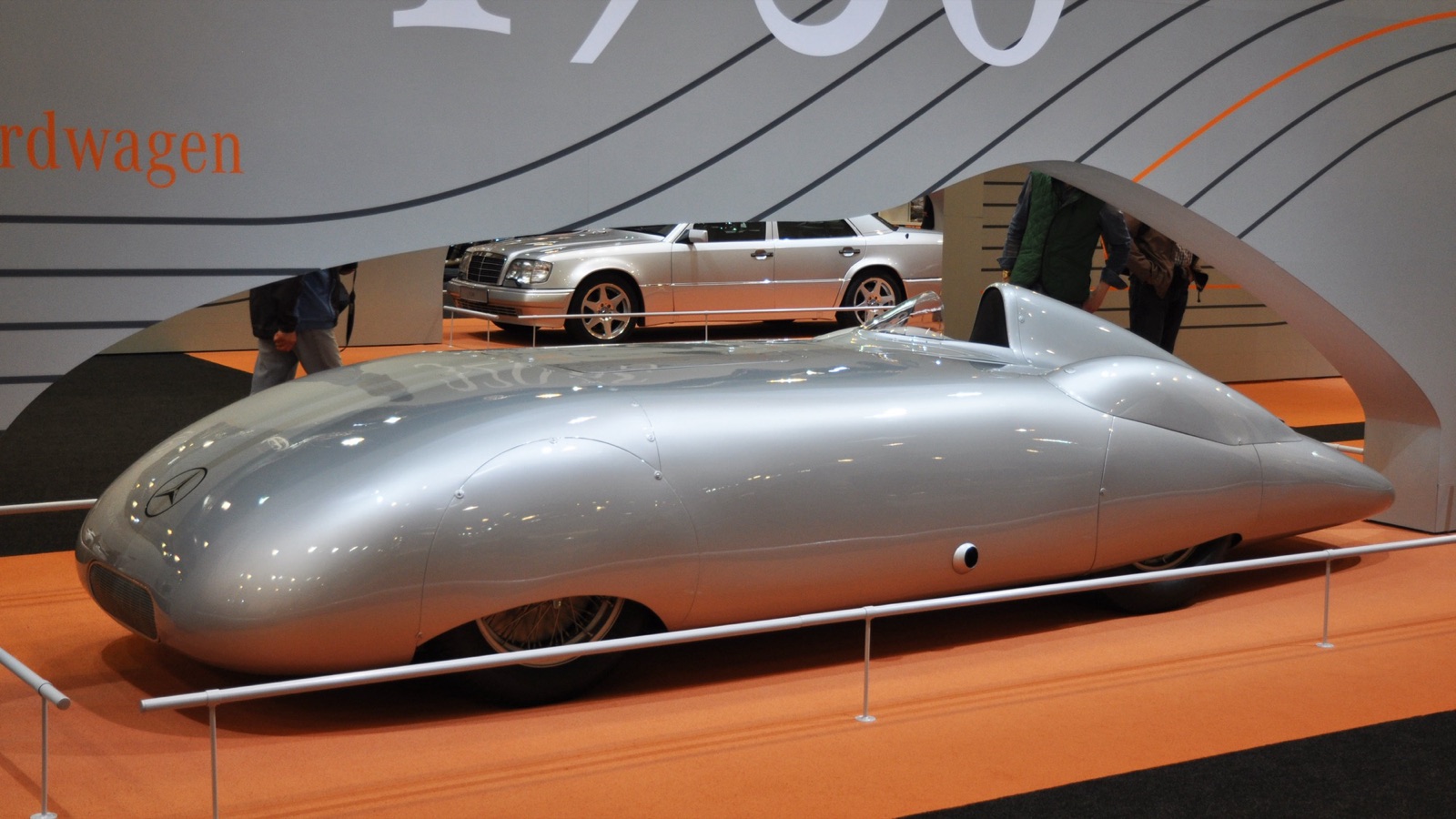
The 1936 record car is a W25 chassis with a fully enclosed body and Albert Heess's V12, the MD 25 DAB, of 82 × 88 mm with two superchargers. At almost 295 kg the engine was too heavy for the 750 kg Grand Prix car it was first meant for; on the test bed it gave 616 hp. Aerodynamicists from the Zeppelin company at Friedrichshafen advised on a body with a drag coefficient of 0.235, but their wind-tunnel tests found 217 kg of lift at the front, which lead weights on the front axle countered.
On the autobahn between Frankfurt and Darmstadt on 26 October 1936, Caracciola set Class B records of 364.372 km/h for the flying kilometre and 366.918 km/h for the flying mile, and raised Stuck's five-kilometre record to 340.523 km/h. On 11 November he added five miles at 336.838 km/h, ten kilometres at 331.889 km/h and a world record of 333.489 km/h for ten miles (Mercedes-Benz Classic's entry for the 1936 record car). Motor Sport's January 1941 review reported the engine as 5,370 cc and "said to develop 600 b.h.p. at 7,000 r.p.m."
The V12 streamliner at the Avus
For the Avus race of May 1937, run without the weight limit, Mercedes-Benz put the V12 into two of the short W25 chassis in the autumn of 1936. Von Brauchitsch's car, with a streamlined body and 616 hp, won its heat ahead of Rudolf Hasse's Auto Union and Lang, but lasted only half a lap of the final before an oil line to the gearbox failed. The second, an open car meant for Goffredo Zehender, broke its engine in practice (Mercedes-Benz Classic's entry for the W 25 Avus car). Lang won the race in a streamlined W125.
Who drove the Mercedes W25?
The Mercedes W25 was raced in all three seasons by Rudolf Caracciola, Luigi Fagioli and Manfred von Brauchitsch, with Ernst Henne in 1934, Hanns Geier in 1934 and 1935, Hermann Lang in 1935 and 1936 and Louis Chiron in 1936 (Motor Sport database); Alfred Neubauer managed the team. Motor Sport's April 1934 issue named the drivers as Fagioli, Caracciola, von Brauchitsch, Henne, Broschek and Bernet, with Fagioli expected only to stand in for Caracciola until he was fit, its 1940 review recalls.
Rudolf Caracciola
Caracciola won nine races in the W25, one of them shared with Fagioli, and the 1935 European Championship. He had injured his hip in an Alfa Romeo in practice at Monaco in April 1933, and at Monaco in April 1934, "still limping", he opened the course in a W25 (Motor Sport, 1940). He also drove both W25 record cars.
Luigi Fagioli
Luigi Fagioli, an Italian whose place in a German team drew "much comment" in 1934 (Motor Sport, 1940), won six races in the W25, one of them shared. He clashed with Neubauer over team orders at the Eifelrennen in 1934 and at Spa in 1935. Fearnley wrote that after Monaco in 1935 he "tended to play an unwilling and disaffected second fiddle" to Caracciola.
Manfred von Brauchitsch
Von Brauchitsch won the W25's first race and no other in it; he lost the 1935 German Grand Prix on the last lap. Alan Henry counted "just three major international races" won by him between 1934 and 1939 (Motor Sport, 2000).
Hermann Lang, Louis Chiron and the reserves
Lang, the team's junior driver in 1935, was fifth in that year's Eifelrennen in a car the database lists as a W25A. In the 1936 German Grand Prix he broke a finger and von Brauchitsch took over his car (Motor Sport, 1941). Chiron joined for 1936 and, after testing at Monza in December 1935, called the car "Une veritable bicyclette!"; Motor Sport recorded that "Hitler was said to have given personal attention to Chiron's appointment". Henne, who then held the world motorcycle speed record for BMW, was sixth at Pescara in 1934, and Geier fractured his skull in a practice crash at Bremgarten in 1935 (Motor Sport, 1940).
How many Mercedes W25s were built, and where are they now?
The Mercedes W25 was built in three batches, by Mercedes-Benz Classic's account: six cars for 1934, two more for 1935 and six of the short-wheelbase car for 1936. A W25 stands in the racing curve of Legend Room 7, "Silver Arrows: Races and Records", in the Mercedes-Benz Museum in Stuttgart, and its exhaust pipe is still tinged blue from the heat of the gases (2024 release).
For the Goodwood Revival in September 2012 Mercedes-Benz Classic brought a 1934 W25 among four pre-war Grand Prix cars it described as originals that had always belonged to the company, driven by Roland Asch, Jochen Mass, Bernd Schneider and Jackie and Paul Stewart (2012 release). A replica W25 was shown at the Fuji Motorsports Museum in Japan from 7 October 2022 to 5 October 2023.
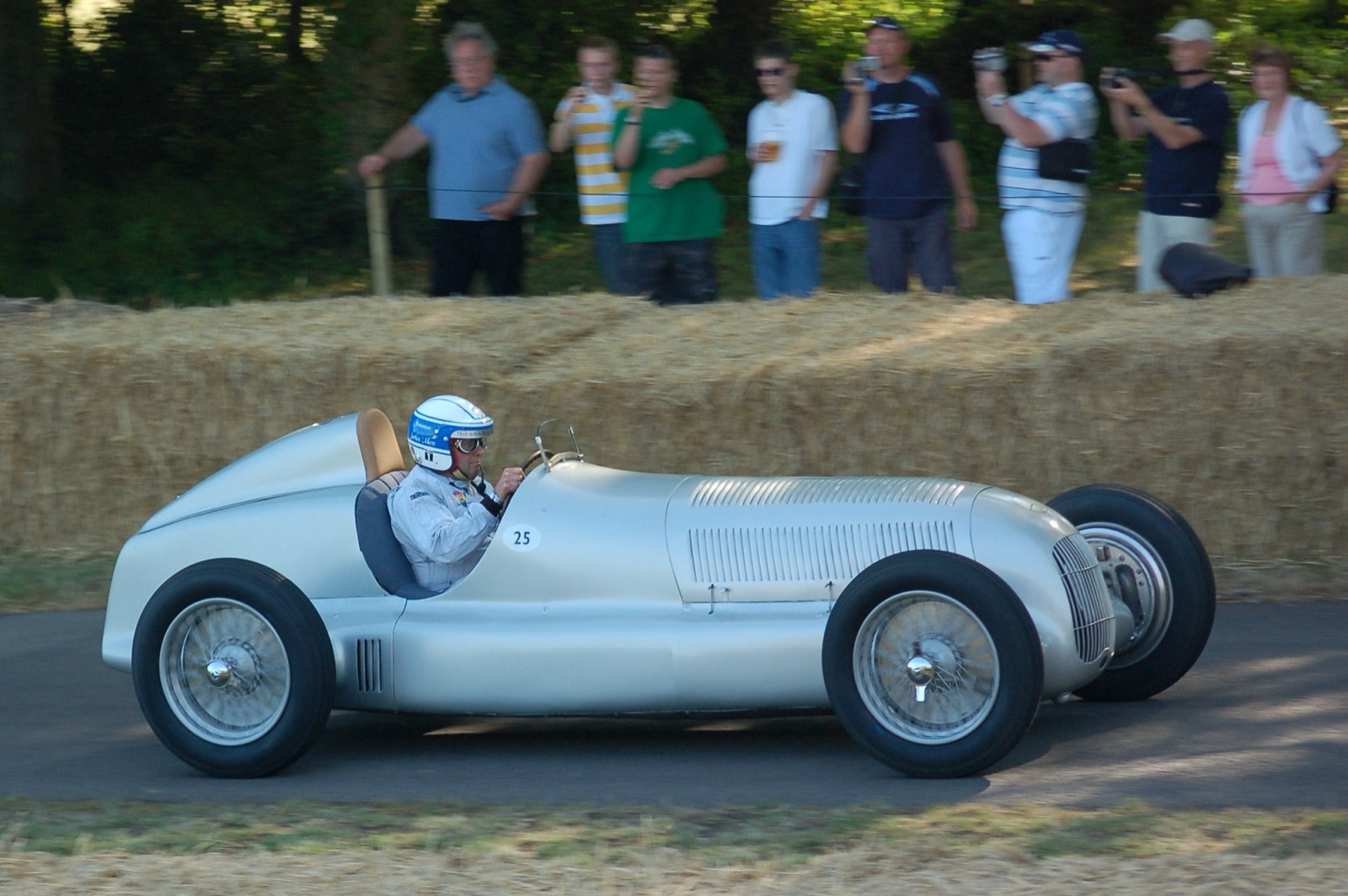
Mercedes W25 rivals and successor
The Mercedes W25's main rival was Auto Union's mid-engined V16 car, designed by Ferdinand Porsche, and it also raced against Alfa Romeo, Bugatti and Maserati; for 1937 Daimler-Benz replaced the W25 with the W125.
Auto Union
Auto Union's V16 grew from 4.4 litres and 295 hp in 1934 to 5 litres and 375 hp in 1935 and just over 6 litres in 1936 (archive). It won three races to the W25's four in 1934 and four to its nine in 1935, by Motor Sport's counts, and in 1936 Rosemeyer won the German, Swiss and Italian Grands Prix and the European Championship with it (database).
Alfa Romeo, Bugatti and Maserati
For 1934 Alfa Romeo bored the P3's engine out to 2.9 litres and Bugatti enlarged its straight-eight to 3.3 litres in the Type 59, and these engines gave 250 to 270 hp against the W25's 314 to 354 (archive). The Alfa Romeos took the first three places in the 1934 French Grand Prix, and Nuvolari beat the W25s in the 1935 German Grand Prix and at Barcelona and Budapest in 1936 (database). In 1935 the Maserati six- and eight-cylinder cars could not keep up either, by the archive's account.
The successor
Daimler-Benz came back in 1937 with the W125, a new car for the 750 kg formula (Mercedes-Benz Classic), which in Fearnley's words the "precocious engineer Rudi Uhlenhaut" licked into shape.
Questions and answers
What does the W in Mercedes W25 stand for?
Wagen, German for car. Daimler-Benz gave its racing cars W numbers and their engines M numbers, for Motor, so the W25 ran M 25 engines; Denis Jenkinson set out the scheme in Motor Sport in August 1968.
When did the Mercedes W25 first race?
At the Eifelrennen on the Nürburgring on 3 June 1934, which Manfred von Brauchitsch won. Mercedes had entered the Avus race in Berlin a week earlier but withdrew its cars after practice with trouble in the fuel system.
How much did the Mercedes W25 weigh?
Mercedes-Benz Classic gives 847 kg with tyres, oil and coolant; the 750 kg formula weighed cars without them. At the 1934 French Grand Prix the three W25s weighed 739.5, 739 and 737 kg, according to Motor Sport's 1940 review of the season.
Did the Mercedes W25 win the European Championship?
Yes, in 1935, the first year the AIACR awarded it: Rudolf Caracciola won the title in a W25, with his team-mate Luigi Fagioli second, according to Mercedes-Benz Classic.
Who won the most races in the Mercedes W25?
Rudolf Caracciola, with nine wins from 1934 to 1936, one of them shared with Luigi Fagioli. Fagioli won six, one shared, and Manfred von Brauchitsch one, by the Motor Sport database's results.
Is the Mercedes W25 the same car as the W125?
No. The W125 of 1937 replaced the W25's pressed-steel frame with one of oval tubes and used torsion bars at the rear in place of quarter-elliptic springs, according to Mercedes-Benz Classic, which says the W25 had been inferior in 1936.
Sources
- Mercedes-Benz Classic, archive entries: "Mercedes-Benz Grand-Prix racing car W 25, 1934" and its technical data (design, engines, funding, the paint story, the 1934 season); "W 25, 1935" (M 25 B and M 25 C, the 1935 season, the championship); "W 25 SWB, 1936" (the short car, the 1936 season, the withdrawal); "W 25 record car, 1934"; "W 25 record car, 1936"; "W 25 SWB AVUS racing car with streamlined body, 1937"; "SSKL streamliner, 1932–1933" (Laven's "silver arrow"). Technical data read for 1934, 1935 and 1936. Read 30 October 2026.
- Mercedes-Benz Classic, press release (in Italian), Goodwood Revival 2012, 13 September 2012 (silver as a new colour, the Eifelrennen outside the formula, the original cars and their drivers).
- Mercedes-Benz, press release (in Italian), "90 anni debuttava la Mercedes-Benz W 25: la prima 'Freccia d'argento'", 28 May 2024 (the museum car, Neubauer's story, the 122.5 km/h average).
- Mercedes-Benz Classic, archive entry "Mercedes-Benz Grand-Prix racing car W 125, 1937" (how the W125 differed from the W25).
- Motor Sport, "On Germany's rise to supremacy in motor racing", September 1940 (the formula, the 1934 season, weigh-in at Montlhéry, Gyón records, the season's score).
- Motor Sport, "Mercedes-Benz versus Auto-Union", October 1940 (the 1935 season, Nibel's death, engine sizes, timed speeds, the season's score).
- Motor Sport, "Mercedes-Benz versus Auto-Union", January 1941 (the 1936 season, Chiron, the 1936 record engine).
- Motor Sport, Alan Henry, "Manfred von Brauchitsch: Mercedes' sole survivor", March 2000 (von Brauchitsch and the paint story).
- Motor Sport, Paul Fearnley, "Team orders in the 1930s and today", 28 March 2013 (Fagioli).
- Motor Sport, Doug Nye, "Mercedes and Auto Union: a nation divided", July 2014 (state funding, the 1932 commentary, the Avus withdrawal of 1934).
- Motor Sport, Doug Nye, column, October 2019 (the case against the paint story).
- Motor Sport, Denis Jenkinson, "Letter from Europe", August 1968 (the W and M type letters).
- Motor Sport database, 1935 European Championship, 1936 European Championship and its pages for the races of 1934, 1935 and 1936 (dates, results, the W25A, W25B and W25C labels).
- Fuji Motorsports Museum, "Mercedes-Benz W25 (Replica)" (the replica's exhibition dates).