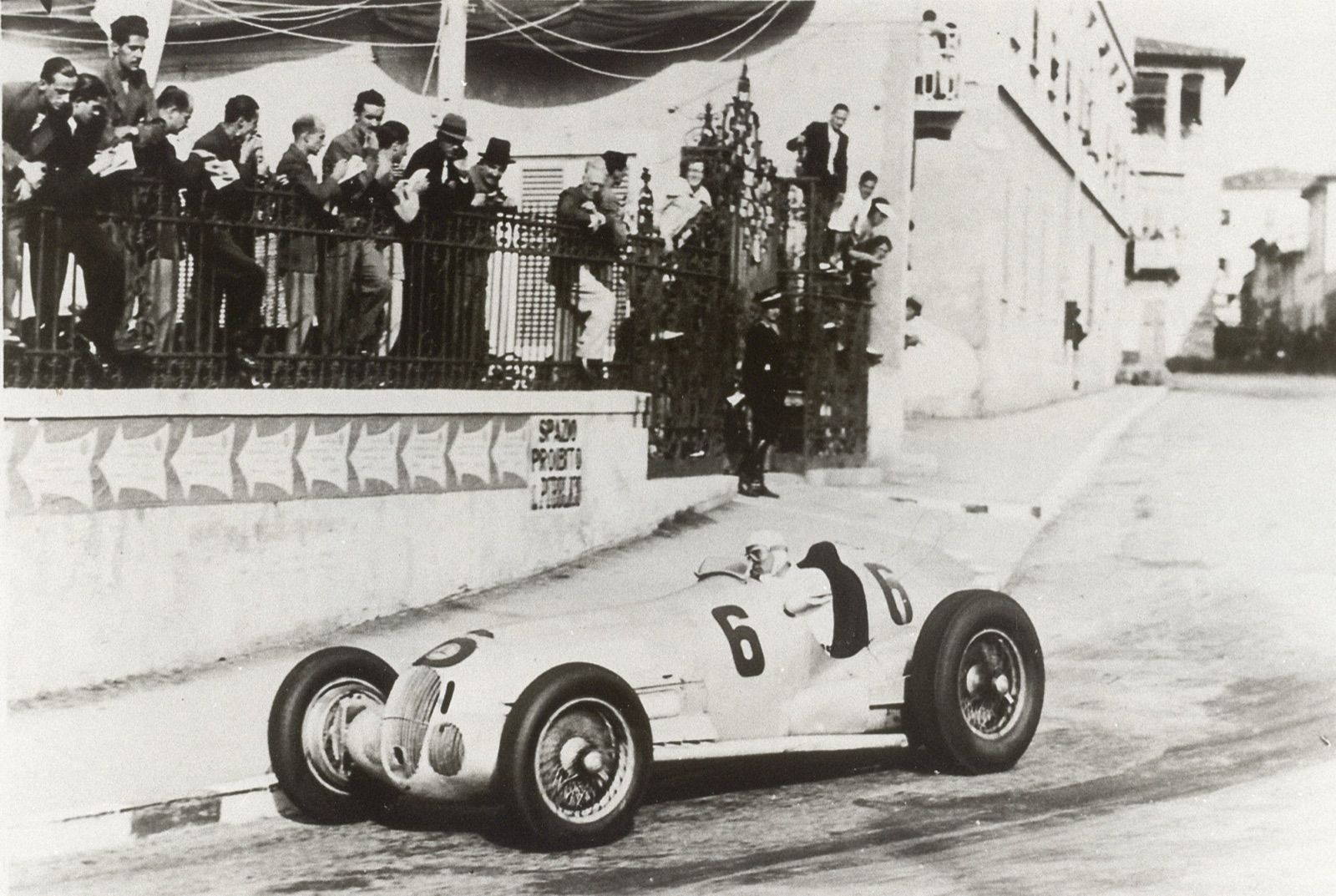
The Mercedes W125 (Mercedes-Benz W 125) is the Grand Prix car Daimler-Benz built for 1937, the last season of the 750 kg formula, with a supercharged straight-eight of about 5.66 litres. In that one season Mercedes-Benz won seven major races with the W125, four of them rounds of the European Championship, and Rudolf Caracciola became European champion for the second time. Mercedes-Benz Classic records eleven built (the Society of Automotive Historians in Britain says nine), and a record car on a W125 chassis reached 432.7 km/h on the Frankfurt to Darmstadt autobahn in January 1938.
Who designed the Mercedes W125, and why?
Rudolf Uhlenhaut, a 30-year-old engineer put in charge of a new racing department at Daimler-Benz in 1936, set the brief for the Mercedes W125; Josef Müller drew the chassis and Georg Scheerer the engine. The company needed a new car because its W25 had been beaten by Auto Union in 1936, and the team withdrew from the European Championship at the end of August that year, after the Swiss Grand Prix, according to Mercedes-Benz Classic's archive entry for the W 125.
The 750 kg formula
The governing body of the time, the AIACR, limited Grand Prix cars to a maximum weight of 750 kg from 1934 to 1936, expecting a weight limit to hold down engine size and power. New rules, with supercharged engines cut to 3,000 cc and unsupercharged ones to 4.5 litres, were agreed too late for the teams to build cars for 1937, so the 750 kg rule was extended by one season, as Doug Nye explained in Motor Sport in July 2017. The W125 weighed 749 kg without driver, fuel and tyres, according to a Mercedes-Benz Classic press release of 10 May 2012.
What was wrong with the W25
The short-wheelbase W25 of 1936 was hard to drive, and its drivers thought it dangerous (Nye). Uhlenhaut, a driver no slower than the works drivers by Mercedes-Benz Classic's account, drove it at the Nürburgring and found three faults: the pressed-steel frame twisted, the tube of the de Dion rear axle twisted too, and the front springs had too little travel. Its eight-cylinder engine had reached 494 hp at 5,800 rpm and was at its limit.
Design work began in August 1936, and by 9 September Müller's team had decided to stretch the wheelbase from 2,505 mm to 2,798 mm (Nye). The first car was finished at the beginning of 1937 and began testing at Monza in early February; two cars were testing by April, according to Mercedes-Benz Classic.
Mercedes W125 design and engineering
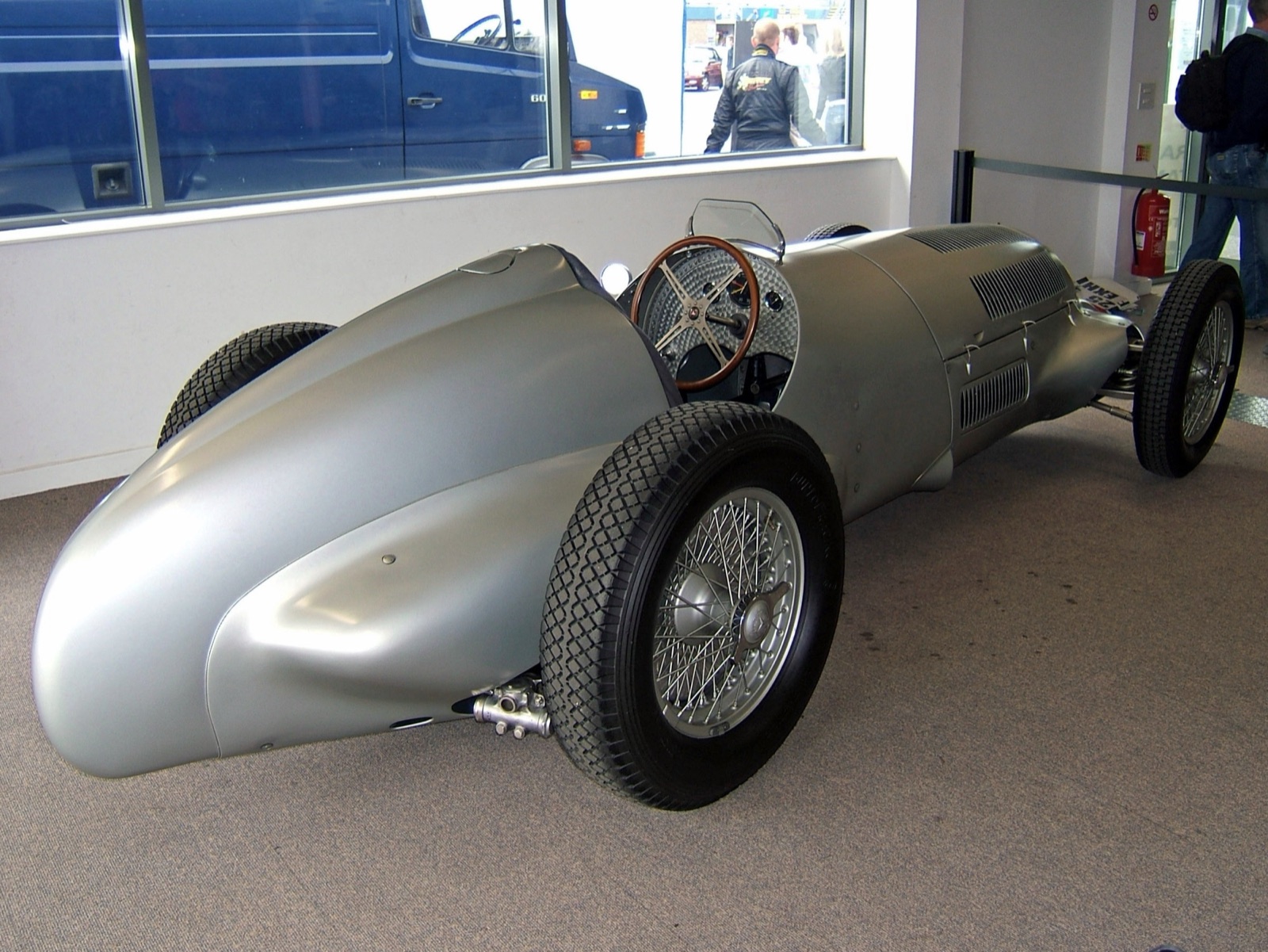
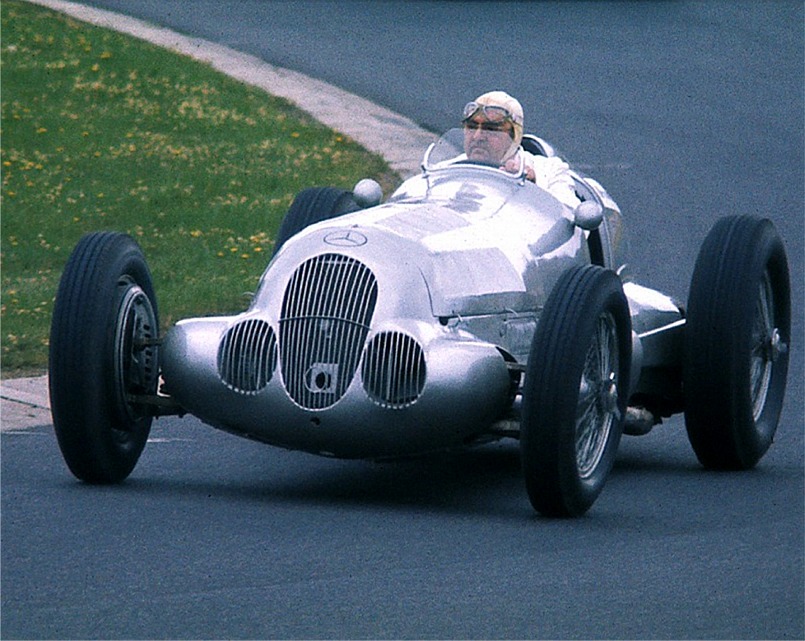
The Mercedes W125 kept the front engine and rear-wheel drive of the W25 but had a new tubular frame, new suspension at both ends, a larger engine and a body with three openings in the nose. Nye gives the new frame a claimed 2.65 times the torsional stiffness of the W25's; the 2012 press release puts the gain at three times, engine excluded.
Frame and suspension
The frame is a ladder of two oval-section side tubes joined by round cross-tubes, in nickel-chrome-molybdenum steel, with four cross-members (2012 release). At the front, two unequal trapezoidal arms each side work vertical coil springs; at the rear, a de Dion axle runs on torsion bars, and hydraulic lever-type dampers control both ends. Uhlenhaut chose soft, long-travel springs with better damping, and front spring travel went up by 50 mm to 140 mm (Nye). The only major change after the Monza tests was a pair of extra friction dampers at the rear axle, to stop a slight tramp. Motor Sport's 1937 description found the front suspension the same as on the Mercedes-Benz sports cars of the day, and the 2012 release says the soft-spring approach was later adopted on all modern Mercedes-Benz sports cars.
The M125 supercharged straight-eight
The M125 engine is the W25's straight-eight bored out by 8 mm to 94 mm, giving a displacement of 5,663 cc, in a new cylinder block. It has larger valves (40 mm across instead of 37 mm), compression ratios up to 9.4:1, stronger connecting rods and, on some engines, a crankshaft with nine main bearings instead of five (Mercedes-Benz Classic). A description of the car written for Motor Sport in late 1937, and reprinted in July 2004, gives it twin overhead camshafts and four valves per cylinder.
The larger change was in how the engine breathed. The Roots supercharger's rotors grew from 106 mm to 124.6 mm across, and during 1937 the team moved the carburettors from behind the blower to in front of it, so that the blower drew in and compressed a ready-mixed charge instead of pushing air through sealed carburettors. Motor Sport's report of the German Grand Prix in August 1937 noted that it was the first time in Mercedes' history that the blower sat between carburettor and engine, a system already tried at the Roosevelt Raceway and Spa, and that "the famous high-pitched scream" had gone. Denis Jenkinson, writing in Motor Sport in August 1968, said the team built about 12 engines and some 70 superchargers for the season.
Gearbox, brakes and body
The four-speed gearbox, with reverse, is in unit with the rear axle and is worked by the driver's right hand through a single dry-plate clutch; the brakes are Lockheed hydraulics (Motor Sport, 1937 text). Mercedes-Benz Classic gives the drums as 400 mm across, the size used on the W25, with shoes widened to 72 mm. Wind-tunnel work on the body lowered its drag coefficient from 0.620 to 0.589 (Nye).
Mercedes W125 specifications
The Mercedes W125 is a single-seat Grand Prix car 4,200 mm long on a 2,798 mm wheelbase, with a 5,663 cc supercharged straight-eight giving between 551 and 585 hp in its 1937 race form.
| Item | Figure |
|---|---|
| Engine | M125 straight-eight, front-mounted, twin overhead camshafts, four valves per cylinder |
| Capacity | 5,663 cc (94 mm bore) |
| Supercharging | One Roots blower, drawing through the carburettors from mid-1937 |
| Power in races | 551 to 585 hp at 5,800 rpm (engines in the last two races of 1937) |
| Gearbox | Four speeds and reverse, in unit with the rear axle |
| Frame | Oval-section steel side tubes, round cross-tubes |
| Front suspension | Unequal trapezoidal arms, coil springs, hydraulic lever dampers |
| Rear suspension | De Dion axle, torsion bars, hydraulic lever dampers |
| Brakes | Hydraulic, 400 mm drums |
| Length, width, height | 4,200 mm, 1,750 mm, 1,200 mm |
| Wheelbase | 2,798 mm |
| Track, front and rear | 1,473 mm and 1,412 mm |
| Weight | 749 kg without driver, fuel and tyres |
| Drag coefficient | 0.589 |
Sources: Mercedes-Benz Classic's archive entry (engine, power, suspension, brakes), the 2012 Mercedes-Benz Classic press release (dimensions, weight), Motor Sport's 1937 description (gearbox, camshafts) and Doug Nye (drag coefficient).
How much horsepower did the Mercedes W125 have?
The Mercedes W125's race engines gave 551 to 585 hp at 5,800 rpm in the last two races of 1937, by Daimler-Benz's own measurement reports; the 646 hp often quoted came from one engine, number 9, fitted with an extra carburettor, and as far as the records show it never raced in that form (Mercedes-Benz Classic). The published figures differ by source:
| Source | Figure | What it describes |
|---|---|---|
| Mercedes-Benz Classic archive | 551 to 585 hp at 5,800 rpm | Engines used in the last two races of 1937 |
| Mercedes-Benz Classic archive | 646 hp | Engine no. 9 on the test bed, with an extra carburettor |
| Mercedes-Benz Classic press release, 2012 | 600 CV (441 kW) | Maximum output |
| Denis Jenkinson, Motor Sport, August 1968 | 570 bhp on average, up to 606 bhp | Test beds; 5,300 to 5,500 rpm the limit in races |
| Doug Nye, Motor Sport, July 2017 | 556 to 585 bhp; 646 bhp | Race output; best figure on a Stuttgart dynamometer |
For comparison, Mercedes-Benz Classic gives Auto Union's 1937 V16, enlarged to 6,333 cc, 545 hp. Doug Nye has written that no Grand Prix car matched the W125's power until the 1.5-litre turbocharged cars of 1981 and 1982 (Motor Sport, 2017); in a later column he dated it to the arrival of turbo cars in 1977.
How fast was the Mercedes W125?
The Mercedes W125 reached more than 300 km/h (186 mph) in races during 1937 (Nye). Motor Sport's reporter at the German Grand Prix put the cars at "nearly 170 m.p.h." on the two-mile straight of the Nürburgring, and at Donington in October 1937 Lang came over the hill crest at "some 170 m.p.h.", according to Motor Sport's report of the race. With a streamlined body at the Avus in Berlin, Lang won at an average of 261.7 km/h (Mercedes-Benz Classic), 162.61 mph by Motor Sport's 1941 figures.
Mercedes W125 racing history
The Mercedes W125 raced as a Grand Prix car only in 1937, and Mercedes-Benz won seven of the twelve races it entered with it: Tripoli, the Avus, and the German, Monaco, Swiss, Italian and Masaryk Grands Prix. Motor Sport's review of the season in September 1941 gave Mercedes seven wins, eight second places and five thirds, against Auto Union's five wins, three seconds and seven thirds.
| Race | Date | W125 placings | Winner |
|---|---|---|---|
| Tripoli Grand Prix, Mellaha | 9 May | Lang 1st, Caracciola 6th, Seaman 7th | Lang |
| Avusrennen, Berlin | 30 May | Lang 1st (streamliner, see below), Seaman 5th | Lang |
| Eifelrennen, Nürburgring | 13 June | Caracciola 2nd, von Brauchitsch 3rd, Lang 6th, Kautz 9th | Rosemeyer (Auto Union) |
| Vanderbilt Cup, Roosevelt Raceway, New York | 5 July | Seaman 2nd | Rosemeyer (Auto Union) |
| Belgian Grand Prix, Spa-Francorchamps (EC) | 11 July | Lang 3rd, Kautz 4th | Hasse (Auto Union) |
| German Grand Prix, Nürburgring (EC) | 25 July | Caracciola 1st, von Brauchitsch 2nd, Kautz 6th, Lang 7th | Caracciola |
| Monaco Grand Prix (EC) | 8 August | Von Brauchitsch 1st, Caracciola 2nd, Kautz 3rd, Zehender 5th | Von Brauchitsch |
| Coppa Acerbo, Pescara | 15 August | Von Brauchitsch 2nd | Rosemeyer (Auto Union) |
| Swiss Grand Prix, Bremgarten (EC) | 22 August | Caracciola 1st, Lang 2nd, von Brauchitsch 3rd, Kautz 6th | Caracciola |
| Italian Grand Prix, Livorno (EC) | 12 September | Caracciola 1st, Lang 2nd | Caracciola |
| Masaryk Grand Prix, Brno | 26 September | Caracciola 1st, von Brauchitsch 2nd, Seaman 4th | Caracciola |
| Donington Grand Prix | 2 October | Von Brauchitsch 2nd, Caracciola 3rd | Rosemeyer (Auto Union) |
Placings from Mercedes-Benz Classic's archive entry, with the Avus and Coppa Acerbo results from Motor Sport (1941); dates and the Livorno venue from Motor Sport's database of the 1937 European Championship and its race pages.
Tripoli and the Avus
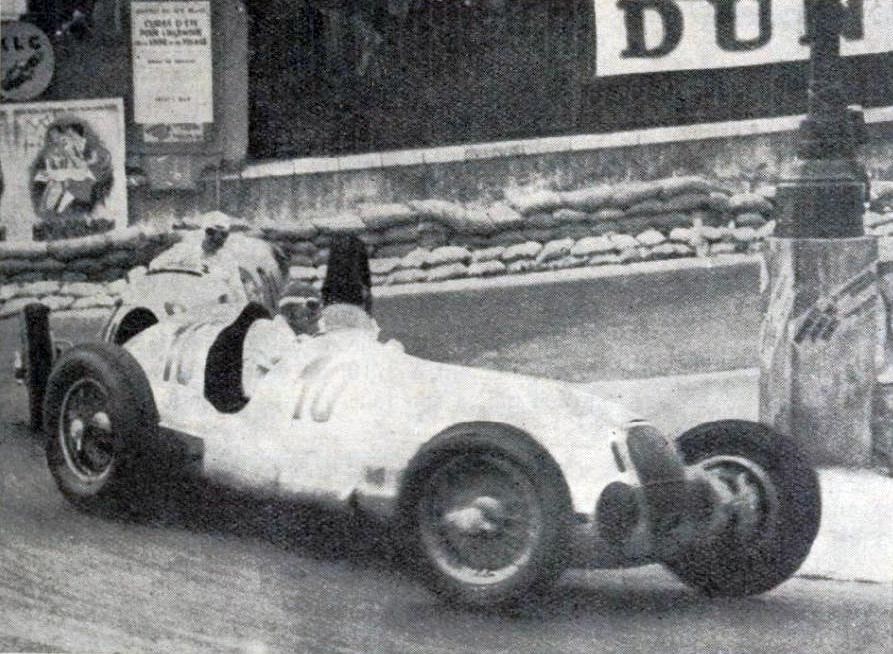
The W125 won first time out, at the Tripoli Grand Prix on 9 May 1937, where Mercedes brought five cars, four to race and one for practice. Lang won his first Grand Prix, ahead of four Auto Unions, by Mercedes-Benz Classic's account; Nye gives his average as 131.75 mph.
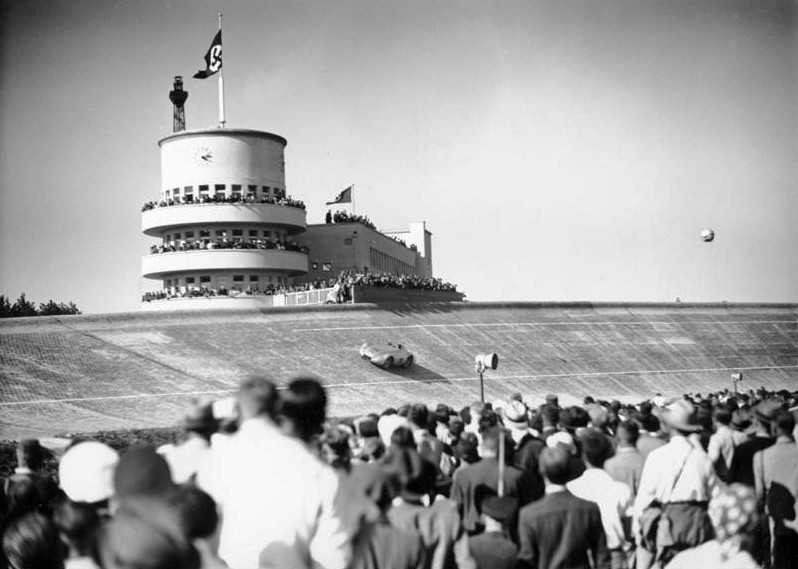
The Avus race in Berlin on 30 May was run without the weight limit, on a track with a new, steeply banked north curve, so both German teams built streamlined cars. Caracciola won the first heat and von Brauchitsch the second, but in the final both retired when heat melted the solder of a gearbox oil pipe under the enclosed bodies. Lang's car had a screwed joint there, and he won from three Auto Unions. Which car Lang drove is disputed, even among Mercedes' own sources: the Mercedes-Benz Classic archive says a W125 with a streamlined body, its 2012 press release a streamlined W25 with the M125 engine, and Motor Sport's 100 Greatest Grands Prix a stretched 1936 W25 record car with a straight-eight. Seaman, in an unstreamlined W125, finished fifth.
Defeats at the Eifelrennen, the Vanderbilt Cup and Spa
Auto Union won the next three races. At the Eifelrennen on 13 June Bernd Rosemeyer beat Caracciola by about 50 seconds. Mercedes then split the team: Caracciola and Seaman took two W125s to the Vanderbilt Cup in New York, where Seaman finished second to Rosemeyer, while Lang, von Brauchitsch and Kautz raced at Spa on 11 July and Rudolf Hasse and Hans Stuck gave Auto Union a one-two ahead of Lang (Mercedes-Benz Classic). Lang's lap of 5 min 5.6 sec at Spa, 109.437 mph, is listed in Motor Sport's database as the Spa-Francorchamps lap record for Grand Prix cars.
The European Championship: Germany, Monaco, Switzerland and Italy
The W125 won the last four European Championship rounds in succession. At the Nürburgring on 25 July Caracciola won the German Grand Prix by 46 seconds from von Brauchitsch, with Rosemeyer third. Seaman's W125 collided with Ernst von Delius's Auto Union on the Döttinger Höhe straight; Seaman broke an arm, and von Delius died in hospital the next day (Motor Sport, August 1937).
At Monaco on 8 August von Brauchitsch and Caracciola fought for the lead for most of the 100 laps. Motor Sport's 1941 review has Caracciola retaking the lead on lap 80 and stopping again two laps later, and its report at the time has him waving von Brauchitsch on from the pits; von Brauchitsch won at 63.27 mph, 1 min 24.3 sec ahead, with Christian Kautz third and Goffredo Zehender fifth on his first drive for Mercedes. Motor Sport's database says von Brauchitsch "disobeyed team orders for once" to win.
Caracciola won the Swiss Grand Prix at Bremgarten on 22 August at 99.3 mph (Motor Sport, 1941), with Lang second and von Brauchitsch third. The title was settled at the Italian Grand Prix on 12 September, run on Livorno's Montenero circuit for the only time (Motor Sport's database and the 2012 press release; Mercedes-Benz Classic's archive and Motor Sport's 1941 review place it at Monza), where Caracciola beat Lang, by a hair in Mercedes-Benz Classic's words.
Brno and Donington
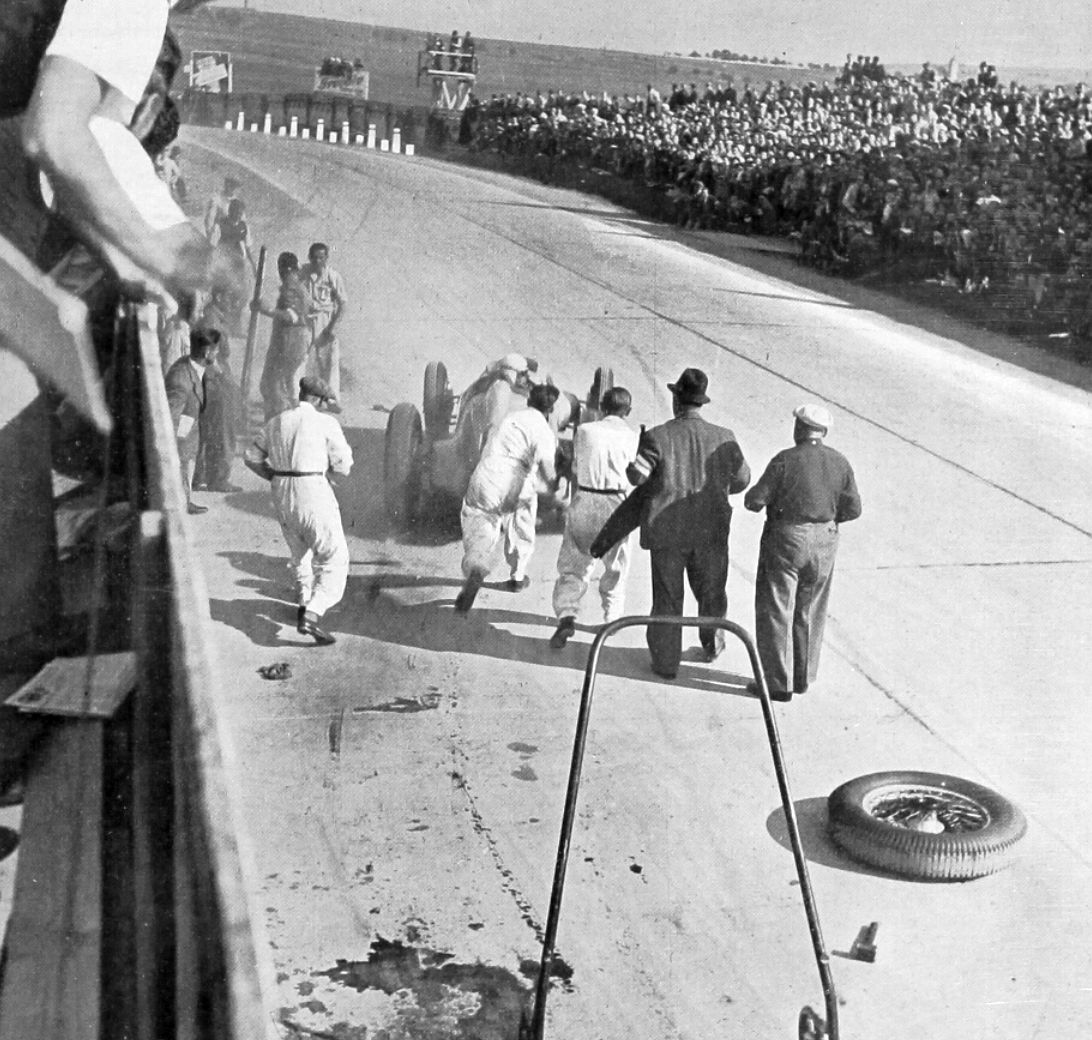
Caracciola and von Brauchitsch finished first and second in the Masaryk Grand Prix at Brno on 26 September, 35 seconds apart, with Seaman fourth; Lang led the first three laps and crashed on the fourth. A Daimler-Benz bulletin to its staff and dealers, dated 27 September 1937 and published by Doug Nye in Motor Sport's December 2026 issue, gave Caracciola's time as 3 hr 9 min 25.3 sec and said the race was run "in brilliant sunshine before 100,000 enthusiastic spectators".
The season ended at Donington Park on 2 October 1937, the first time the German teams had raced in Britain, before a crowd first reported at 38,000 to 40,000. Lang retired with broken suspension and Seaman with damage from a collision with Hermann Müller's Auto Union; von Brauchitsch was 14.8 seconds behind Rosemeyer when a front tyre burst at about 170 mph, and he finished second, 37.8 seconds behind, with Caracciola third (Motor Sport, October 1937). The W125s ran with bonnet straps there for the first time, to meet British regulations.
Who drove the Mercedes W125?
Rudolf Caracciola, Manfred von Brauchitsch, Hermann Lang and Richard Seaman were the Mercedes W125's regular drivers in 1937, with Christian Kautz and Goffredo Zehender in the reserve places; Alfred Neubauer managed the team, and at Donington Uhlenhaut attended it (Motor Sport, 1937 text).
Rudolf Caracciola
Caracciola won four Grands Prix in the W125 and the 1937 European Championship, his second title after 1935 (Mercedes-Benz Classic). Daimler-Benz's September 1937 bulletin called him "German Champion". In January 1938 he drove the W125-based record car to 432.7 km/h.
Manfred von Brauchitsch
Von Brauchitsch's one Grand Prix win in the W125 was Monaco, against team orders, and he was second four times, as Motor Sport's 1941 tally also records. Telling of his puncture at Donington, Nye calls him "perennially the team's Pechvogel" ("unlucky bird"). In June 1939 he drove a W125 hill-climb car to third place in the Vienna Höhenstrasse climb (Mercedes-Benz Classic).
Hermann Lang
Lang, the team's former engine mechanic (Nye), won at Tripoli and the Avus in 1937, and in August 1939 he won the Grossglockner hill climb in a W125 hill-climb car, with von Brauchitsch fourth in the other (Mercedes-Benz Classic).
Richard Seaman
Seaman, the British driver new to the team in 1937, was second in the Vanderbilt Cup and fourth at Brno (Mercedes-Benz Classic). He overturned a Mercedes in tests at Monza before the season and missed Monaco while recovering in hospital at Adenau from his German Grand Prix crash (Motor Sport, 1937 and 1941). After the season he demonstrated a Mercedes-Benz at the Crystal Palace circuit in London.
Christian Kautz and Goffredo Zehender
Kautz, a young Swiss driver newly signed by Mercedes, scored his best result of the season with third place at Monaco. Zehender, an Italian, drove at Monaco in place of the injured Seaman and finished fifth (Mercedes-Benz Classic; Motor Sport, August 1937).
Streamliners, record cars and hill-climb versions
Besides the Grand Prix car, Daimler-Benz built W125s with streamlined bodies for the Avus race of 1937, record cars on the W125 chassis in 1937 and 1938, and lightened hill-climb cars that raced in 1939.
The Avus streamliners
For the Avus, two new W125s were given fully enclosed bodies and larger wheels, 22-inch at the front and 24-inch at the rear, to cope with the speed, the banking and a weight more than 200 kg above the Grand Prix car's, according to Mercedes-Benz Classic's entry for the W 125 Avus car. In practice Lang found the front wheels lifting at more than 200 mph and asked for the wheel covers to be removed (Motor Sport, 100 Greatest Grands Prix). Von Brauchitsch's streamliner was a W25 with a V12 engine, which reached 380 km/h on the straights, according to Mercedes-Benz Classic's entry for that car.
The record car of 1937
For the record week on the Frankfurt to Darmstadt autobahn in October 1937, Daimler-Benz built a record car on a W125 chassis with a new streamlined body and Albert Heess's V12, the MD 25 DAB of nearly 5.6 litres, which gave 736 hp on the test bed. On 25 October it reached 366 km/h over the flying kilometre, but the nose lifted on the second run; three days later, with 46 kg of lead over the front axle, it managed 398.89 km/h before the team withdrew (Mercedes-Benz Classic's entry for the 1937 record car). Rosemeyer's Auto Union reached 406.3 km/h that week.
The record car that reached 432.7 km/h
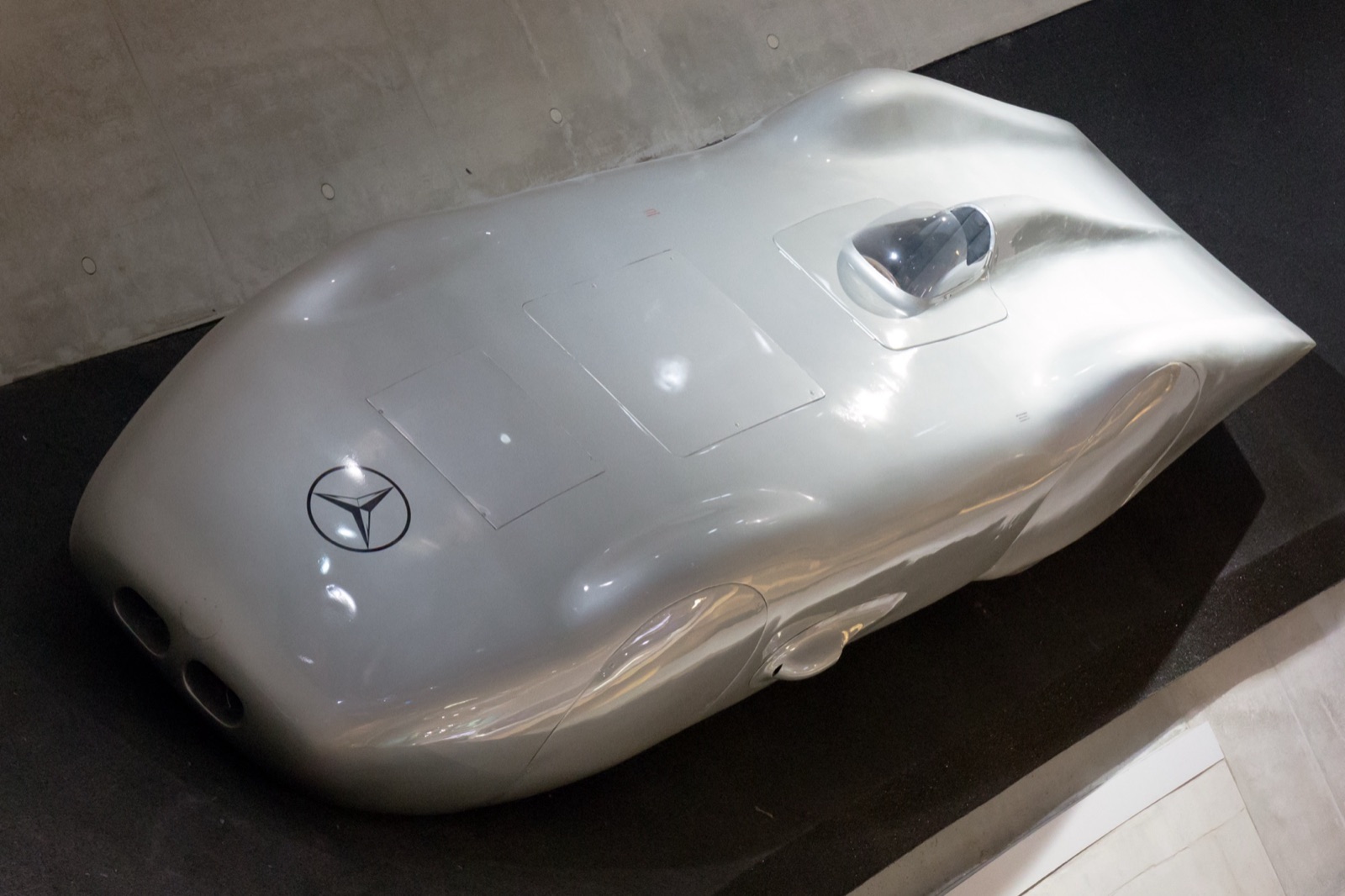
The 1938 record car is a heavily revised version of the same car, with the same engine, number 3, and a body reworked on the advice of aircraft-industry aerodynamicists and the German aviation research institute, the DVL: a lower nose with two small air intakes in place of the radiator opening, 80 mm off the front and 500 mm added to the tail, a rounded windscreen and a slight waist. The DVL suggested cooling the V12 with ice, so that the car needed no radiator opening, and internal records put its output at about 765 hp (Mercedes-Benz Classic's entry for the 1938 record car). A Mercedes-Benz Museum press release of January 2013 gives 736 hp from 5,577 cc and the engine type as MD 25 DAB/3. Mercedes-Benz Classic's press release of January 2018 says the radiator sat in a container holding 48 litres of water and 5 kg of ice, with dry ice for extra cooling if needed; the 2013 release gives 500 litres of ice and water.
On 28 January 1938 Caracciola averaged 432.692 km/h over the flying kilometre and 432.361 km/h over the flying mile, the means of two runs in opposite directions; his return run touched 437 km/h. Wind-tunnel measurement decades later gave the body a drag coefficient of 0.157, by the archive entry and the 2013 release, or 0.170 in race configuration, by the 2018 release. Motor Sport's report of February 1938 gave the return-run kilometre as 271.311 mph and recorded that Caracciola found the engine reaching its peak revs too soon on the gearing fitted. Later that day Rosemeyer was killed when a gust of wind caught his Auto Union as he tried to beat the new figures.
The record for a public road stood until 4 November 2017, when it was raised to 445.54 km/h (Mercedes-Benz Classic) by a Koenigsegg Agera RS, as Top Gear reported on 7 November 2017. Top Gear gave the Agera RS 1,360 bhp; Mercedes-Benz Classic says the car that broke the record had almost twice the power.
Hill-climb W125s
Two W125s were rebuilt as hill-climb cars for 1939 on the two lightest frames available, with glycol evaporative cooling which, with the oil tank, was moved to the tail for traction, twin rear tyres, a 45-litre fuel tank and short stub exhausts, according to Mercedes-Benz Classic's entry for the 1939 hill-climb W 125. The 2012 press release says both the light hill-climb cars and the Grand Prix W125 were used in hill climbs in 1938 and 1939.
How many Mercedes W125s were built, and where are they now?
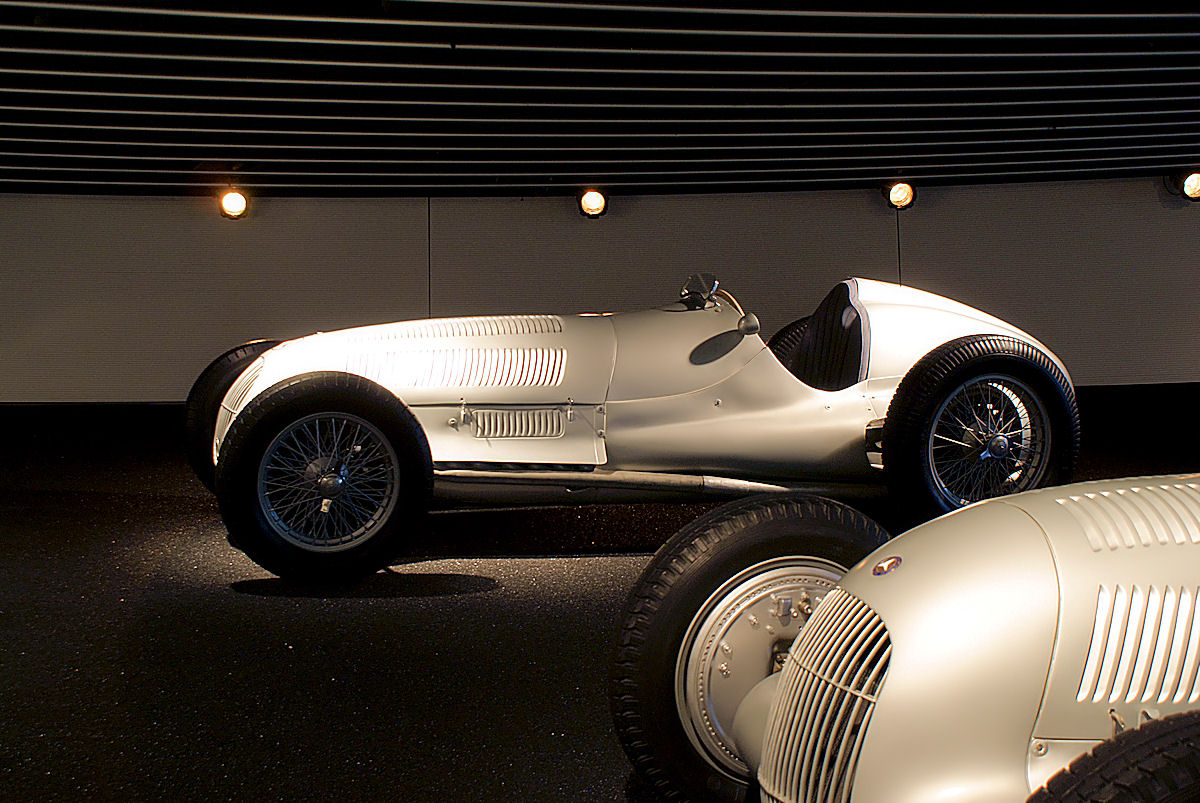
Daimler-Benz built eleven Mercedes W125s at Untertürkheim, and nine of them raced in 1937 (Mercedes-Benz Classic). The Society of Automotive Historians in Britain puts the number at nine. Survivors include an original W125 kept by Mercedes-Benz Classic, the record car in the Mercedes-Benz Museum, and chassis 190815, which Tom Hartley Jnr describes as the only one in private ownership.
The cars Mercedes-Benz kept
Mercedes-Benz Classic took an original 1937 W125 to the Goodwood Revival in September 2012, with a W25, a W154 and a W165, and said in its press release that these cars had always belonged to the company. In 2013 the 1938 record car hung on a wall at the top of the banked display in the Mercedes-Benz Museum's room 7, "Silver Arrows: Races and Records", with six other record cars (2013 release).
Juan Manuel Fangio drove a W125 in demonstration laps at Donington Park on 3 June 1979, at the Gunnar Nilsson memorial meeting; he had never driven the car or the circuit before, Nigel Roebuck recalled in Motor Sport in November 2010.
Chassis 190815, from East Germany to Goodwood
Colin Crabbe found a W125 in East Germany in 1968, in very poor condition, and rebuilt it; it raced for the first time since the war at Oulton Park in 1971, where Crabbe won the Richard Seaman Memorial Historic Trophy at 82.20 mph, as Motor Sport reported in August 1971. The rebuilt car had a supercharger that was not original, an SU carburettor and brakes from a W163, and ran on a Mercedes fuel mixture prepared by Shell: methyl alcohol, benzene and ethyl alcohol with 4 per cent petrol, as the society's Snapshot 137 remembers it from the Oulton Park paddock.
Its history before 1968 is told two ways. Jenkinson wrote in 1968 that it was probably one of four Grand Prix cars Daimler-Benz gave to the automobile museum in Dresden in 1939, and the W125 von Brauchitsch drove in the Vienna hill climb that June; Motor Sport called it "ex-Brauchitsch" in 1971. The dealer Tom Hartley Jnr lists the car as chassis 190815, winner of the 1937 Czechoslovakian (Masaryk) Grand Prix with Caracciola, ex-Bernie Ecclestone, and sold.
The SAHB records that Crabbe won at Oulton Park again in 1972 and sold the car to Neil Corner in 1973; Corner later sold it to Ecclestone, and it then went to a German collection, was restored to running order and appeared at the Goodwood Festival of Speed in 2017.
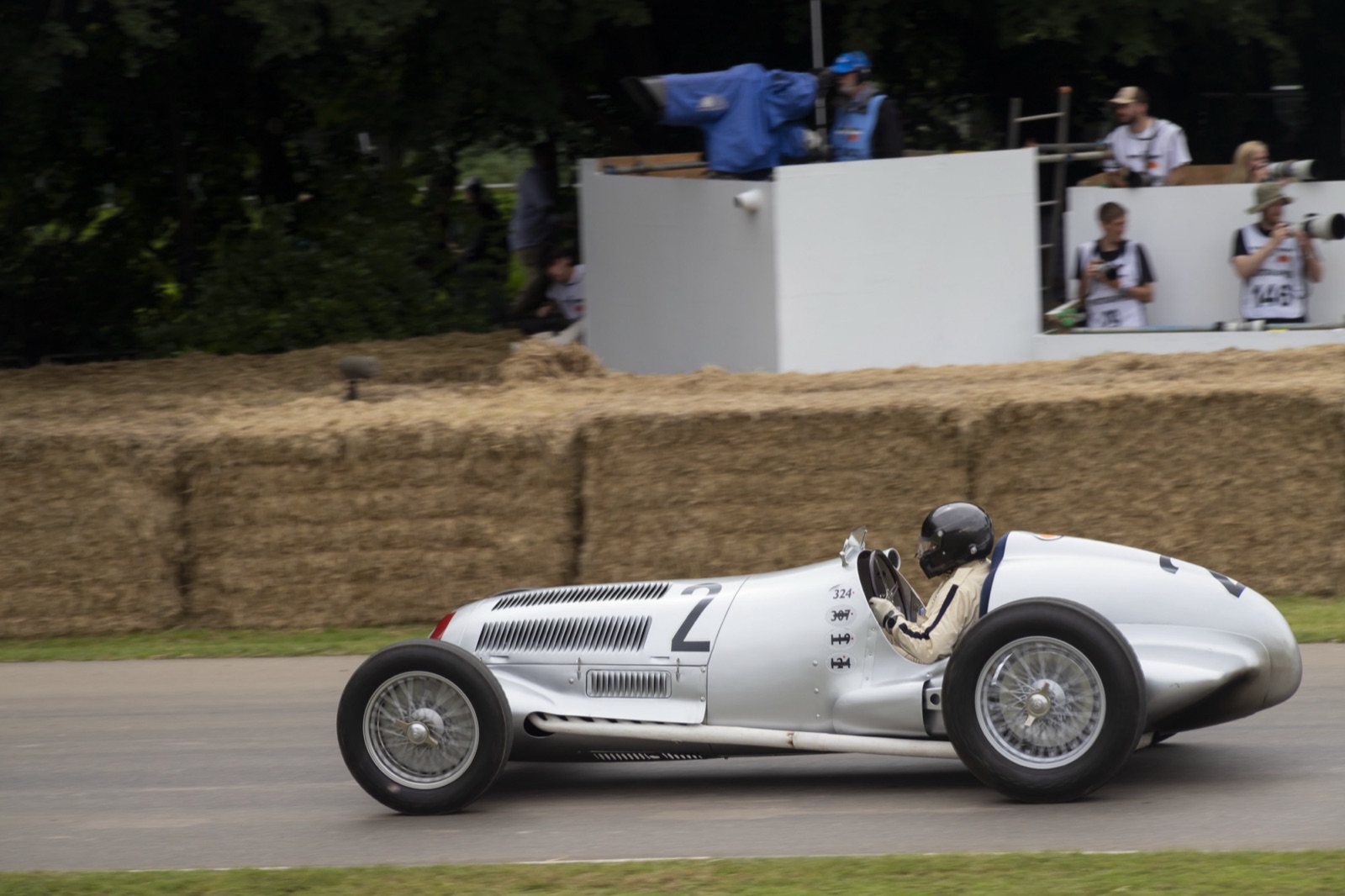
Mercedes W125 replicas
Crosthwaite & Gardiner built five W125 recreations, using Bernie Ecclestone's original car for reference, and all five went to collectors; Tom Hartley Jnr, which sold one of them, says it was the only one allowed Mercedes-Benz badges on the nose and wheel spinners, and the only one offered for resale.
Rivals, predecessor and successor
The Mercedes W125's rival in 1937 was the rear-engined Auto Union Type C, which beat it in five races. Alfa Romeo "could only score minor placings", Tazio Nuvolari's fourth in the German Grand Prix among them, and Maserati "struggled financially", in the words of Motor Sport's database. The one Alfa Romeo win in Motor Sport's 1941 tally of the season came at Milan, where Nuvolari beat Hasse's Auto Union.
Auto Union Type C
The Auto Union Type C had a V16 engine behind the driver, enlarged to 6,333 cc for 1937 and giving 545 hp. The V16 had always had more torque than the Mercedes straight-eight, but by 1937 the M125 matched it, both reaching at least 900 Nm (Mercedes-Benz Classic). Bernd Rosemeyer won the Eifelrennen, the Vanderbilt Cup, the Coppa Acerbo and the Donington Grand Prix with it, and Rudolf Hasse the Belgian Grand Prix (Mercedes-Benz Classic; Motor Sport, 1941).
From the W25 to the W154
The W125 followed the W25, the Mercedes-Benz Grand Prix car of 1934 to 1936, and was replaced for 1938 by the three-litre W154 built to the new formula. Max Wagner, the engineer responsible, used the W125's frame design for the W154 (2012 release).
Questions and answers
What does W125 stand for?
In Daimler-Benz type numbers W stands for Wagen (car) and M for Motor, so the W125 car had the M125 engine, as Denis Jenkinson explained in Motor Sport in August 1968.
How much did the Mercedes W125 weigh?
749 kg without driver, fuel and tyres, just inside the 750 kg limit of the Grand Prix formula, according to a 2012 Mercedes-Benz Classic press release. The streamlined W125s built for the Avus race of 1937 were more than 200 kg heavier.
Who won the 1937 European Championship?
Rudolf Caracciola, in a Mercedes W125, his second European title after 1935. Mercedes-Benz drivers won four of the five championship rounds: Caracciola the German, Swiss and Italian Grands Prix and Manfred von Brauchitsch the Monaco Grand Prix.
Did the Mercedes W125 race after 1937?
Not in Grands Prix: the formula changed for 1938. W125s ran in hill climbs in 1938 and 1939, and Hermann Lang won the Grossglockner climb in a W125 hill-climb car in August 1939. Colin Crabbe raced a rebuilt W125 at Oulton Park in 1971 and won.
What engine did the W125 record car have?
A V12 with two superchargers, type MD 25 DAB/3, of 5,577 cc, according to the 2013 Mercedes-Benz Museum press release. That release gives it 736 hp; the Mercedes-Benz Classic archive puts the 1938 output at about 765 hp.
Which car broke the W125 record car's public-road record?
A Koenigsegg Agera RS, according to Top Gear, which gave its speed over the flying kilometre as 276.9 mph, the mean of two runs. Mercedes-Benz Classic dates the new record 4 November 2017 and gives it as 445.54 km/h. Caracciola's 432.692 km/h of 28 January 1938 had stood for almost 80 years.
Sources
- Mercedes-Benz Classic, archive entries: "Mercedes-Benz Grand-Prix racing car W 125, 1937" (design, engines and power, eleven built, 1937 results); "W 125 AVUS racing car with streamlined body, 1937"; "W 25 SWB AVUS racing car with streamlined body, 1937" (von Brauchitsch's V12 streamliner); "W 125 record car, 1937"; "W 125 record car, 1938"; "Hillclimb racing car W 125, 1939" (in German). Read 30 October 2026.
- Mercedes-Benz Classic, press release (in Italian), "Una Mercedes-Benz W 125 originale del 1937 protagonista al Goodwood Revival 2012", 10 May 2012 (dimensions, weight, 600 CV, frame, hill-climb cars, the W154).
- Mercedes-Benz Classic, press release, "Inspiring to the present day: Caracciola's 432.7 km/h on a public road on 28 January 1938", January 2018 (the 1938 record car's ice cooling and its 0.170 drag figure; the release is reproduced in full in the motoring press).
- Mercedes-Benz Museum, press release (in Italian), "Mercedes-Benz W 125: auto da record", 22 January 2013 (record car's engine, ice cooling, display).
- Motor Sport, "Mercedes break Nürburg record", August 1937 (German Grand Prix, new supercharger system).
- Motor Sport, Monaco Grand Prix report, August 1937.
- Motor Sport, "The Germans' Grand Prix at Donington", October 1937.
- Motor Sport, "Achievement and tragedy", February 1938 (the 1938 record runs).
- Motor Sport, "Mercedes-Benz versus Auto-Union", September 1941 (the 1937 season, marque score).
- Motor Sport, Denis Jenkinson, "Letter from Europe", August 1968 (engines, superchargers, Crabbe's car).
- Motor Sport, "Veteran-Edwardian-vintage", August 1971 (Crabbe's Oulton Park win).
- Motor Sport, "Racing car", July 2004 (a 1937 description of the car: valves, gearbox, brakes, team).
- Motor Sport, Nigel Roebuck, "The morning I met the maestro", November 2010 (Fangio at Donington, 1979).
- Motor Sport, Doug Nye, "From the archives", July 2017 (the formula, design dates, power, drag).
- Motor Sport, Doug Nye, "Once again we lead the field with superiority", December 2026 (the Daimler-Benz bulletin of 27 September 1937).
- Motor Sport, "49: 1937 Avusrennen", from the special issue 100 Greatest Grands Prix (the Avus cars).
- Motor Sport database, 1937 European Championship and its pages for the 1937 races (dates, venues, Spa lap record).
- Society of Automotive Historians in Britain, "Snapshot 137: 1937 Mercedes-Benz W125" (chassis 190815's later owners, fuel).
- Tom Hartley Jnr, "Mercedes-Benz W125" (chassis 190815) and "Mercedes-Benz W125 by Crosthwaite & Gardiner", sold-stock pages.
- Top Gear, Vijay Pattni, "The Koenigsegg Agera RS has claimed five speed records", 7 November 2017.