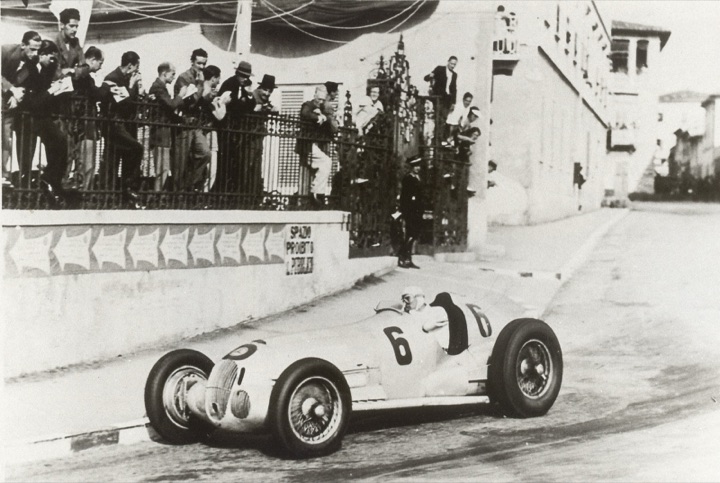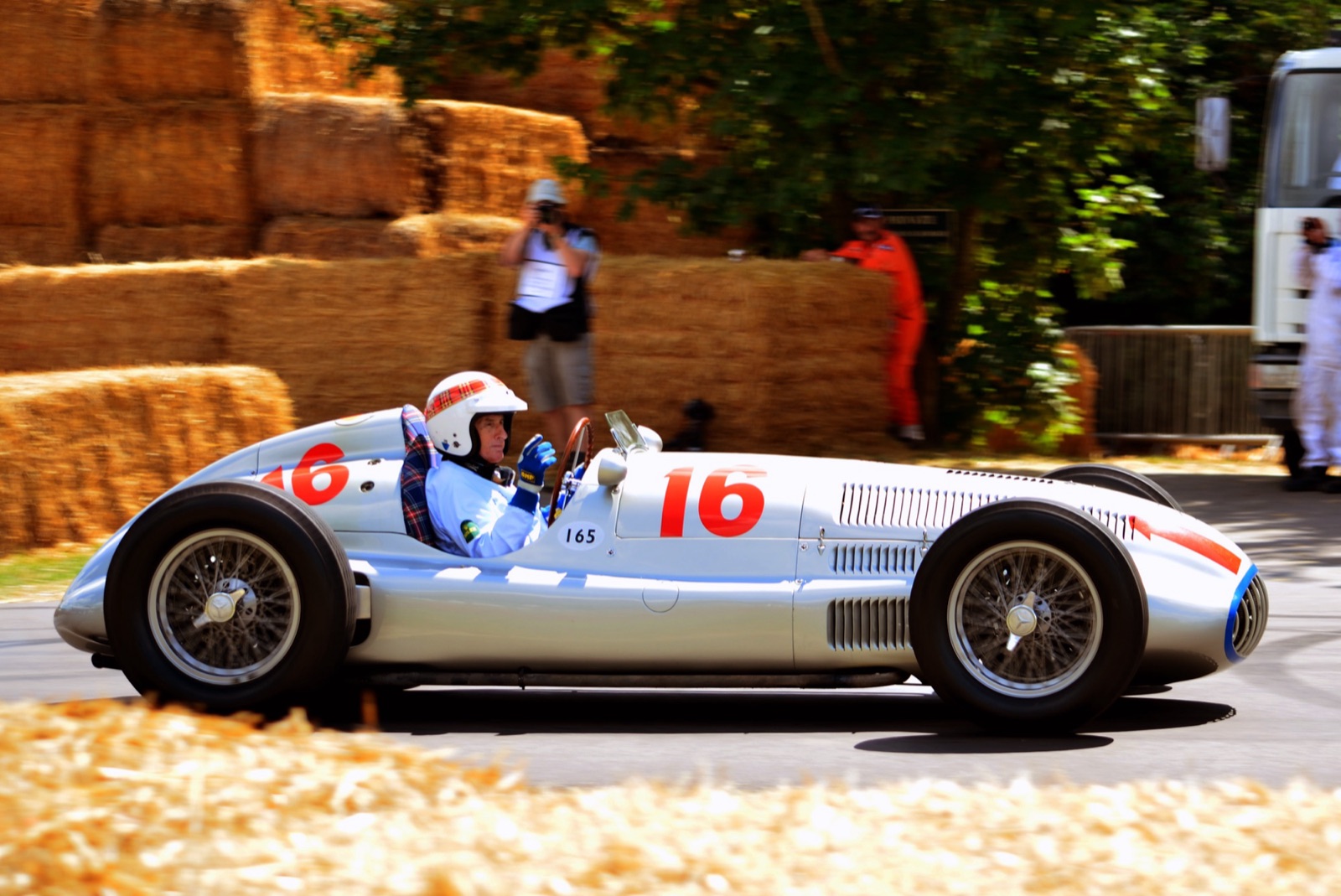
The Mercedes-Benz W165 is the supercharged 1.5-litre V8 racing car that Daimler-Benz built in secret for one race, the Tripoli Grand Prix of 7 May 1939, after the Italian organisers limited it to voiturettes of up to 1,500 cc. Hermann Lang won in one W165 and Rudolf Caracciola finished second in the other. Neither car raced again, and both are still owned by Mercedes-Benz, according to Mercedes-Benz Classic's archive entry for the W 165.
Why did Mercedes-Benz build the W165?
The Mercedes-Benz W165 was built because in September 1938 the Tripoli organisers announced that the 1939 race would be for voiturettes of up to 1,500 cc, a class in which Daimler-Benz had no car, says Mercedes-Benz Classic. German cars had won the Grand Prix every year since 1935: Caracciola for Mercedes-Benz that year, Achille Varzi for Auto Union in 1936, and Lang in 1937 and 1938, as Motor Sport's report of the 1939 race listed them. Caracciola's car was a W25, Varzi's an Auto Union Type C, and Lang won in a W125 and then a W154, the three-litre V12 car of 1938 and 1939.
Why the Italians changed the rules
Money was one reason. The race was run with a national lottery whose winnings the drivers shared, and the field was limited to 30 cars because the lottery had 30 prizes. The winner took about £6,000, Denis Jenkinson wrote in Motor Sport in March 1978. Mercedes-Benz Classic gives two reasons for the change: thirty three-litre Grand Prix cars could not be found to fill the grid, and the organisers did not want another mixed race of three-litre and 1.5-litre cars, for safety. Italy had the cars for the smaller class. Alfa Romeo had its new 158, and Maserati, by the archive's account, led the class.
Motor Sport saw it more simply. Its Continental notes of May 1939, written before the race, said the Italians had limited it to 1,500 cc "so as to break the run of German victories in their great race". The Italian sporting authority restricted all its major races of 1939 to 1½-litre cars that September, notes Leif Snellman in his history of the 1939 race on The Golden Era of GP Racing. The class was then expected to become the next Grand Prix formula.
How long did it take to build the W165?
About eight months passed between the decision and the race. The team manager Alfred Neubauer first heard of the new rules at the Italian Grand Prix on 11 September 1938, Snellman writes. Daimler-Benz held a special meeting four days later, and three days after that ordered three voiturette cars and three 1½-litre engines. The first test runs took place at Hockenheim in mid-April 1939, on 13 and 16 April, three weeks before the race, according to Mercedes-Benz Classic. Bill Boddy wrote in "A remarkable debut" (Motor Sport, April 1950) that the first car was tested at the Nürburgring. The sources do not agree on how long the work took:
| Source | Build time given |
|---|---|
| Motor Sport, Continental notes, June 1939 | "Within the space of two months", as stated at the time; the writer doubted it |
| Bill Boddy, Motor Sport, April 1950 | "Four to six months" |
| Mercedes-Benz Classic, archive entry for the W 165 | "Little more than seven months" |
| Mercedes-Benz press release, Goodwood Revival, 13 September 2012 | Less than eight months |
| Leif Snellman, The Golden Era of GP Racing | Order of 18 September 1938, three days after the meeting of 15 September; "planned and built in only eight months" |
The order date in the last row is counted from Snellman's own dates. The work was done in secret, Mercedes-Benz Classic says, to keep both the Italians and Auto Union, at Zwickau, unaware of it.
Mercedes W165 design and engineering
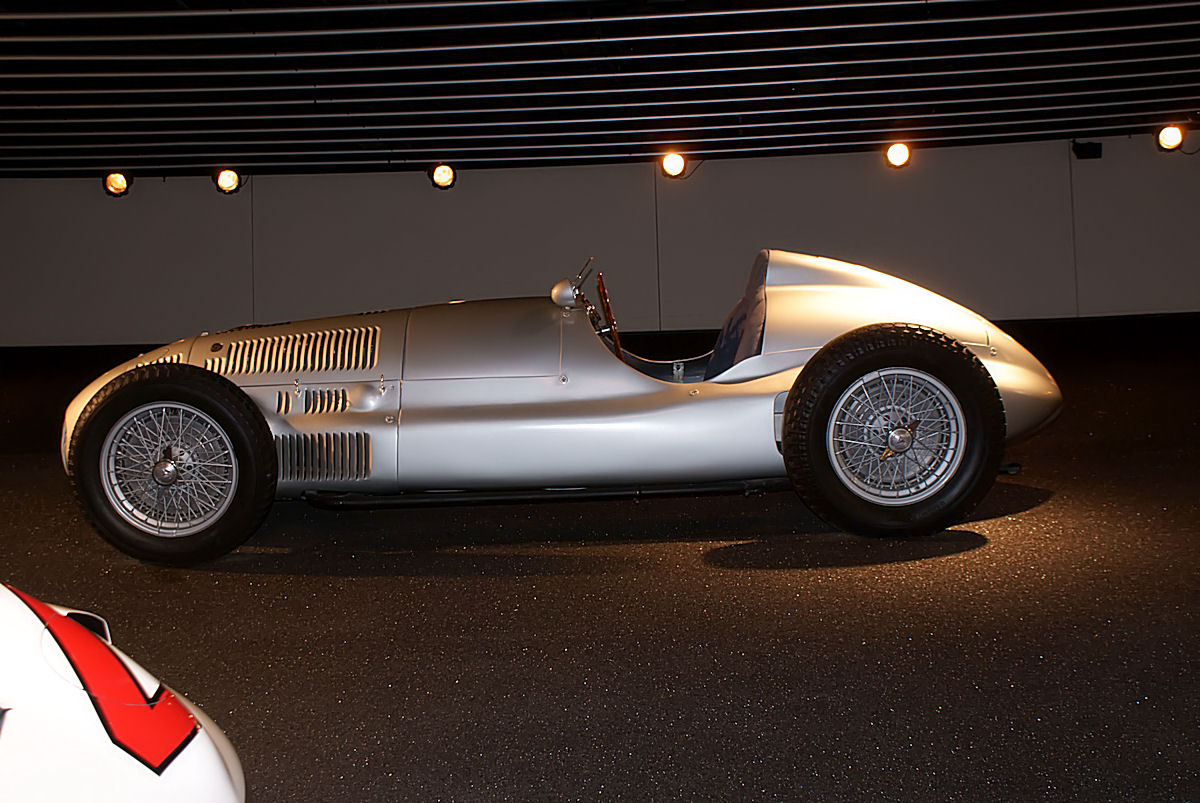
The Mercedes-Benz W165 looked like a 1939 W154 scaled down, but it had a new engine, the M 165 V8, in a chassis built to the W154's pattern, according to Mercedes-Benz Classic. The W165 was a front-engined single-seat racing car, a voiturette in the language of the day, and Motor Sport's race report described the two cars as "in external line and shape scaled down versions of their big Formula brothers".
The M 165 V8 engine
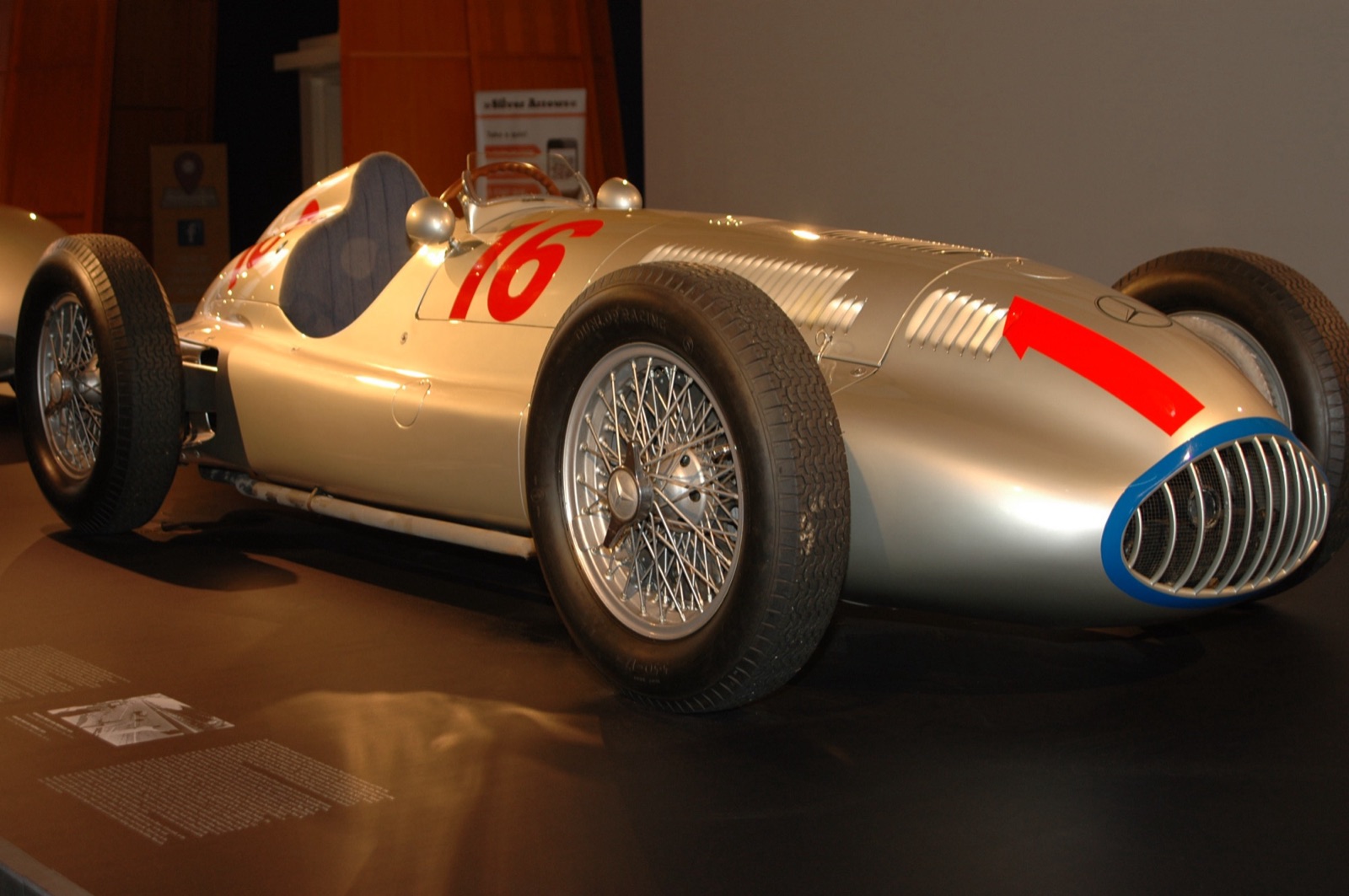
The M 165 was the first V8 in Daimler-Benz history, a 90-degree engine with its cylinders and heads welded together into one unit per bank and a welded-on water jacket of sheet steel, Mercedes-Benz Classic says. Two gear-driven overhead camshafts per bank worked four valves per cylinder. The bore and stroke of 64 mm by 58 mm were the company's first short-stroke dimensions: they left room for large valves and let the engine rev towards the 9,000 rpm it was designed for. The Mercedes-Benz press release for the 2012 Goodwood Revival (in Italian) adds that the right-hand bank sat 18 mm ahead of the left.
Time was short, so the engine kept single-stage supercharging. Mercedes-Benz Classic's account and its data sheet for the W 165 list two Roots superchargers, one for each bank, each with a Solex carburettor. Motor Sport's June 1939 report described "a single blower and two carburetters", and its review of 1½-litre racing, published in September 1940, a single Roots blower drawing from twin carburettors. The two-stage supercharger of the 1939 W154 and Bosch direct fuel injection were planned for later, the archive says.
Chassis, body and the offset engine
The frame was a cross-braced ladder of oval tubes, as on the W154, with the same type of suspension: coil springs and wishbones at the front and a de Dion axle on torsion bars at the rear. The wheelbase was 280 mm shorter than the W154's and the tracks 135 mm narrower at the front and 132 mm at the rear, which made the smaller frame much stiffer, Mercedes-Benz Classic says. The engine sat at six degrees to the car's centre line to fit, so the steering column, seat and windscreen moved to the right. The brakes were hydraulic, with 360 mm light-alloy drums (data sheet).
The fuel tanks were the main difference in the body. The W165 needed about 245 litres, against over 400 for the W154, so for Tripoli most of it went ahead of the rear axle and the tail could be short, according to the archive. Motor Sport described the same layout in "The trend of racing-car design" in February 1940: "central tanks on this car, around the scuttle". After Tripoli the car went back to a W154-style rear tank.
How the two Tripoli cars differed
The two W165s were not identical. Mercedes-Benz Classic says Caracciola's car had a shorter fifth gear, for a lower top speed, and an engine of 238 hp at 7,800 rpm, while Lang's engine gave 263.6 hp, about 26 hp more. Snellman has Caracciola's car set up for acceleration, with 15.5 mm torsion bars and quicker steering, and Lang's for top speed, with 16 mm bars and slower steering. Caracciola's had a thin white ring round the radiator and Lang's a dark ring, "possibly blue".
Mercedes W165 specifications
The Mercedes-Benz W165 had a 1,495 cc supercharged V8 of 254 hp at 8,000 rpm and a top speed of 272 km/h (169 mph), according to Mercedes-Benz Classic's data sheet.
| Item | W165 |
|---|---|
| Engine | M 165, 90-degree V8, front-mounted, lengthways |
| Bore and stroke | 64 mm x 58 mm |
| Capacity | 1,495 cc |
| Compression ratio | 6.5:1 |
| Valve gear | Two gear-driven overhead camshafts per bank, four valves per cylinder |
| Induction | Two Roots superchargers, two Solex carburettors |
| Power | 254 hp at 8,000 rpm (250 hp at 7,900 rpm) |
| Maximum engine speed | 9,000 rpm |
| Lubrication | Dry sump, with three pressure, four suction and two scavenging pumps |
| Gearbox | Five-speed, in unit with the differential below the rear axle |
| Frame | Oval-tube frame with five cross members |
| Front suspension | Double wishbones, coil springs, hydraulic dampers |
| Rear suspension | De Dion axle, longitudinal torsion bars, hydraulic dampers |
| Brakes | Hydraulic, drums of 360 mm front and rear |
| Tyres | 5.00 x 17 front, 7.00 x 17 rear |
| Wheelbase | 2,450 mm |
| Track, front and rear | 1,340 mm, 1,280 mm |
| Length, width, height | 3,680 mm, 1,510 mm, 850 mm |
| Vehicle weight | 700 kg |
| Fuel tank | 250 litres |
| Top speed | 272 km/h (169 mph) |
The archive's own history gives 605 kg and a 245-litre tank. Boddy gave the capacity as 1,490 cc and the weight as 17½ cwt with driver and fuel; Mike Lawrence, in "One race wonder" (Motor Sport, March 1995), gave 1,493 cc.
How much power did the W165 have?
Power figures for the W165 range from about 240 to 275 hp, and Mercedes-Benz's own two sources differ:
| Source | Power | Engine speed |
|---|---|---|
| Motor Sport race report, June 1939 | About 240 bhp, "reputed" | 9,000 rpm |
| Motor Sport, 1½-litre review, September 1940 | "At least 250 b.h.p." | Up to 10,000 rpm |
| Bill Boddy, Motor Sport, April 1950 | About 270 bhp | 7,800 rpm |
| Mike Lawrence, Motor Sport, March 1995 | 256 bhp | 8,000 rpm |
| Mercedes-Benz Classic data sheet | 254 hp (250 hp) | 8,000 rpm (7,900 rpm) |
| Mercedes-Benz Classic archive entry | 238 hp (Caracciola's car), 263.6 hp (Lang's) | 7,800 rpm (Caracciola's) |
| Andrew Frankel, Goodwood, July 2018 | 275 hp | Not given |
Lawrence also wrote that the engine had two-stage supercharging, which the archive says was put off to a later date.
How fast was the Mercedes W165?
The data sheet gives a top speed of 272 km/h, and Lang lapped the Mellaha circuit at 131.53 mph in the race, by Motor Sport's 1940 review; its Continental notes of June 1939 put his best at 130 mph. Snellman gives the lap as 3 min 43.77 sec, or 131.0 mph. Lang's race average of 122.9 mph was 4.55 mph below his winning speed in the three-litre W154 in 1938, the 1940 review noted.
The Mercedes W165 at the Tripoli Grand Prix
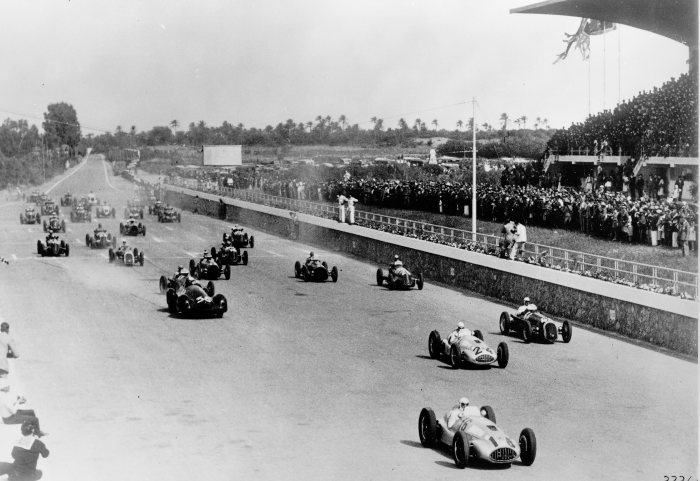
The Mercedes-Benz W165 raced once, in the Tripoli Grand Prix on the Mellaha circuit in Libya on Sunday 7 May 1939, and Lang and Caracciola finished first and second. The race ran over 30 laps of 13.1 km (8.14 miles), Snellman records.
Practice and the grid
The two Mercedes-Benz were, in Motor Sport's words, a "surprise entry". Thirty cars started: the two Mercedes-Benz, six Alfa Romeo 158s for Giuseppe Farina, Clemente Biondetti, Emilio Villoresi, Francesco Severi, Carlo Pintacuda and Giordano Aldrighetti, and 22 Maseratis, Motor Sport's June 1939 report said. Maserati's works drivers were Carlo Felice Trossi, Franco Cortese and Luigi Villoresi, whose fully streamlined 4CL was fastest in practice in 3 min 41.8 sec (134 mph). Lang lapped in 3 min 42.3 sec and Caracciola in 3 min 43.1 sec. Snellman's times show the works teams fastest in the first session, on the Thursday, with Lang quickest in 3 min 45.73 sec.
The Mercedes-Benz drivers were not getting on. On the Saturday, Snellman writes, Caracciola accused Neubauer of setting Lang up to beat him to the better grid place, and Lang's wife Lydia said she had forbidden her husband to race. The Daimler-Benz director Max Sailer talked Lang back into the car. Each driver thought the other had the advantage in car and tyres. Lang then set the day's fastest time and started second on the grid, which Snellman reconstructs as Farina, Caracciola, Lang and Luigi Villoresi on the front row.
The race
Air temperatures were around 40 degrees, Mercedes-Benz Classic says. Neubauer's plan, in Snellman's account, was for Lang to run flat out on scrubbed tyres to break the opposition while Caracciola took it easier on new ones. The start was to be given both by lights and by the flag of Marshal Balbo; Neubauer pointed Lang to the lights, and Lang was away before the flag fell. Alfa Corse protested and asked for a two-minute penalty.
Motor Sport's June 1939 report had all three works Maseratis out on the first lap: Luigi Villoresi's gearbox failed at the start, and Trossi and Cortese broke pistons. Snellman has Villoresi rejoining after seven laps of repairs, only to retire with a broken piston. After five laps Lang led Farina's Alfa Romeo by half a minute, with Caracciola close behind. Farina lasted ten laps. From then on, the report said, "the two silver German cars pulled steadily ahead". There were no major problems with the new cars, Mercedes-Benz Classic says, and the two Silver Arrows kept pulling away. Snellman writes that Lang came in first for the pit stops and, near the end, chose not to lap his team-mate; Lawrence wrote in 1995 that Lang ran the whole race without stopping.
Tripoli Grand Prix results
Lang won from Caracciola, with Emilio Villoresi's Alfa Romeo 158 third.
| Place | No. | Driver | Car | Time or gap | Average |
|---|---|---|---|---|---|
| 1 | 16 | Hermann Lang | Mercedes-Benz W165 | 1 hr 59 min 12.36 sec | 122.9 mph |
| 2 | 24 | Rudolf Caracciola | Mercedes-Benz W165 | 3 min 37.28 sec behind | 119.2 mph |
| 3 | 48 | Emilio Villoresi | Alfa Romeo 158 | 4 min 10.36 sec behind Caracciola | 115.3 mph |
Times and averages from Motor Sport's 1940 review; car numbers from Snellman; Lang's number and time also from the Motor Sport database. The 1940 review printed Villoresi's car as a Maserati; the June 1939 report, Mercedes-Benz Classic and Snellman have him in an Alfa Romeo 158, the only Alfa to finish. Maseratis filled the next seven places, by the 1940 review.
It was Lang's third Tripoli win in a row. "So the Germans did it after all!", Motor Sport's June 1939 report began. It called the result "just about as convincing a victory as one is likely to see in any motor-race": a new car averaging 123 mph for two hours "in that blazing sun" had "stamina in plenty".
Who drove the Mercedes W165?
Hermann Lang and Rudolf Caracciola were the only drivers to race the Mercedes-Benz W165, with Alfred Neubauer managing the team at Tripoli. Lang drove number 16 and Caracciola number 24, Snellman records. Max Sailer, the director whose engineers designed the M 165 according to the 2012 Revival release, was there to settle the drivers' quarrel.
Hermann Lang
Lang had been a mechanic in the Mercedes-Benz racing department before he became a driver, Lawrence wrote. In his account one of the two W165s had slightly better gear ratios and Caracciola took it as team leader, while Lang, made the "hare" to break the opposition, was "a very angry man indeed". Lang later worked as a consultant to the Mercedes-Benz museum until his death in 1987, at 78.
Rudolf Caracciola
Caracciola lived in Lugano, and the W165's later history runs through him. In July 1941 he asked Daimler-Benz to give him one of the cars instead of his retirement pay, Mercedes-Benz Classic says, and in 1946 he tried to take one to Indianapolis. Lawrence wrote that by 1939 Caracciola's career "was on the wane" while Lang was "on the verge of greatness".
The W165 after Tripoli: Switzerland, Indianapolis and Formula 1
The Mercedes-Benz W165 never raced again: Daimler-Benz kept it for 1½-litre races, the war stopped its development, and plans to race it at Indianapolis in 1946 and in the Formula 1 of 1951 both came to nothing.
Kept for 1½-litre races
Mercedes-Benz would not send its 1,500 cc cars to any race where its three-litre cars were due, Motor Sport's Continental notes of June 1939 reported, so it declined the Nuffield Trophy at Donington by telegram. The cars were demonstrated at the Nürburgring during the Eifelrennen meeting but did not compete again, "being retained for purely 1½-litre contests", Motor Sport wrote in its February 1940 article. The same article expected 1½-litre cars to govern international racing from 1940. Mercedes-Benz Classic says development went on after Tripoli, with work on supercharging, fuel mixture and a record car planned, until it stopped in 1940 because of the war.
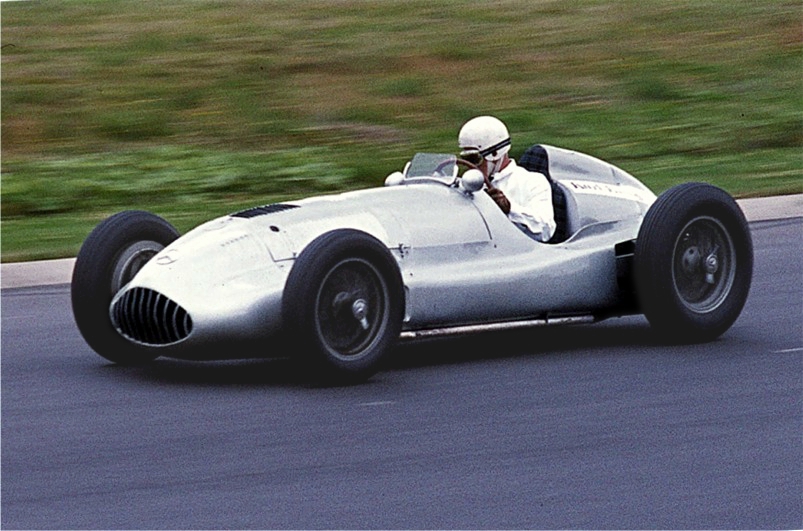
Caracciola, Switzerland and the Indianapolis 500
At the end of April 1945 the two W165s were taken by lorry from their hiding place near Dresden to Switzerland, where the authorities seized them at the Swiss Mercedes-Benz importer as German property, according to Mercedes-Benz Classic. The American Pete DePaolo, the 1925 Indianapolis 500 winner, then stationed in Switzerland, pressed for Caracciola to drive one in the 500 on 30 May 1946. One car was repaired with parts from the other and from the factory, a crate was made for 1,200 francs, and the Zurich police closed a suburban street for Caracciola to test it. The Allied Control Council's permit was refused at the last moment.
Caracciola went to Indianapolis anyway, drove one of Joel Thorne's Thorne Engineering Specials in qualifying, crashed and was thrown out of the car, the archive says. Tony Watson, in Motor Sport in February 2005, put the failure of the W165 plan down to "red tape". Lawrence wrote that it was two years before Caracciola "could walk and speak properly".
The Zurich court case and the sale
In 1948 the Swiss Clearing House sued in the Zurich District Court to settle who owned the cars. The court first found for Caracciola, to whom the Daimler-Benz chairman Wilhelm Kissel had promised them by word of mouth; on appeal, the importer was ordered to hand them over as German property, Mercedes-Benz Classic says. In 1950 the Swiss authorities advertised the two cars for sale to the highest bidder, and the Swiss Mercedes-Benz sales company made the highest bid, so the cars "could be returned to their place of origin".
The plan for five new W165s
The Grand Prix formula from 1947 allowed 1.5-litre supercharged engines, and on 15 June 1951 the Daimler-Benz board resolved to build five W165 racing cars and five more engines, the archive says. After watching the German Grand Prix at the Nürburgring on 29 July 1951, Neubauer wrote that the W165 "promises equivalence at best, but not superiority". The W165 was replaced by the W195, a 1.5-litre supercharged V12 design, and the chief technical officer, Nallinger, stopped work on that on 22 September 1951, because no one knew how long the formula would last.
How many Mercedes W165s were built, and where are they now?
Two Mercedes-Benz W165s were built and raced in 1939, and both belong to Mercedes-Benz: Lang's winning car is on display in the Mercedes-Benz Museum in Stuttgart, and Caracciola's is used at exhibitions and driving events, according to Mercedes-Benz Classic. Daimler-Benz had ordered three cars and three engines in September 1938, by Snellman's account. Andrew Frankel wrote in Motor Sport in September 2011 that four chassis numbers were issued and that a third car may have been built as a streamliner, its whereabouts unknown.
The sources disagree on which car is which. Frankel drove the running car at the Goodwood Festival of Speed in 2011. In a Goodwood column of 20 July 2018 he wrote that the museum has the other car and that "the winning car" is the one that works. He added that its engine had been checked over the years but never rebuilt, so "every internal component" is the one that took Lang to the finish at Tripoli.
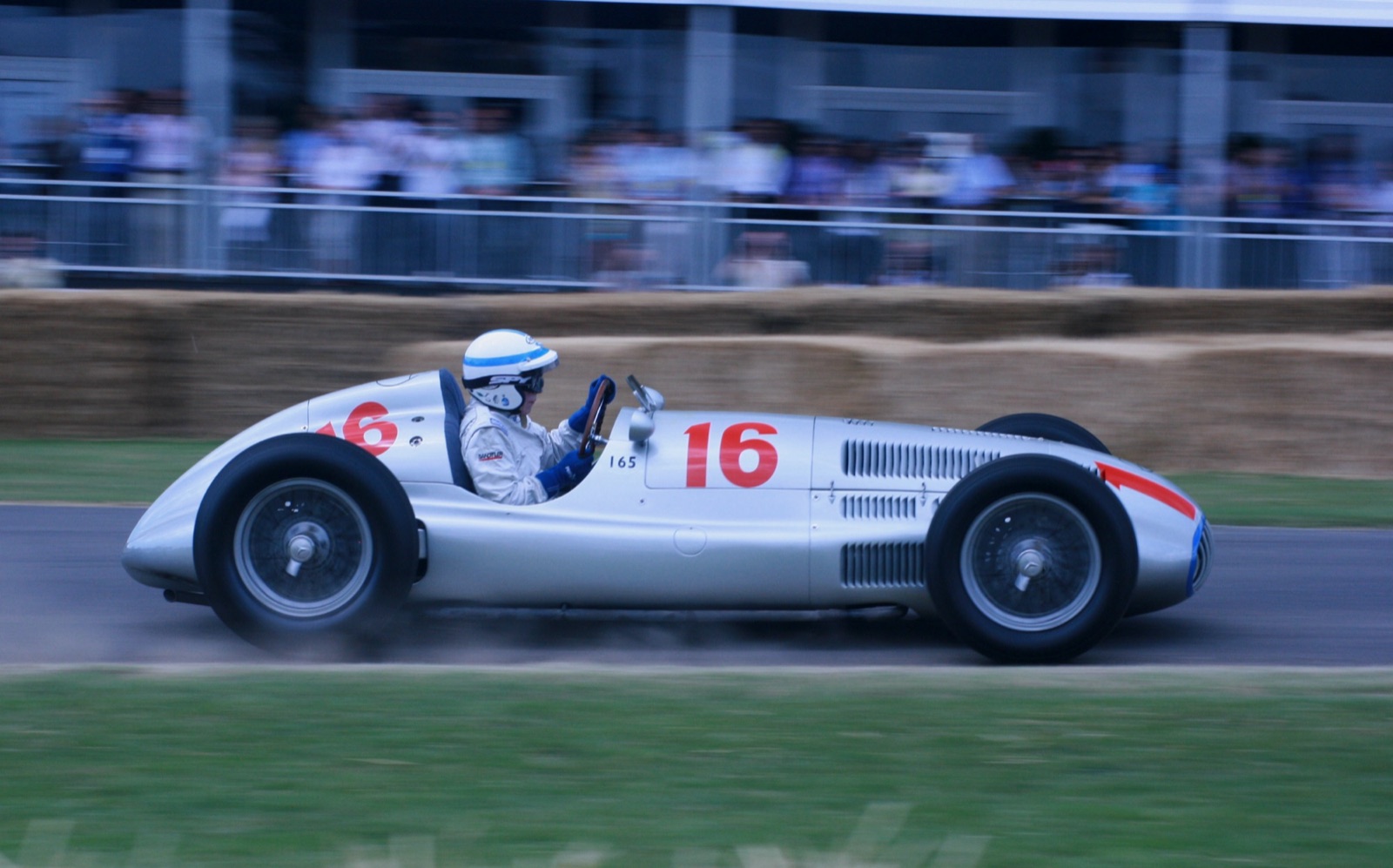
The W165 at Goodwood and on show
A W165 ran at the Goodwood Festival of Speed in June 1995, which Lawrence called only the second time the model had "competed in an event". Mercedes-Benz took a W165 to the Goodwood Revival in September 2012 with a W25, a W125 and a W154, four Silver Arrows that its press release said had always belonged to the company. Its drivers there included Jochen Mass and Jackie Stewart, and the four ran alongside Auto Unions from Audi Tradition. The Louwman Museum in The Hague then showed the W165 with other Silver Arrows lent from the Mercedes-Benz Museum's permanent collection, from 11 October 2012 to 6 January 2013.
Has a Mercedes W165 ever been sold?
The Swiss authorities sold both Mercedes-Benz W165s in 1950, to the highest bidder, the Swiss Mercedes-Benz sales company, and Mercedes-Benz Classic says the two cars have been in the company's collection since. Frankel wrote in 2011 that he would not "hazard a guess at the car's value because it cannot be realistically determined".
Rivals, predecessor and successor
Alfa Romeo and Maserati were the W165's rivals at Tripoli, and the car came from the same line as the three-litre W154. In the 1939 season Mercedes-Benz scored one first and one second in 1½-litre racing, against Maserati's five wins and Alfa Romeo's three, Motor Sport's 1940 review counted.
Alfa Romeo 158
The 158's straight-eight had a single Roots blower and gave 195 to 210 bhp at 7,000 rpm, by the 1940 review. Only one of the six 158s finished at Tripoli, and the June 1939 Continental notes judged that "the Alfettes simply lacked the necessary speed". When Tripoli was run again on 12 May 1940, without Mercedes-Benz, Farina won in a 158 at 128.14 mph, 5.24 mph faster than Lang's average, and his fastest lap was 1.02 mph quicker than Lang's (1940 review).
Maserati 4CL and ERA
Maserati's new 4CL had a four-cylinder, 16-valve engine of 200 bhp at 7,000 rpm, the 1940 review recorded. ERA did not race at Tripoli; its new six-cylinder car of 1939 gave 220 to 250 bhp, and the June 1939 Continental notes thought the new ERAs, well prepared, could be "a match for the Mercedes".
Auto Union
Auto Union had no 1.5-litre car. Its 1939 car was the three-litre Type D, and Motor Sport reported only "talk of a 1½-litre Auto-Union" in February 1940.
From the W125 and W154 to the W195
The W165 took its frame and suspension layout from the W154, according to the 2012 Revival release. A Mercedes-Benz release of 10 May 2012 on the W 125 says the engineer Max Wagner had carried the W125's frame design over to the W154. The W125 was the first car of the independent racing department under Rudolf Uhlenhaut described in Mercedes-Benz Classic's entry for the W 125. Its intended successor, the W195 V12 of 1951, was stopped before it was built. In Daimler-Benz type numbers W stands for Wagen (car) and M for Motor, Denis Jenkinson explained in Motor Sport in August 1968, so the W165 car had the M 165 engine.
Questions and answers
What does W165 stand for?
In Daimler-Benz type numbers W stands for Wagen (car) and M for Motor, as Denis Jenkinson explained in Motor Sport in August 1968, so the W165 car had the M 165 engine. Mercedes-Benz Classic's data sheet gives the engine type as M 165.
Was the Mercedes W165 a Formula 1 car?
No. It was built for the 1½-litre voiturette class, which Mike Lawrence called the Formula Two of its day. The Grand Prix formula of 1947 admitted 1.5-litre supercharged engines, and Daimler-Benz resolved in June 1951 to build five new W165s for it, but dropped the plan that summer, according to Mercedes-Benz Classic.
How much did the Mercedes W165 weigh?
Mercedes-Benz Classic's history gives 605 kg, about 250 kg less than the W154, while its data sheet gives a vehicle weight of 700 kg. Bill Boddy wrote in Motor Sport in 1950 that it weighed 17½ cwt with driver and fuel.
What fuel did the Mercedes W165 run on?
A racing mixture of nitro-methanol, methanol, ether and water, Andrew Frankel wrote for Goodwood in 2018. Mercedes-Benz Classic's data sheet gives a fuel consumption of 137 litres and a 250-litre tank.
Where was the Mellaha circuit?
Outside Tripoli, in Libya, on public roads round the Mellaha salt lake. Denis Jenkinson gave its length as 13.1 km (8.14 miles) in Motor Sport in March 1978 and wrote that the last race there was run in 1940.
Sources
- Mercedes-Benz Classic, "Mercedes-Benz W 165 racing car, 1939", archive entry (undated, read 31 October 2026): the Tripoli rule change, the build, the M 165 engine, the two cars' outputs, the race, the 1941–51 history, where the cars are now.
- Mercedes-Benz Classic, W 165 technical data (read 31 October 2026): the specification table.
- Mercedes-Benz Classic, "Mercedes-Benz Grand Prix racing car W 125, 1937", archive entry: Uhlenhaut's racing department.
- Mercedes-Benz, press release (in Italian), "Goodwood Revival 2012", 13 September 2012: less than eight months, Max Sailer, the 18 mm bank offset, the cars at the Revival.
- Mercedes-Benz, press release (in Italian) on the W 125 at Goodwood, 10 May 2012: Max Wagner and the W125 frame design.
- Motor Sport, "Continental notes and news", May 1939 (before the race): the 1,500 cc limit.
- Motor Sport, "New Mercedes wins Tripoli", June 1939: earlier winners, the field, practice times, the race, the verdict.
- Motor Sport, "Continental notes and news", June 1939: the two-month claim, the 1,500 cc policy, Donington, Lang's best lap, Maserati and ERA.
- Motor Sport, "The trend of racing-car design", February 1940: the Nürburgring demonstration, the expected formula, the fuel tanks, Auto Union.
- Motor Sport, "1½-litre racing from 1935", September 1940: race times and averages, fastest lap, the rivals' engines, the 1939 score, Tripoli 1940.
- Bill Boddy, "A remarkable debut", Motor Sport, April 1950: four to six months, 270 bhp, 1,490 cc, the weight.
- Denis Jenkinson, "Letter from Europe", Motor Sport, August 1968: the W and M type letters.
- Denis Jenkinson, "Tripoli: a dip into the past", Motor Sport, March 1978: the lottery and the 30-car field.
- Mike Lawrence, "One race wonder", Motor Sport, March 1995: Lang and Caracciola, the cars' gearing, Goodwood 1995, 256 bhp.
- Tony Watson, "Temporada hitch", Motor Sport, February 2005: the 1946 Indianapolis plan.
- Andrew Frankel, "Small point, well made: Mercedes W165", Motor Sport, September 2011: four chassis numbers, the possible third car, the value.
- Andrew Frankel, "Thank Frankel it's Friday: A 1.5-litre car is the best I've ever driven at FOS", Goodwood, 20 July 2018: which car runs, the unrebuilt engine, 275 hp.
- Leif Snellman, "XIII Gran Premio di Tripoli: Mercedes' greatest surprise", The Golden Era of GP Racing (read 31 October 2026): the build order, the two cars' set-up, practice, the start, the result and car numbers.
- Motor Sport database, 1939 Tripoli Grand Prix: date, Lang's number and time.
- Louwman Museum, "Silver Arrows 1934-1939" (read 31 October 2026): the exhibition of 2012–13.