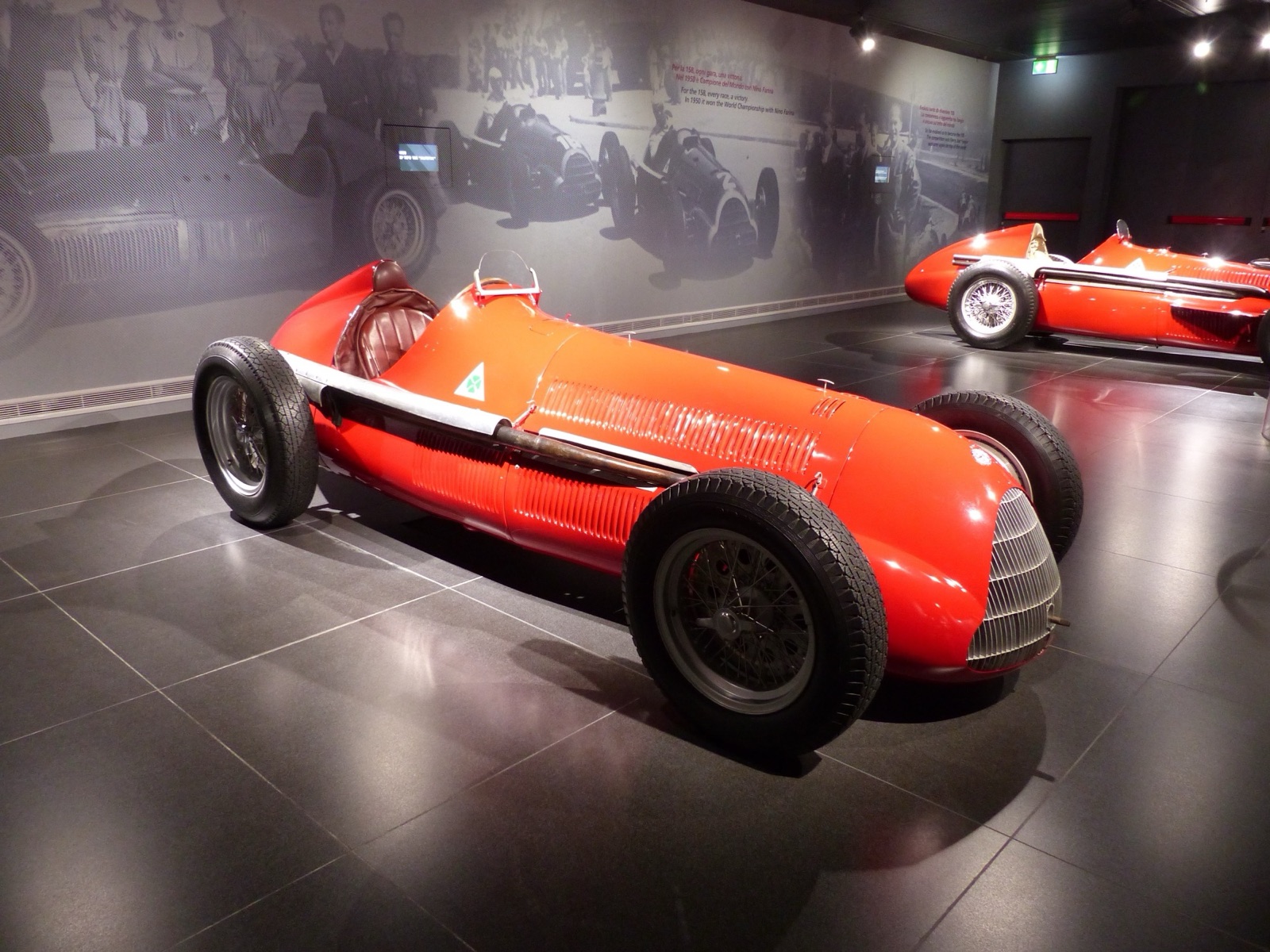
The Alfa Romeo 158, the Alfetta, is the supercharged 1.5-litre single-seat racing car Gioachino Colombo designed in 1937 and 1938 for voiturette racing, the class below the Grand Prix formula. After the war the Alfa Romeo 158 raced as a Grand Prix car. It won its first race, at Livorno in August 1938, with about 195 bhp from its straight-eight, and by 1951 the same engine gave 425 bhp, by Doug Nye's figures in Motor Sport in December 2019. Kept hidden through the war, the cars won all eleven races Alfa Romeo entered in 1950, according to the Museo Storico Alfa Romeo, including the first Formula 1 World Championship race. Giuseppe Farina took that title, and Juan Manuel Fangio the 1951 title in the developed 159.
Who designed the Alfa Romeo 158, and why?
The Alfa Romeo 158 was designed by Gioachino Colombo, Vittorio Jano's deputy at Alfa Romeo, working at Enzo Ferrari's Scuderia Ferrari in Modena from 1937. It was built to race in the 1.5-litre voiturette class, where the German Grand Prix teams did not then race. The idea was Ferrari's, by the account the Alfa Romeo test driver and later team manager Giovanni Battista Guidotti gave Nye. After Nuvolari finished second to the Germans at the 1936 Italian Grand Prix, Ferrari told Jano and Guidotti: "We cannot match their money and effort in the Grand Prix class. We should build a 1500 to race Maserati's four-cylinder, which is winning the class. We can beat them, and there will be no Germans!"
Voiturette racing and the 1.5-litre class
The voiturette formula's rules allowed racing cars of up to 1.5 litres, run alongside the Grand Prix formula, Denis Jenkinson wrote in Motor Sport in August 1990. Before the 158 it belonged to Maserati and ERA; he called that racing "fairly amateurish" and the 158 a "mini-Grand Prix car" built to represent the factory. Italy then decided to run all its own races for voiturettes in 1939, by decree of the Italian federation, Jenkinson added. Motor Sport's Continental notes of May 1939 put it more sharply: the Italians had limited the Tripoli Grand Prix to 1,500 cc "so as to break the run of German victories in their great race". Stellantis Heritage, the historic department of Alfa Romeo's parent company, says in its history of the GP Tipo 158 that the class "was to become the leading class from 1940".
Colombo, Enzo Ferrari and Alfa Corse
Alfa Romeo bought 80 per cent of Scuderia Ferrari in March 1937, Paul Fearnley wrote in Motor Sport in February 2014, and Colombo, "tutored, frustrated and eventually sidelined by Jano", moved to Modena as part of the deal. Colombo proposed a rear-engined car; Ferrari overruled him and otherwise left him a free hand. Alfa Romeo then bought out the Scuderia, staff, equipment and the unfinished Alfetta, and Scuderia Ferrari ceased to exist on 1 January 1938, Fearnley wrote. Ferrari became manager of the re-formed works team, Alfa Corse, fell out with Alfa Romeo's new chief designer Wifredo Ricart, and was sacked in 1939.
Nye dates Colombo's move to May 1937. He adds that the design office at Portello was then drawing the Tipo 316, a 3-litre V16 for the 1938 Grand Prix formula, so "it was logical to design a potent 1500 from one bank of that 3-litre GP engine". Guidotti told him that four cars were built at Modena and "virtually completed in every detail there" before the team moved to Alfa Romeo's Portello works in Milan. Stellantis Heritage's account differs from Fearnley's: after "parting ways with Enzo Ferrari", Portello founded its own racing department, Alfa Corse, and a team "led by Gioachino Colombo" drew the car.
Why is it called the Alfa Romeo 158 and the Alfetta?
The number is the engine: 15 for 1.5 litres and 8 for eight cylinders, Jenkinson explained, adding that the later name 159 "did not mean 1.5-litre 9 cylinder" but marked further development. The designer's name is spelt Gioachino Colombo by Stellantis Heritage and Keith Howard, and Gioacchino Colombo by Andrew Frankel and the Motor Sport database. Alfetta means "little Alfa"; Stellantis Heritage says the car was "soon to be nicknamed the Alfetta", and Motor Sport's review of the 1½-litre seasons, published in September 1940, wrote of "the amazing Alfettes, as the 1½-litre Alfa-Romeos became known".
Alfa Romeo 158 design and engineering
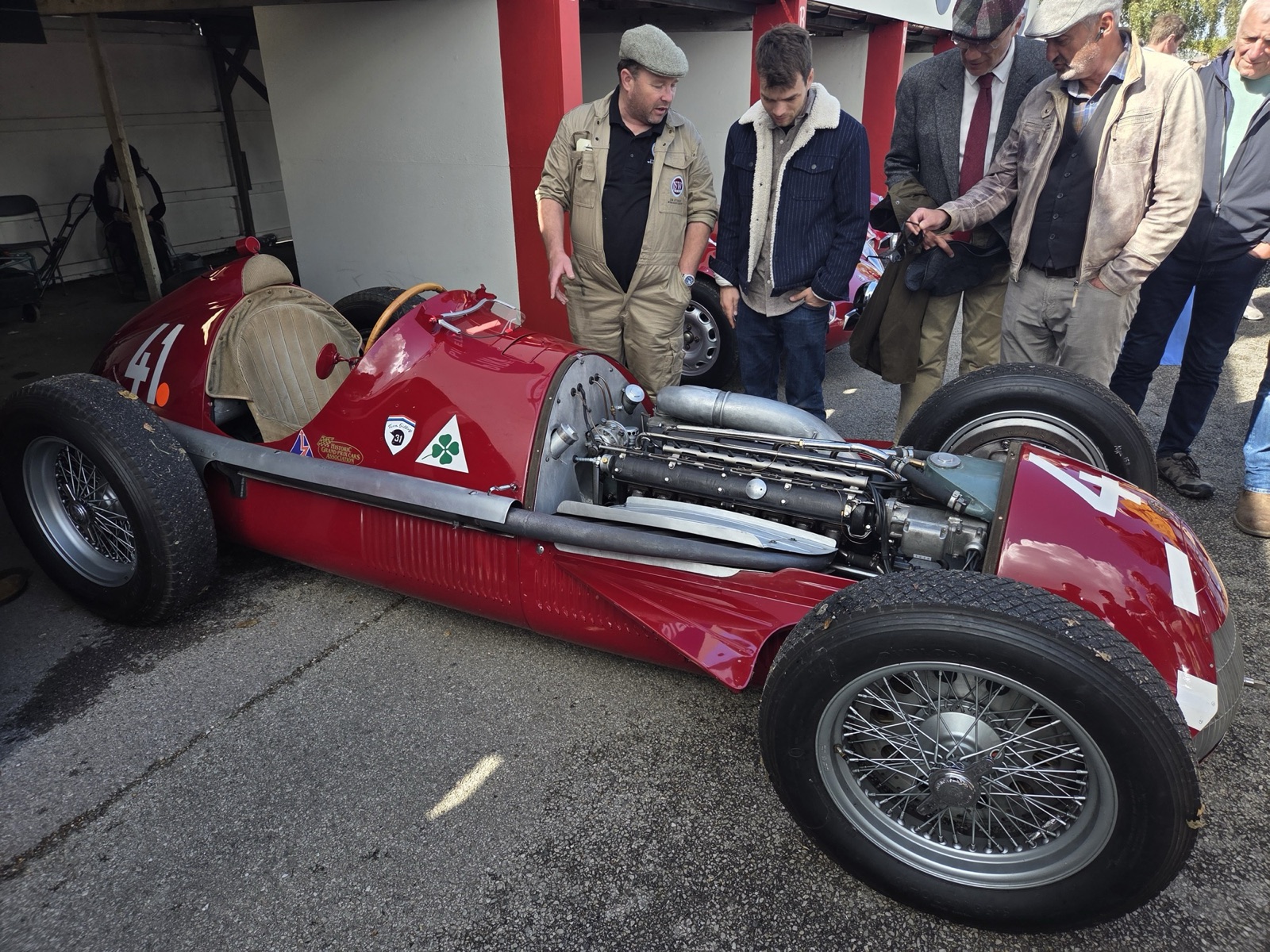
The Alfa Romeo 158 has a supercharged straight-eight of 1,479 cc mounted in front of the driver, with its four-speed gearbox in unit with the differential at the back "for perfect weight distribution", according to Stellantis Heritage. Nye describes a twin-tube steel chassis, and Guidotti told him the car had "50/50 weight distribution on half-full tanks".
The straight-eight engine and its superchargers
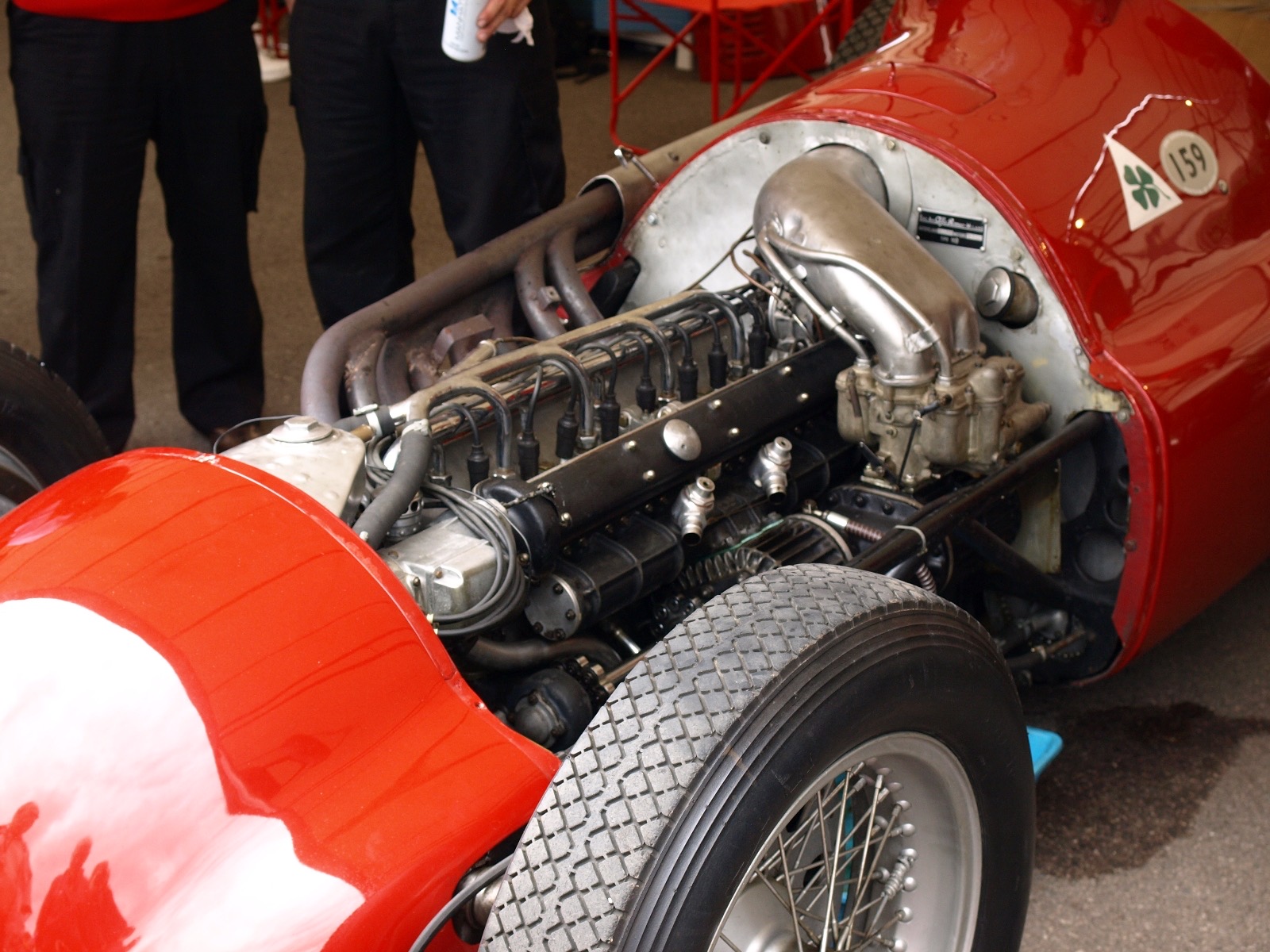
In Nye's account, Colombo drew two aluminium cylinder blocks, with a 58 mm bore and 70 mm stroke, on an Elektron alloy crankcase with steel liners. The crankshaft ran in eight main bearings and a ninth subsidiary one, lubrication was dry sump, and the gear train to the twin overhead camshafts moved from the back of the Tipo 316's engine to the front of the 158's. A single-stage Roots supercharger boosted at 17.6 psi to begin with. The engine gave 180 bhp at 6,500 rpm in testing at Modena and 195 bhp at 7,000 rpm by its first race. Stellantis Heritage adds the screw-in steel liners and the "cascade of gears" to the camshafts, and the museum's 2019 data gives two valves per cylinder.
The power came from ever larger superchargers. Two-stage supercharging, which worked on Ricart's rear-engined flat-12 Tipo 512 during the war, was fitted to two 158s for the Grand Prix des Nations at Geneva in 1946, Nye wrote. By 1951 the boost was 42.6 psi, with the superchargers absorbing "eventually some 135bhp"; Stellantis Heritage describes the 159's two compressors as "arranged in series". Jenkinson gave the same rise in boost, from 17.6 to 42.6 psi, "principally through the use of two-stage compressors". The restorer Tony Merrick, who prepared Carlo Vögele's car, told Keith Howard in Motor Sport in July 2003 that the triple-choke Weber carburettor "was designed for the car".
Chassis, suspension and brakes
The frame is a ladder of two elliptical main tubes "only 360mm apart", stiff because the engine and transaxle are stressed members with 20 mounting bolts each, Merrick said in 2003; later cars had extra tubes to stiffen it. Front suspension was by trailing arms and a transverse leaf spring, and the rear by swing axles, also on a transverse leaf, Andrew Frankel wrote in Motor Sport in November 2010; the trailing arms are Nye's. The 158 has telescopic as well as friction dampers at both ends, Merrick said; in Guidotti's words the telescopic dampers "braked the big suspension movements while friction dampers braked the little ones". Guidotti called the suspension "Colombo's masterpiece": the leaf springs were soft on the straight, and as the car rolled into a corner, bump rubbers met the spring and shortened its working length. The brakes are drums, aluminium with cast-iron inserts and twin leading shoes, larger at the front, though later cars had them all the same size (Merrick).
Gearbox, fuel tanks and cockpit
The four-speed gearbox is compact, its gear cluster "just 5in long", with first and second on the layshaft and third and fourth on the main shaft, Merrick said. The first cars carried "just" a 37.5-gallon tank in the tail, which later grew and was joined by side and scuttle tanks (Nye). In the 159 the tank by the driver's right knee went from 7.7 to 16.5 gallons, for a total "just a smidgeon short of 50 gallons", Frankel found when he drove chassis 159/111. The driver sits among the tanks, with fuel behind and to the right and oil to the left, the gear lever by his left thigh and the accelerator in the middle of the three pedals.
What is the Alfa Romeo 158 like to drive?
The Alfa Romeo 158 was "beautifully balanced" with "a big steering wheel with low ratio making them light to handle even with fuel tanks full", the works test driver Consalvo Sanesi told Nye, and Guidotti said it had "basic understeer". Merrick called Vögele's 159 "one of the most comfortable grand prix cars I've ever sat in", and compared its seat with a Mercedes-Benz W125's, which was "bolt upright, whereas the Alfa's is nicely angled". Frankel drove 159/111 on the Balocco test track to 8,500 rpm and found the gearbox better than he had hoped and the brakes "considerably worse". He wrote: "it is the spread of torque I'll remember more: any speed, any gear, it goes." Guido Moroni, who drove the museum's running 159 into the 1980s, told Nye: "You have to be light and smooth on the throttle to get the best from it."
Alfa Romeo 158 specifications
The Alfa Romeo 158 kept its 58 × 70 mm, 1,479 cc straight-eight from 1938 to 1951 while its power rose from about 195 bhp to 425 bhp; the sources give different figures for each stage, set out below.
| 158, 1938 | 158, 1939–40 | 158/47, 1947–48 | 158, 1950 | 159, 1951 | |
|---|---|---|---|---|---|
| Engine | Straight-eight, two light-alloy blocks with steel liners, two overhead camshafts driven by gears, two valves per cylinder, front-mounted (Stellantis Heritage; Museo Storico Alfa Romeo) | ||||
| Bore × stroke, capacity | 58 × 70 mm, 1,479 cc (Stamer, 1961; Museo Storico Alfa Romeo, 2019) | ||||
| Supercharging | Single-stage Roots, 17.6 psi (Nye) | Single-stage Roots (Nye) | Two-stage, enlarged low-pressure blower (Nye) | Two-stage (Stellantis Heritage) | Two-stage, two compressors in series, 42.6 psi (Stellantis Heritage; Nye) |
| Power | 195 bhp at 7,000 rpm (Nye); 190 bhp at 6,500 rpm (Stamer) | 225 bhp at 7,500 rpm (Nye; Stamer; Stellantis Heritage) | 310 bhp at 7,500 rpm on the test bed (Nye); 275 hp "during the early postwar period" (Stellantis Heritage) | 350 hp at 8,500 rpm (Museo Storico); 340 hp at 8,000 rpm (Stellantis Heritage) | 425 hp at 9,300 rpm (Museo Storico; Stellantis Heritage); 420 bhp at 9,300 rpm (Howard) |
| Top speed | About 140 mph (Motor Sport, May 1939) | 232 km/h (Stellantis Heritage) | 270 km/h, early post-war (Stellantis Heritage) | 290 km/h (Stellantis Heritage; Museo Storico) | 305 km/h (Museo Storico); over 290 km/h (Stellantis Heritage) |
| Gearbox | Four speeds, in unit with the differential at the rear (Stellantis Heritage; Howard) | ||||
| Front suspension | Trailing arms, transverse leaf spring, hydraulic and friction dampers (Nye; Museo Storico); on the 1939 cars Motor Sport described swinging links and transverse torsion bars (September 1940) | ||||
| Rear suspension | Swing axles, transverse leaf spring (Frankel; Howard) | De Dion tube, transverse leaf spring (Museo Storico; Stellantis Heritage); swing axles on three of the four 159s, by Howard | |||
| Brakes | Drums, aluminium with cast-iron inserts, twin leading shoes (Howard, on Vögele's car) | ||||
| Weight | 700 kg (Stellantis Heritage) | 710 kg (Museo Storico); 620 kg (Stellantis Heritage) | |||
| Fuel tanks | 37.5 gallons, in the tail (Nye) | Side and scuttle tanks added (Nye) | Just short of 50 gallons in all (Frankel) | ||
Sources: Stellantis Heritage's 158 and 159 histories; the Museo Storico Alfa Romeo's note of 10 July 2019; Sir Anthony Stamer, Motor Sport, December 1961; Nye, Motor Sport, December 2019; Howard, Motor Sport, July 2003; Frankel, Motor Sport, November 2010.
How much horsepower did the Alfa Romeo 158 have?
The Alfa Romeo 158 had about 195 bhp in 1938 and, as the 159, 425 bhp at 9,300 rpm in 1951, by the figures Nye and Stellantis Heritage share; the table gives each stage between. Motor Sport's 1940 review credited the early cars with more: 200 bhp at 8,000 rpm in 1938 and 195–210 bhp at 7,000 rpm in 1939. Merrick saw "something around 400bhp at 8500" on his dynamometer from Vögele's engine, which he did not rev to 9,300. The museum adds peaks of 450 hp, which Frankel says came at 10,500 rpm and were "never officially raced"; Nye wrote that the 1951 engines were run to 10,500 rpm on the bench and to a race limit of 8,500–9,000.
How fast was the Alfa Romeo 158?
The Alfa Romeo 158 reached 290 km/h (180 mph) in its 1950 form, by Stellantis Heritage and the museum, and the 159 305 km/h by the museum's figure. At Silverstone in May 1950 the 158s "reached over 150 mph on the straights", Motor Sport reported. Guidotti told Nye that at the 1951 Spanish Grand Prix, "on the main straight there, I saw 310kph", or 192 mph. In the 1938 Coppa Acerbo Francesco Severi's 158 was timed at 139.53 mph over the kilometre (Motor Sport, September 1940).
How much fuel did the Alfa Romeo 158 use?
The Alfa Romeo 158's fuel consumption rose with its power, and by 1951 the engine, as the 159, did about 1.6 miles to the gallon. Nye, Frankel and the Motor Sport database's account of the 1951 season all give that figure, which meant two or more fuel stops in a Grand Prix. Merrick put Vögele's car, running on methanol, at "about a mile to the gallon".
Alfa Romeo 158 versions, from the 158 to the 159
The Alfa Romeo 158 was developed in stages, each version a set of changes to the first, as Nye sets them out. The 1939 cars had new bearings and bodies, two-stage supercharging came in 1946, the 158/47 engine in 1948, and the 159, with more boost and de Dion rear suspension, in 1950–51.
158C and 158D, 1939–40
Bearings were the 158's weakness in 1938, Nye records, so for 1939 it had needle-roller big ends and better oil feeds to the main bearings, and after Tripoli new cooling and lubrication and bodies "to virtually their final form". Motor Sport's 1940 review noted new front suspension "by swinging links controlled by transverse torsion bars". In Nye's account the 1939 cars appear in some records as the 158C; six new cars were built for 1940, and a seventh, with experimental de Dion rear suspension, was the 158D. Howard wrote that the head test driver Attilio Marinoni was killed in the 158D in an accident on the autostrada in 1940.
158/46B and 158/47: two-stage supercharging
Nye calls the two 158s fitted with the two-stage system for the 1946 Grand Prix des Nations, for Farina and Achille Varzi, 158/46Bs. Motor Sport's report, "Form on the Continent" in September 1946, said Farina won "assisted, of course, by having a two-stage-blower Alfette, whereas Trossi had one of the less-young cars". The 158/47, in Nye's account, had an enlarged low-pressure supercharger and gave 310 bhp at 7,500 rpm on the test bed. It cracked the Elektron crankcases around the main bearings, whose caps were then braced to the blocks with tie-rods, and it first raced at the 1948 Italian Grand Prix, which Wimille won.
The Alfa Romeo 159 of 1950–51
The 159 is the 158 with modifications: larger superchargers, more boost and fuel, stronger brakes and transmission, and a de Dion rear axle in place of the swing axles. Stellantis Heritage, in its history of the GP Tipo 159, calls the de Dion axle the "only conspicuous difference compared to the 158", and the museum lists four 159s, all modified 158s. Howard, though, wrote that Vögele's 159 had de Dion rear suspension and "the other three had swing axles". When the first 159 raced is less clear. The Motor Sport database gives Farina a 159 at the 1950 Italian Grand Prix and lists Fangio's two cars there as 158s; Stellantis Heritage says Farina and Fangio both drove "the new 159". Guidotti told Nye that "il vero 159", the true 159, first raced at the German Grand Prix in July 1951, Frankel reported. The true 159s had extra tubes to stiffen the frames, and the Alfa Romeo archivist Luigi Fusi classified them as 159M, for maggiorata, "increased" (Nye). Frankel wrote that "some updated 158s were referred to informally or otherwise as 159s" and that no definitive record shows which chassis did what.
Alfa Romeo 158 racing history
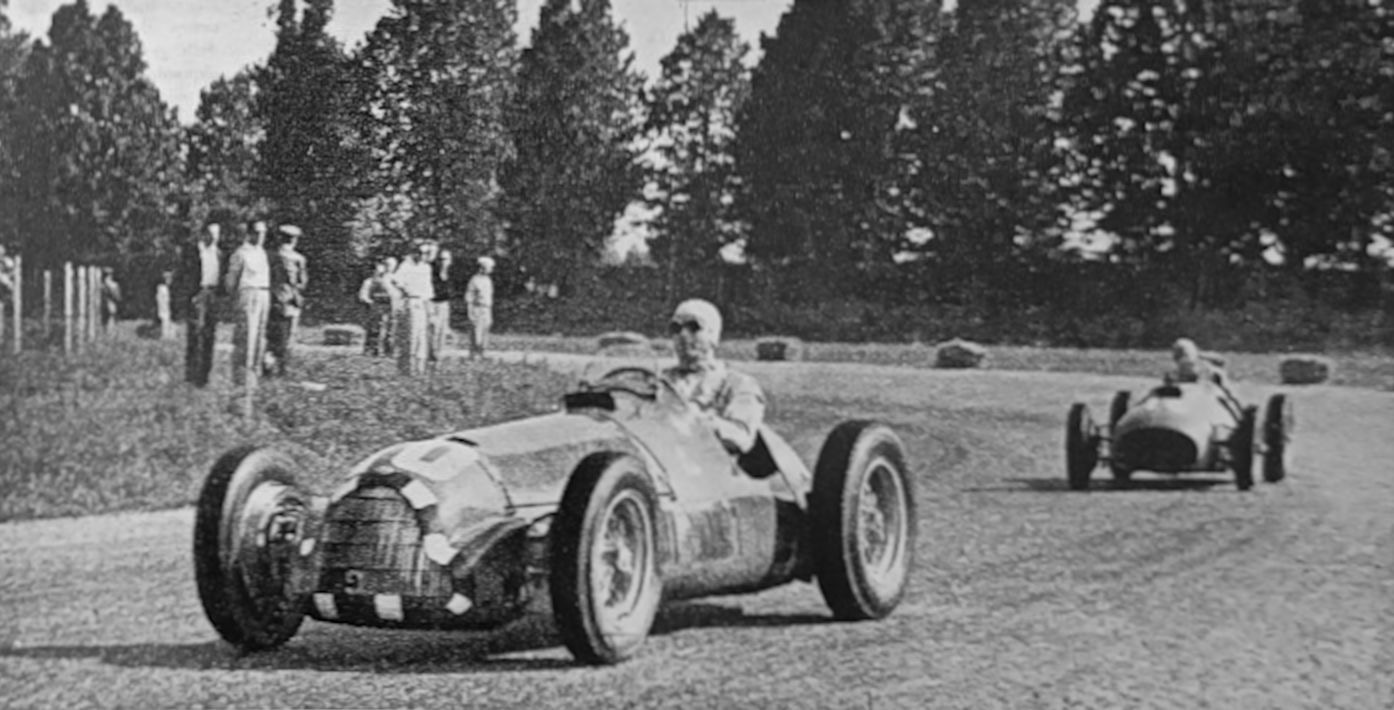
The Alfa Romeo 158 raced as a voiturette from 1938 to 1940 and as a Grand Prix car from 1946 to 1951, apart from 1949. "They won the first event they entered with the 'Alfetta' team, in August 1938, and they won the last event they entered, in October 1951," Jenkinson wrote. The results table lists the wins the Motor Sport database and Motor Sport's period reports record.
| Date | Race | Circuit | Winner | Note |
|---|---|---|---|---|
| 31 Jul or 7 Aug 1938 | Coppa Ciano (voiturettes) | Livorno | Emilio Villoresi | Debut; Clemente Biondetti 2nd |
| 11 Sep 1938 | Milan Grand Prix | Monza | Emilio Villoresi | Francesco Severi 2nd |
| 30 Jul 1939 | Coppa Ciano | Livorno | Giuseppe Farina | |
| 15 Aug 1939 | Coppa Acerbo | Pescara | Clemente Biondetti | Carlo Pintacuda, Farina, Severi 2nd–4th |
| 20 Aug 1939 | Prix de Berne | Bremgarten | Giuseppe Farina | Biondetti 2nd |
| 12 May 1940 | Tripoli Grand Prix | Mellaha | Giuseppe Farina | Biondetti 2nd, Trossi 3rd |
| 21 Jul 1946 | Grand Prix des Nations | Geneva | Giuseppe Farina | Trossi 2nd, Jean-Pierre Wimille 3rd |
| 1 Sep 1946 | Turin Grand Prix | Valentino Park | Achille Varzi | Wimille 2nd |
| Sep 1946 | Milan Grand Prix | Milan | Carlo Felice Trossi | Varzi 2nd, Consalvo Sanesi 3rd |
| 8 Jun 1947 | Swiss Grand Prix | Bremgarten | Jean-Pierre Wimille | Varzi 2nd, Trossi 3rd |
| 29 Jun 1947 | Belgian and European Grand Prix | Spa-Francorchamps | Jean-Pierre Wimille | Varzi 2nd |
| 13 Jul 1947 | Bari Grand Prix | Bari | Achille Varzi | Sanesi 2nd |
| 7 Sep 1947 | Italian Grand Prix | Milan | Carlo Felice Trossi | Varzi 2nd, Sanesi 3rd |
| 4 Jul 1948 | Swiss and European Grand Prix | Bremgarten | Carlo Felice Trossi | Wimille 2nd |
| 18 Jul 1948 | French Grand Prix | Reims | Jean-Pierre Wimille | Sanesi 2nd, Alberto Ascari 3rd |
| 5 Sep 1948 | Italian Grand Prix | Valentino Park | Jean-Pierre Wimille | 158/47's first race |
| 17 Oct 1948 | Monza Grand Prix | Monza | Jean-Pierre Wimille | Trossi, Sanesi, Piero Taruffi 2nd–4th |
| 16 Apr 1950 | San Remo Grand Prix | San Remo | Juan Manuel Fangio | Fangio's first race for Alfa Romeo |
| 13 May 1950 | British and European Grand Prix (WC) | Silverstone | Giuseppe Farina | Luigi Fagioli 2nd, Reg Parnell 3rd |
| 21 May 1950 | Monaco Grand Prix (WC) | Monte Carlo | Juan Manuel Fangio | |
| 4 Jun 1950 | Swiss Grand Prix (WC) | Bremgarten | Giuseppe Farina | Fagioli 2nd |
| 18 Jun 1950 | Belgian Grand Prix (WC) | Spa-Francorchamps | Juan Manuel Fangio | Fagioli 2nd |
| 2 Jul 1950 | French Grand Prix (WC) | Reims | Juan Manuel Fangio | Fagioli 2nd |
| 9 Jul 1950 | Bari Grand Prix | Bari | Giuseppe Farina | Fangio 2nd |
| 30 Jul 1950 | Grand Prix des Nations | Geneva | Juan Manuel Fangio | Emmanuel de Graffenried 2nd, Taruffi 3rd |
| 15 Aug 1950 | Pescara Grand Prix | Pescara | Juan Manuel Fangio | Fagioli 3rd |
| 26 Aug 1950 | International Trophy | Silverstone | Giuseppe Farina | Fangio 2nd |
| 3 Sep 1950 | Italian Grand Prix (WC) | Monza | Giuseppe Farina | Farina in a 159; Fagioli 3rd |
| 27 May 1951 | Swiss Grand Prix (WC) | Bremgarten | Juan Manuel Fangio | Farina 3rd |
| 2 Jun 1951 | Ulster Trophy | Dundrod | Giuseppe Farina | |
| 17 Jun 1951 | Belgian Grand Prix (WC) | Spa-Francorchamps | Giuseppe Farina | |
| 1 Jul 1951 | French and European Grand Prix (WC) | Reims | Luigi Fagioli and Juan Manuel Fangio | Fangio took over Fagioli's car |
| 2 Sep 1951 | Bari Grand Prix | Bari | Juan Manuel Fangio | |
| 28 Oct 1951 | Spanish Grand Prix (WC) | Pedralbes | Juan Manuel Fangio | Farina 3rd |
Sources: the Motor Sport database's race page for each race from 1938 to 1951, read 31 October 2026. The 1938 Coppa Ciano and 1939 Prix de Berne are from Motor Sport, September 1940 and September 1939. The 1946 Milan Grand Prix is from Motor Sport, November 1946, with the date from the magazine's 1946 calendar. The 158/47 note is Nye's.
How many races did the Alfa Romeo 158 win?
The table lists 34 wins in the races those records cover, but the totals in print differ, and each covers a different span. Jenkinson counted 37 wins from 45 events entered from August 1938 to October 1951. Nye counted 42 "top-flight races" from 1946 to 1951, with 38 wins. Goodwood's website, in October 2022, gave 47 wins from 55 Grands Prix entered. The museum counts 11 wins from 11 races in 1950, which matches the database's results. By the end of 1948, Nye added, the 158s had won 13 races in a row.
1938: a win first time out at Livorno
The 158 first raced in the voiturette race at Livorno, run before the Coppa Ciano for Grand Prix cars. Motor Sport's 1940 review recorded that Emilio Villoresi won in 1 hr 5 min 21.6 sec, at 82.7 mph, from Clemente Biondetti, "no one else finishing". His brother Luigi had led in a lightened Maserati 6CM until it broke, Motor Sport's obituary of Luigi Villoresi in October 1997 recorded.
The date is disputed. Sir Anthony Stamer, in Motor Sport in December 1961, gave 31 July 1938. The Motor Sport database dates the Grand Prix Coppa Ciano 7 August 1938, and the 1940 review puts the voiturette race at that meeting, before "the race for the big stuff". Jenkinson placed it "before the Coppa Ciano" in August.
In the Coppa Acerbo at Pescara both 158s were "continually at the pits" with plug trouble, and Severi finished fifth (1940 review). The cars came back for the Milan Grand Prix at Monza on 11 September, where Villoresi beat Severi by one second, at 91.70 mph. In practice there the 1.5-litre Alfas were "actually faster than Farina" in the new 16-cylinder Grand Prix Alfa Romeo, Motor Sport reported in October 1938. All the 158s retired at Modena, the last race of the year. Nye's tally for 1938 is four races, 14 starts, two wins and eight retirements.
1939: beaten by the Mercedes W165 at Tripoli
Six 158s, "now better streamlined than before", started the Tripoli Grand Prix on 7 May 1939, Motor Sport's 1940 review recorded. Their drivers were Farina, Biondetti, Emilio Villoresi, Severi, Carlo Pintacuda and Giordano Aldrighetti. Farina ran second after five laps and was out after ten. Hermann Lang won in a new Mercedes-Benz W165 at 122.9 mph, with Rudolf Caracciola second in the other. Stamer and Nye give Villoresi's 158 third; the review printed "E. Villoresi's Maserati" in third place.
The 158s then won three of the four voiturette races they ran. Farina won the Coppa Ciano by a lap, and Biondetti led a 1-2-3-4 in the Coppa Acerbo. At the Prix de Berne, Farina's 158 ran second to Lang's 3-litre Mercedes on the first lap of the combined final and finished sixth overall, winner of the 1.5-litre race by over a lap, Motor Sport reported in September 1939. Aldrighetti was killed in practice at Pescara when his car caught fire. Emilio Villoresi was killed in a 158 at Monza, during a press reception in Nye's account.
1940: Tripoli, then the war
The Tripoli Grand Prix of 12 May 1940 was the 158's last race before Italy entered the war. Without Mercedes-Benz, Farina won at 128.14 mph from Biondetti and Carlo Felice Trossi, by Motor Sport's 1940 review. Alfa Romeo's pit work beat Maserati's, and Farina refuelled in 24 seconds. Stamer had the 158s first, second, third and fifth. The review noted that Farina's average was 5.24 mph faster than Lang's in the W165 the year before, and called the 158 "perhaps the outstanding 1½-litre racing-car of to-day".
Where was the Alfa Romeo 158 hidden in the war?
The sources name different hiding places. Stellantis Heritage says Alfa Romeo hid the cars "under a fake wood-pile on a pig farm near Milan, to avoid discovery by German army search parties". Frankel wrote of a farmhouse in Melzo, near Milan, and Howard of a cheese factory.
Nye, in 2019, wrote that the cars were stored after 1943 in several places, "some in a cheese factory, some at Melzo east of Milan, others in Brianza". He quoted Sanesi: "It took about a month to remember where they all were." In an earlier column, in Motor Sport in February 2013, he quoted a letter from Carlo Leto di Priolo to Jenkinson. Two Alfettas, it said, were hidden "under a coal mountain" at Castoldi's works at Abbiategrasso, 25 km from Milan, and the SS gave up searching before they had moved the coal. The Portello factory itself was almost destroyed in an air raid in October 1944, Richard Williams wrote in Motor Sport in July 2014.
1946–48: unbeaten after Geneva
From the Grand Prix des Nations at Geneva in July 1946 to July 1951, the 158s were unbeaten in the races they entered, Jenkinson wrote. Their one defeat of 1946 came before that, at St Cloud on 9 June, where Jean-Pierre Wimille and Farina both retired and Raymond Sommer's Maserati won. At Geneva on 21 July Farina won from Trossi and Wimille. Wimille had set fastest lap and won his heat before "the oil-patch (some say Nuvolari) got him", in Motor Sport's 1946 words. In the Milan Grand Prix that September, Farina "had been flagged down to allow Trossi to win and had retired disgruntled!", Motor Sport reported in November 1946.
The 158s "met no serious opposition" in 1947, Nye wrote, and were unbeaten in 1947 and 1948. Varzi was killed when his 158 overturned in wet practice for the Swiss Grand Prix at Bremgarten in 1948. Alberto Ascari drove a 158 to third in the 1948 French Grand Prix at Reims, by the database.
1949: a year away
Alfa Romeo did not race in 1949. Varzi was dead, Wimille had been killed driving a Gordini in Argentina that winter, and Trossi died of cancer, so "robbed of drivers, short of money (and engineer-power), Alfa withdrew from racing for 1949", Nye wrote. Money for 1950 came from a collection among Alfa Romeo's Italian dealers, organised by the director of its Como branch, which raised 200 million lire. William Mearns, in Motor Sport in December 1999, dates Wimille's death to practice for the Palermo Grand Prix in Buenos Aires on 28 January 1949.
The Alfa Romeo 158 in the 1950 and 1951 World Championships
Alfa Romeo won all six European rounds of the first World Championship in 1950, three with Farina and three with Fangio, and Farina became champion, by the Motor Sport database. In 1951 the 159 won four of the seven European rounds, and Fangio took the title.
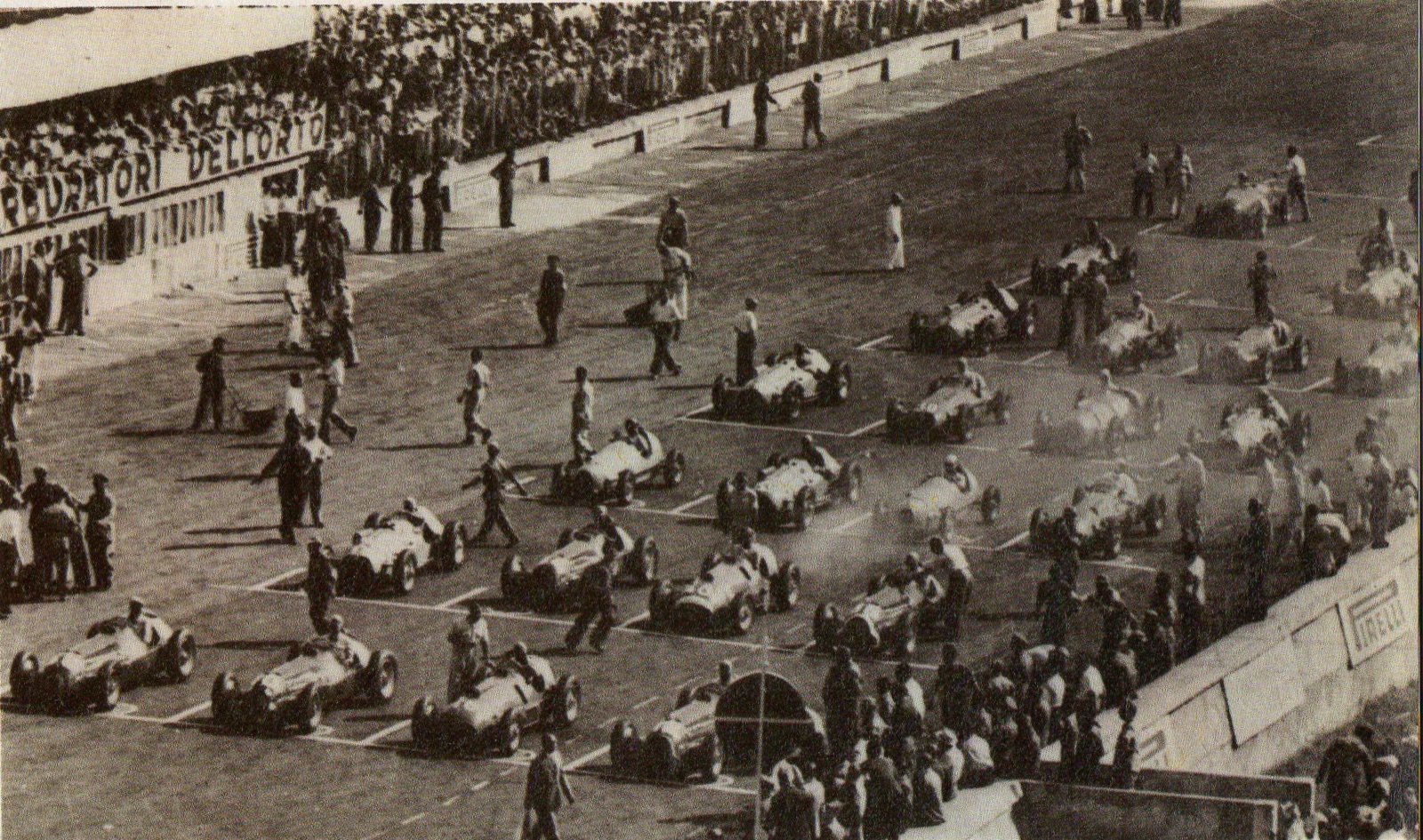
1950: Silverstone and the first world champion
Alfa Romeo's drivers in 1950 were Farina, Fangio and Luigi Fagioli, "the Three Fs", aged 44, 39 and 52 (Nye). The British Grand Prix at Silverstone on 13 May 1950 was the first World Championship race. The four 158s were on English soil for the first time, Motor Sport reported in June 1950, and the drivers were presented to King George VI and Queen Elizabeth before a crowd it estimated at over 150,000. The magazine judged that the team "had been instructed how to finish" while appearing to race for the crowd. Fangio retired with a broken connecting rod after hitting a straw bale at Stowe. Farina won from Fagioli and Reg Parnell, the British guest driver, at 90.95 mph.
At Monza in September Farina drove the first 159, won, and took the title with 30 points to Fangio's 27 and Fagioli's 24, by the database's 1950 championship page. Fangio's 1950 and 1951 seasons in the cars, which began with a win at San Remo in April 1950, are told on the Fangio tribute site's page on his Alfa Romeo 158 and 159. Stellantis Heritage says Alfa Romeo missed only the Indianapolis 500, which no European team entered that year. Ferrari's new 4.5-litre unsupercharged 375 finished second at Monza, with Ascari sharing Dorino Serafini's car. The database's account of the season says Alfa Romeo "would face a serious challenge in 1951".
1951: the 159 against Ferrari's 4.5-litre cars
In 1951 Ferrari's 375 was "almost as fast" as the 159, in Nye's words, and needed fewer fuel stops. Fangio won in Switzerland and Farina at Spa. At Reims on 1 July Fangio took over Fagioli's car and won, the 158 series' 34th victory since 1946 by Nye's count. At Silverstone on 14 July José Froilán González beat Fangio's 159 in a Ferrari 375, and Ascari won the German and Italian Grands Prix. The database's account of the season calls these "the first defeats inflicted on Alfa Romeo in five years", but it also records Parnell's Ferrari 375 beating Fangio's 159 in the International Trophy at Silverstone in May. At Monza, Jenkinson wrote, Farina took over Felice Bonetto's car after his own broke. He drove it to third with a leaking fuel tank, holding 9,000 rpm "right to the end".
The title was settled in Spain, at the Spanish Grand Prix at Pedralbes on 28 October 1951. Alfa Romeo fitted newly cast cylinder heads after porous old ones failed at Monza, Guidotti told Nye. Ferrari chose the wrong wheels and tyres, Nye wrote in Motor Sport in May 2010. Fangio won from González and Farina, and finished the championship with 31 points to Ascari's 25, by the database.
Why did Alfa Romeo withdraw after 1951?
Alfa Romeo's board decided its research and development staff should concentrate on production cars, Nye wrote. Stellantis Heritage says the Giulietta was being designed and an assembly line installed at Portello. Motor Sport's April 1981 article "Alfa Interlude" said the cost of a new engine for the planned 2.5-litre formula "was enough to deter them for a start", and noted that the company was state-owned. With Alfa Romeo gone, the World Championship of 1952 and 1953 was run for 2-litre Formula 2 cars (Nye, 2010). The marque did not return to Grand Prix racing until 1979, by the database's account.
Who drove the Alfa Romeo 158?
Only Alfa Corse's works drivers raced the 158, since the factory never sold one to a private team (Jenkinson, 1990). The Motor Sport database and the period reports name, before the war, Emilio Villoresi, Biondetti, Severi, Farina, Pintacuda, Aldrighetti, Trossi and Sommer. From 1946 to 1948 they name Wimille, Varzi, Trossi, Sanesi, Piero Taruffi, Alessandro Gaboardi, Guidotti and Ascari. In 1950–51 Farina, Fangio, Fagioli, Parnell, Sanesi, Taruffi, Emmanuel de Graffenried, Bonetto and Paul Pietsch drove the cars.
Jean-Pierre Wimille
Mearns wrote that Wimille, the team's only foreign driver in 1946, drove six races for Alfa Corse in 1947 and 1948. He won five of them "and ceded another certain victory to Count Trossi in the other". Sanesi copied Wimille's style, he told Nye, using the brakes "very lightly, to be neat and smooth".
Farina, Fangio and Fagioli
Giuseppe Farina, known as Nino, won at Geneva in 1946 and drove for Ferrari and a private Maserati in 1947 and 1948, wrote Mike Lawrence in Motor Sport in December 2004. By 1951 Fangio was "clearly the quickest Alfa driver". Lawrence put Farina's fourth place in the points down to "the Alfetta being at the end of its competitive tether". Fangio qualified ahead of Farina "invariably" in 1951, the database's account of the season says. Fagioli finished second four times in 1950 and shared the 1951 French Grand Prix win with Fangio.
How many Alfa Romeo 158s were built, and where are they now?
No two sources give the same build count. Most of the survivors belong to Alfa Romeo and are shown at its museum at Arese. Jim Stokes, whose firm has worked on both, said two are in private hands.
How many Alfa Romeo 158s were built?
Howard wrote in 2003 that "a total of six 158s were built, to which were added four 159s in 1951". The museum lists four 159s, all modified 158s. Nye, in 2019, wrote that four cars were built at Modena, six new cars for 1940 and a seventh, the 158D, and gave no total. Frankel wrote that no definitive record shows which chassis did what. He also wrote that there are "reputedly just three complete 159s in the world, all owned by Alfa Romeo".
Where can you see an Alfa Romeo 158?
Alfa Romeo's own collection is shown at the Museo Storico Alfa Romeo in Arese, near Milan. Stellantis Heritage says its 158 "is owned by FCA Heritage and normally exhibited" there. The museum sent a 159 to lead the drivers' parade at the 2019 British Grand Prix, with Kimi Räikkönen driving it on the Sunday. Jenkinson wrote in 1990 that the museum kept its own 159s, "both running and on display". Frankel drove 159/111, the test and development car, at Alfa Romeo's Balocco test track for the company's centenary in 2010. A 159 numbered 75, Fangio's number at the 1951 German Grand Prix by the database, was on display at the Museo Nazionale dell'Automobile in Turin in 2015.
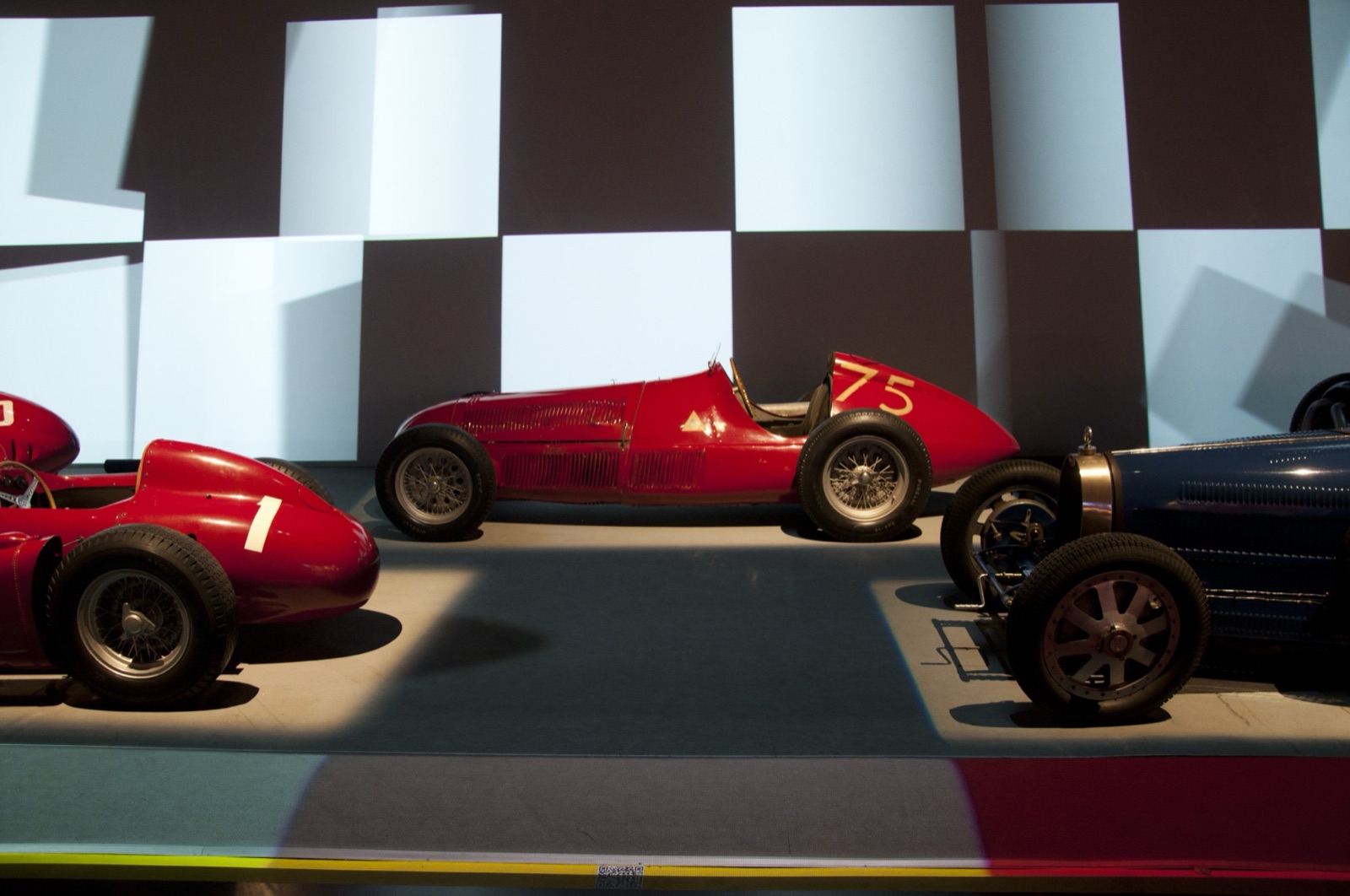
The Alfa Romeo 158s in private hands
The first Alfetta to leave the factory went to "Mike Sparken" (Mike Poberejsky, in Nye's 2019 account) in exchange for the works Alfa Romeo coupé that ran at Le Mans in 1938, Jenkinson wrote. The museum then found one more car "lying at the back of the store house, unrestored". Jim Stokes rebuilt its engine and Paul Grist its chassis and body over two years, and Sparken demonstrated it on the track at the Vintage Sports-Car Club's Silverstone meeting on 16 June 1990.
In 2003 Carlo Vögele's car, a 159 with de Dion rear suspension prepared by Tony Merrick, was the only one still racing, Howard wrote. "There's only two of these in private hands around the world, and we've done both of them," Stokes told Goodwood's website in October 2022.
Alfa Romeo 158 values and sales
The one public sale the sources record is Ant Anstead's 158 re-creation, lot 1044 at Barrett-Jackson's Scottsdale sale on 26 March 2021. It is listed as sold, with a recorded price of $110,000 in the lot's own data. Jenkinson describes the first original car leaving the factory by exchange, and Stokes counts two original cars in private hands.
Alfa Romeo 158 replicas and recreations
One 158 has been rebuilt from original works parts, Nye reported in Motor Sport on 30 October 2019. Stokes's company, JSWL, built it for the collector Peter Giddings from "a trove of original works team parts" cleared from Portello. Its twin-tube frame is new, made to the original drawings. The car was demonstrated at Sonoma on 11 April 2019 in memory of Giddings, who had died. Goodwood's report of October 2022 gave its owner as Peter Greenfield and quoted him that it was rebuilt "with 70% original parts".
Ant Anstead's re-creation, hand-built by the television presenter, has a 2-litre Alfa Romeo twin-cam four, by Barrett-Jackson's description. Its bespoke spaceframe sits on a period MGTD ladder frame under a two-piece composite body, and it is "not street legal".
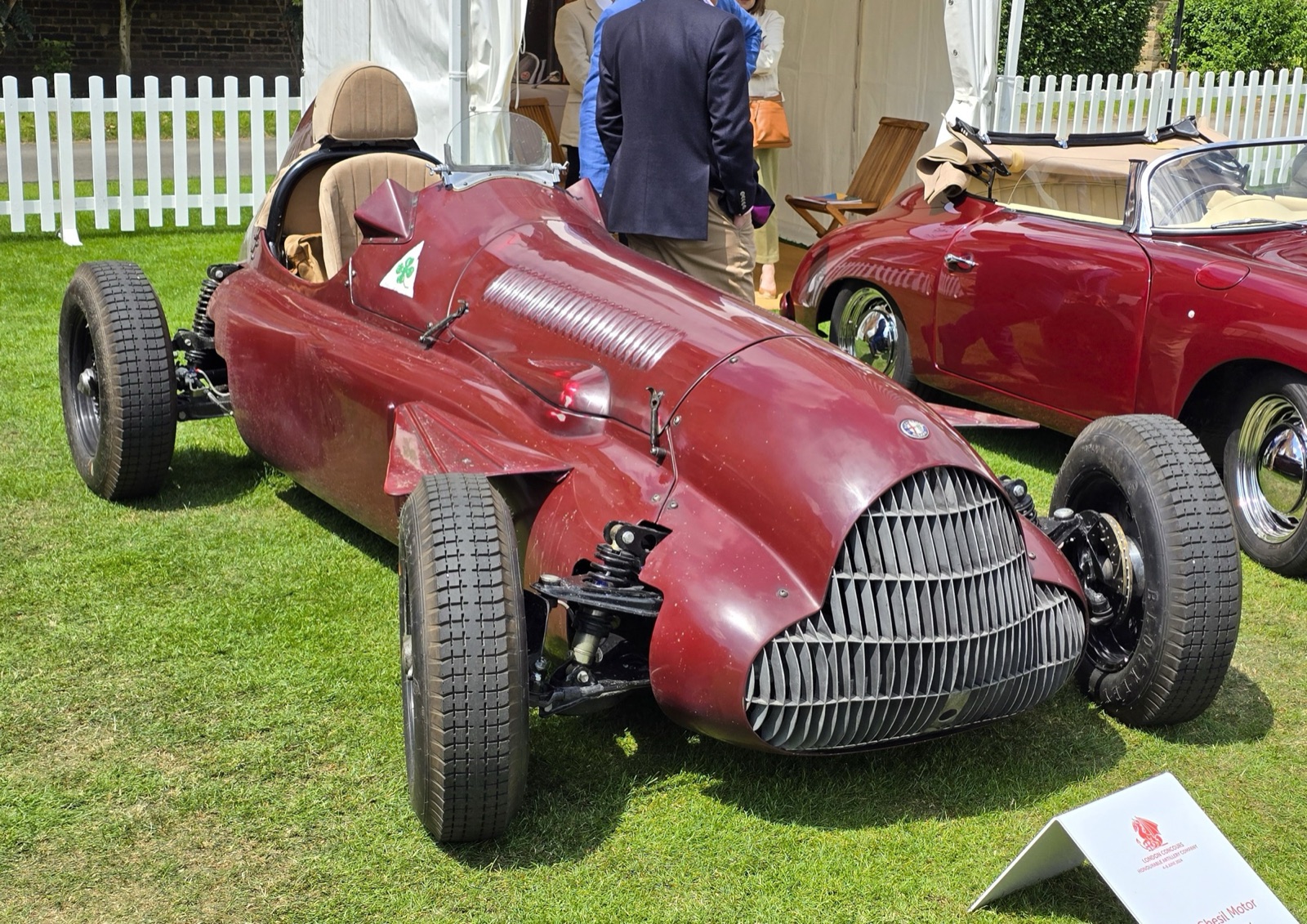
Alfa Romeo 158 rivals
Maserati and ERA were its rivals in the voiturette class, with the Mercedes-Benz W165 in 1939. After the war, in Grand Prix racing, it raced Maserati, Talbot-Lago and, from 1950, Ferrari.
Maserati, ERA and the Mercedes-Benz W165
Motor Sport's 1940 review counted more 1.5-litre wins for Maserati than for Alfa Romeo in both seasons: four to two in 1938, five to three in 1939. Maserati's 1939 cars had a four-cylinder, 16-valve engine of 200 bhp at 7,000 rpm. The new six-cylinder ERA of 1939 gave "some 220-250 b.h.p." and had a de Dion rear axle. The Mercedes-Benz W165 had a V8 running to 10,000 rpm and giving "at least 250 b.h.p.", and raced only once, at Tripoli.
Ferrari, Talbot-Lago and BRM
After the war Maserati's 4CL and 4CLT were raced by Scuderia Milano and then Scuderia Ambrosiana as semi-works teams, Williams wrote. At the 1948 Monza Grand Prix Ascari's 4CLT/48 finished fifth, five laps behind the winning 158. Raymond Sommer's slower Talbot-Lago briefly led at Spa in 1950 while the Alfas refuelled, by the database. The supercharged V16 BRM appeared at the 1951 British Grand Prix, where Parnell finished fifth. Ferrari, the firm Enzo Ferrari set up at Maranello after leaving Alfa Romeo, showed its first car in March 1947, and Colombo designed its 1.5-litre V12 while suspended from Alfa Romeo after the war (Williams). He returned to Alfa Romeo in February 1951 (Nye).
Questions and answers
Did Enzo Ferrari design the Alfa Romeo 158?
No. Gioachino Colombo designed it, working at Scuderia Ferrari in Modena from 1937, and the idea of a 1.5-litre car to beat Maserati was Ferrari's, by the account Giovanni Battista Guidotti gave Doug Nye in Motor Sport in 2019. Ferrari overruled Colombo's plan for a rear-engined car, Paul Fearnley wrote in Motor Sport in 2014.
Which car won the first Formula 1 World Championship race?
An Alfa Romeo 158, driven by Giuseppe Farina, in the British and European Grand Prix at Silverstone on 13 May 1950, with Luigi Fagioli and Reg Parnell second and third in 158s, by the Motor Sport database.
What fuel did the Alfa Romeo 158 run on?
Methanol. Andrew Frankel was told the 159's starting mixture was "methanol, castor oil and, apparently, water" (Motor Sport, 2010), and the restorer Tony Merrick runs Carlo Vögele's car on methanol from the main tank, switching to petrol at the end of a meeting to stop corrosion (Motor Sport, 2003).
Why did Alfa Romeo not race at the 1950 Indianapolis 500?
No European team went to Indianapolis that year, Stellantis Heritage says, so Alfa Romeo raced in the six European rounds of the 1950 World Championship and won them all, five with 158s and Monza with Farina's 159, by the Motor Sport database.
Did Alberto Ascari drive the Alfa Romeo 158?
Yes, once: he finished third in a 158 behind Jean-Pierre Wimille and Consalvo Sanesi in the 1948 French Grand Prix at Reims, by the Motor Sport database. In 1950 and 1951 he raced against the Alfettas for Ferrari.
What gearbox did the Alfa Romeo 158 have?
A four-speed gearbox in unit with the differential at the rear axle, by Stellantis Heritage. Its gear cluster was "just 5in long", the restorer Tony Merrick told Motor Sport in 2003, and the 159's gate is reversed, with third and fourth to the left of first and second (Frankel, 2010).
Sources
- Stellantis Heritage, Alfa Romeo GP Tipo 158 (read 31 October 2026): Alfa Corse and Colombo, the engine, power and speed by stage, the 1-2 debut, the hiding place, 1950, the car at Arese.
- Stellantis Heritage, The GP 159 "Alfetta": The Last Dominator (read 31 October 2026): the 159's engine, suspension, weight and speed, Monza 1950, 1951, the withdrawal.
- Museo Storico Alfa Romeo, Alfetta 159 at Silverstone, 10 July 2019: the 1950 power and speed, 11 wins in 1950, the 159's specification, weight, speed and number built.
- Doug Nye, Motor Sport, The Alfetta tech that beat Ferrari: Alfa Romeo 158/159, December 2019: Guidotti's and Sanesi's accounts, the design, the engine's development, the versions, 1938–51, the counts of races and wins.
- Doug Nye, Motor Sport, Birth of an Alfetta: the Alfa Romeo 158 made from spare parts, 30 October 2019: the car JSWL built for Peter Giddings.
- Doug Nye, Motor Sport, Aqua Romeo!, February 2013: the cars hidden at Abbiategrasso.
- Doug Nye, Motor Sport, 1950s, May 2010: the 1951 Spanish Grand Prix, the 1952–53 championship.
- Andrew Frankel, Motor Sport, Fangio's First Love, November 2010: the 159's changes, chassis 159/111, the cockpit, the survivors.
- Keith Howard, Motor Sport, X-ray spec: Alfa Romeo 158/159, July 2003: Tony Merrick on Carlo Vögele's car, the numbers built, power, the 158D.
- Paul Fearnley, Motor Sport, The Corse of true love, February 2014: Enzo Ferrari, Colombo and the 158's origins at Modena.
- Richard Williams, Motor Sport, Three colours red, July 2014: Portello in the war, 1946, Maserati and Ferrari, Colombo.
- Denis Jenkinson, Motor Sport, A rarity, August 1990: voiturette racing, the name, the record from 1938 to 1951, Mike Sparken's car.
- Sir Anthony Stamer, Motor Sport, Alfa Romeo racing and production cars, 1910–1940, December 1961: the first engine's bore, stroke and power, the races of 1938–40.
- Motor Sport, 1½-litre racing from 1935, September 1940: the 1938–40 voiturette races, the 158's rivals.
- Motor Sport, Continental notes and news: Tripoli, May 1939 (written before the race): the 1,500 cc rule at Tripoli, the 1938 speed.
- Motor Sport, Auto-Unions' first 1938 win, October 1938: the 1938 Milan Grand Prix.
- Motor Sport, Mercedes-Benz one, two, three at Berne, September 1939: the 1939 Prix de Berne.
- Motor Sport, Form on the Continent, September 1946, and Reports of recent events, November 1946: Geneva and Milan, 1946.
- Motor Sport, Farina wins Grand Prix d'Europe, June 1950: the 1950 British Grand Prix.
- Motor Sport, Alfa Interlude, April 1981: the reasons for the 1951 withdrawal.
- Motor Sport, Luigi Villoresi 1909–1997, October 1997: the 1938 Coppa Ciano, Emilio Villoresi's death.
- William Mearns, Motor Sport, Jean-Pierre Wimille: Fangio's hero, December 1999: Wimille's races for Alfa Corse, his death in January 1949.
- Mike Lawrence, Motor Sport, Giuseppe Farina: Formula 1's first world champion, December 2004: Farina in the 158 and 159.
- Motor Sport database, the 1950 and 1951 F1 World Championship pages and the race page for each race in the results table (for example the 1950 British Grand Prix), read 31 October 2026: dates, circuits, placings, car numbers and points.
- Barrett-Jackson, Ant Anstead's 1938 Alfa Romeo Alfetta 158 re-creation, Scottsdale, March 2021: the replica's construction, sale and recorded price.
- Goodwood Road & Racing, The Alfa Romeo 158 was the original dominant force in F1, 5 October 2022: Peter Greenfield's car, Jim Stokes on the cars in private hands, the 47 wins.