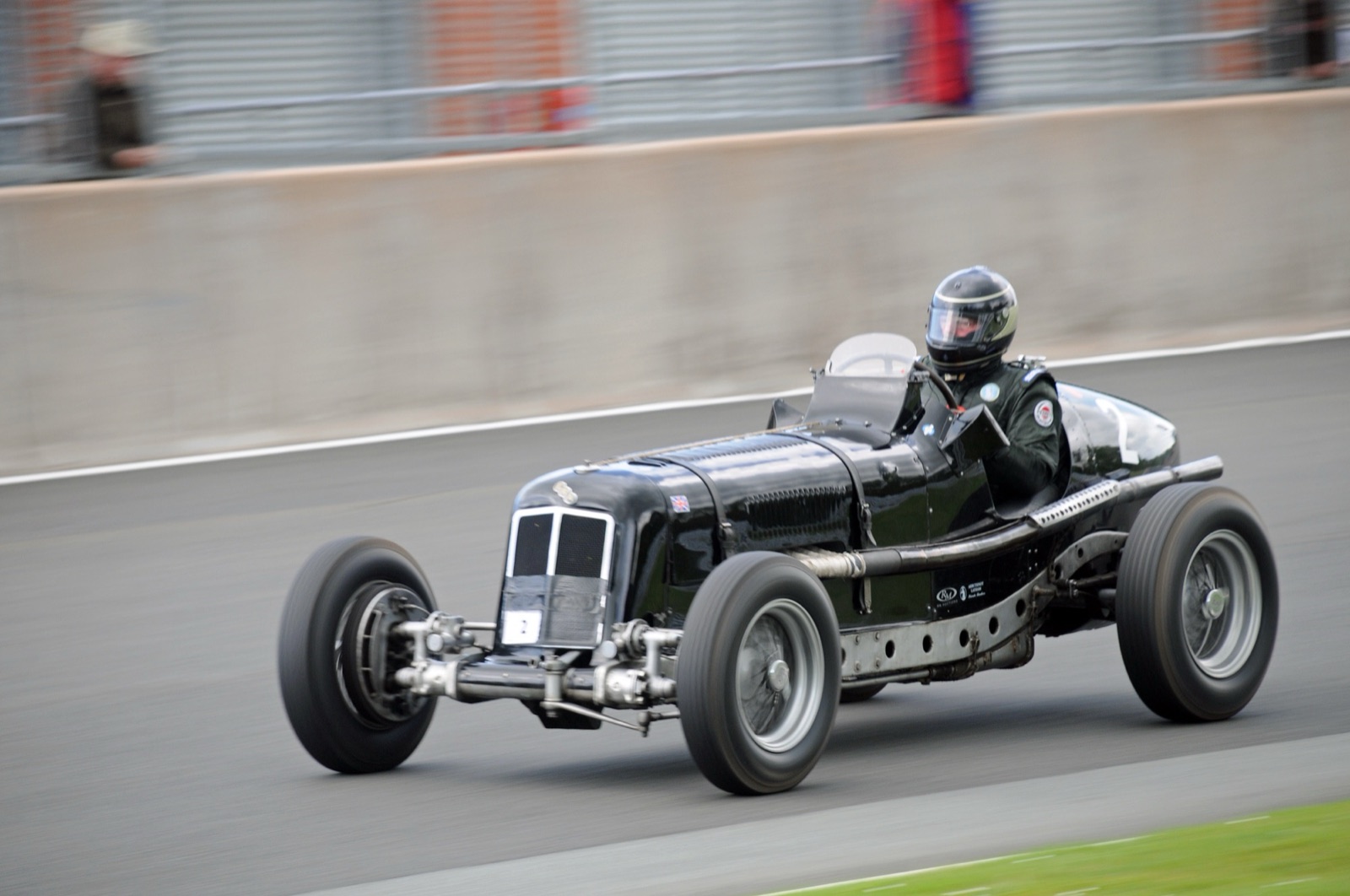
The ERA R-type is the supercharged six-cylinder voiturette that English Racing Automobiles built at Bourne, Lincolnshire, from 1934: 17 single-seaters whose chassis numbers run from R1A to R14B, in A-, B-, C- and D-type forms. In the 1½-litre class, the junior category below Grand Prix racing in Europe, ERA R-types won seven races in 1935 and eight in 1937 by Motor Sport's count, driven by Raymond Mays, Prince Bira, Dick Seaman and their privateer customers. Sixteen of the 17 R-types survive, and most still race.
Who built the ERA R-type, and why?
The ERA R-type was built by English Racing Automobiles Ltd, a company formed by Raymond Mays, his engineer Peter Berthon and Humphrey Cook, who paid for it, to put a British racing car into Continental European races. Motor Sport magazine announced the first car in June 1934: "All British racing enthusiasts must have cherished a hope to see a team of cars from this country competing in foreign Grand Prix events." The R-types were built in the workshop behind Eastgate House, the Mays family home at Bourne, which later housed BRM, Denis Jenkinson wrote in Motor Sport in October 1976.
The White Riley and Humphrey Cook's money
The R-type began with a supercharged Riley Six driven at Shelsley Walsh in the autumn of 1933. Riley built the car at its works that year on a 12/6 TT chassis, and Mays, Berthon and Murray Jamieson fitted what became the prototype ERA engine, say the ERA Club's technical histories, kept in memory of the historian Tim May. The White Riley, as it became known, beat Hans Stuck's Shelsley record in September 1933, and its engine "formed the basis of their new single-seater", Jenkinson wrote in 1976. Before it Mays had raced the Vauxhall-Villiers, a three-litre Vauxhall of the TT type that had once belonged to Cook, supercharged by Amherst Villiers, who later supercharged the Blower Bentley. Motor Sport gave it 260 hp in 1934; Bill Boddy's obituary of Mays in Motor Sport (February 1980) gives "some 300 b.h.p.".
Cook was "a city businessman and racing enthusiast", Jenkinson wrote in Motor Sport in September 1984, and his name, Motor Sport noted in 1934, had "so often been associated with projects for reviving British racing prestige abroad". He "financed the team entirely out of his own pocket, until he was obliged to withdraw his support in 1939", according to Motor Sport's two-part survey "1½-litre racing from 1935" (August and September 1940).
Mays told Motor Sport in 1934 that the R-type was meant for Grand Prix racing, not hill-climbs alone, because "nearly all the Continental races have a class either for 1½-litre or two-litre cars". The company planned three capacities, 1,100 cc, 1,500 cc and two litres, and a team colour of light green.
The 1½-litre voiturette class
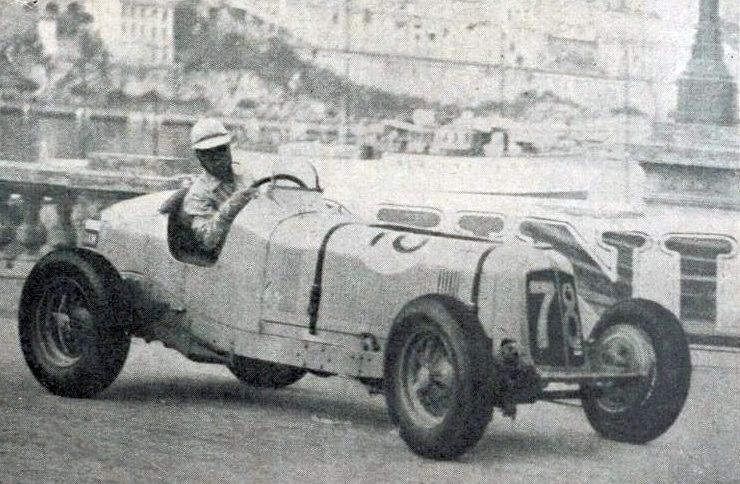
The voiturette races were for cars of up to 1,500 cc, often run on the same weekend as a Grand Prix, as at Monaco in 1936. The 1940 survey explains why the class meant so much in Britain, where the first ERA was "designed to achieve successes that would enhance British prestige": "this country has never made any attempt to compete in full Grand Prix racing", but it had "attained not a little success in events confined to cars the engine size of which does not exceed 1,500 c.c." The survey counted 1935 as the start of serious British involvement. Jenkinson later called the class "in effect a sort of Formula 2". Before the ERA, Jenkinson wrote in 1984, British drivers relied on Continental factories "selling obsolete 'works' cars, like Alfa Romeos or Bugattis, or Maseratis which were rare and expensive". There were plenty of racing cars about, he added, but most were derived from production sports cars; the ERA was "the first pure single-seater racing car, purpose built from scratch, to appear in England, of all-British manufacture".
ERA R-type racing history
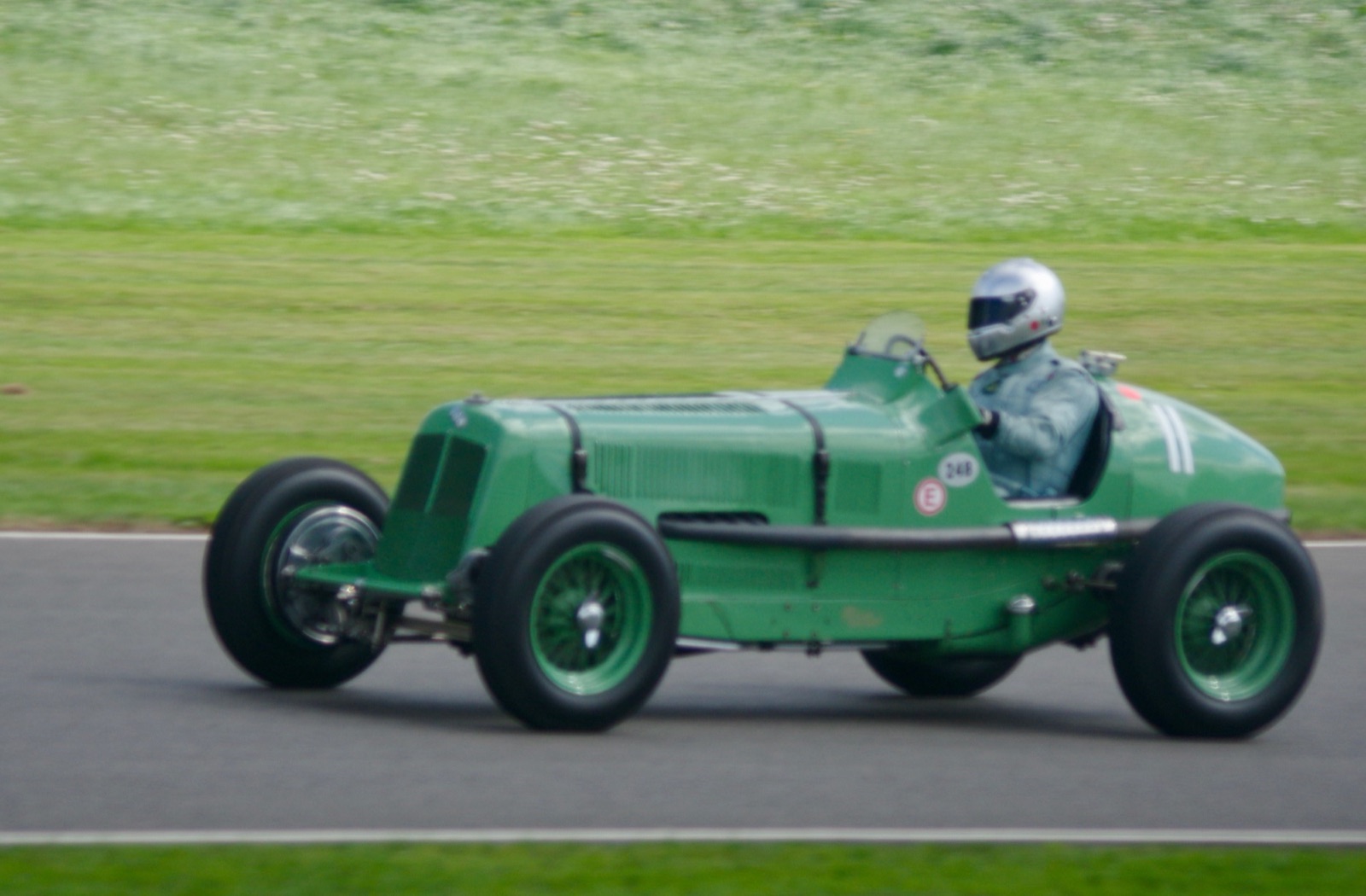
The ERA R-type was the most successful car in 1½-litre racing in 1935 and shared the class with Maserati in 1936 and 1937, before new cars from Alfa Romeo and Maserati outpaced it in 1938 and 1939. The table gives the season counts from Motor Sport's 1940 survey, which leave out races open to larger cars.
| Season | ERA (1st, 2nd, 3rd) | Maserati (1st, 2nd, 3rd) | Others with a win |
|---|---|---|---|
| 1935 | 7, 2, 1 | 2, 4, 1 | Bugatti 1 |
| 1936 | 4, 6, 5 | 4, 3, 4 | Delage 2 |
| 1937 | 8, 6, 6 | 8, 10, 10 | None |
| 1938 | 3, 1, 3 | 4, 5, 4 | Alfa Romeo 2 |
| 1939 | 1, 1, 2 | 5, 6, 6 | Alfa Romeo 3, Mercedes-Benz 1 |
1934: first races
After Mays withdrew it from its first entry, the Mannin Moar in the Isle of Man, over its handling, the first R-type was sorted out and used for standing-start record attempts, the kilometre above all, to show what it could do; it had shown "impressive acceleration" in the Isle of Man, and from then on, Jenkinson wrote in 1984, "the name ERA became a household word in British motor racing" and "also made its mark in European events". Seaman, then racing an MG Magnette, finished second to the works 1½-litre R-type in the 1934 Nuffield Trophy at Donington Park, Motor Sport recalled in "Recalling a fine partnership" (December 2004).
1935: Seaman and Fairfield
Seven 1½-litre wins, on the Isle of Man and in England, France, Germany, Italy, Switzerland and Czechoslovakia, made 1935 the R-type's best season by the survey's count, and three came from Fairfield's 1,100 cc R4A: the Mannin Beg at 67.29 mph, the Nuffield Trophy and the Dieppe race. Mays won the 1½-litre Eifelrennen at the Nürburgring by 30 seconds. Seaman's black R1B then won the 1½-litre Coppa Acerbo at Pescara by 1 min 9.7 sec from Bianco's Maserati, the Prix de Berne with Bira second, and the Masaryk race at Brno by 3 min 26.3 sec from Veyron's Bugatti, a car the survey took to be developed from the Bugatti Type 39A.
1936: Bira at Monaco, Seaman's Delage
Bira's first victory came in the Prince Rainier Cup at Monaco on 11 April 1936, in R2B "Romulus", which beat "both E.R.A. and Maserati works teams", Chula wrote in "The history of the E.R.A. 'Romulus'" (Motor Sport, November 1940), after Tenni's leading Maserati hit the sandbags on lap 35. ERAs took four of the first five places, according to Motor Sport's report in May 1936, against nine Maserati entries. The win, the report said, brought Bira "to the front rank of our English drivers, for such we may regard him since he lives here and was educated at Oxford". Bira went on to win the International Trophy at Brooklands, the Picardie race at Péronne and the Albi race. Seaman had moved to a ten-year-old Delage that Giulio Ramponi prepared, and it beat the ERAs in the Isle of Man, at Pescara and at Berne; the ERA works cars now carried Zoller superchargers.
1937: the C-type and the Avus
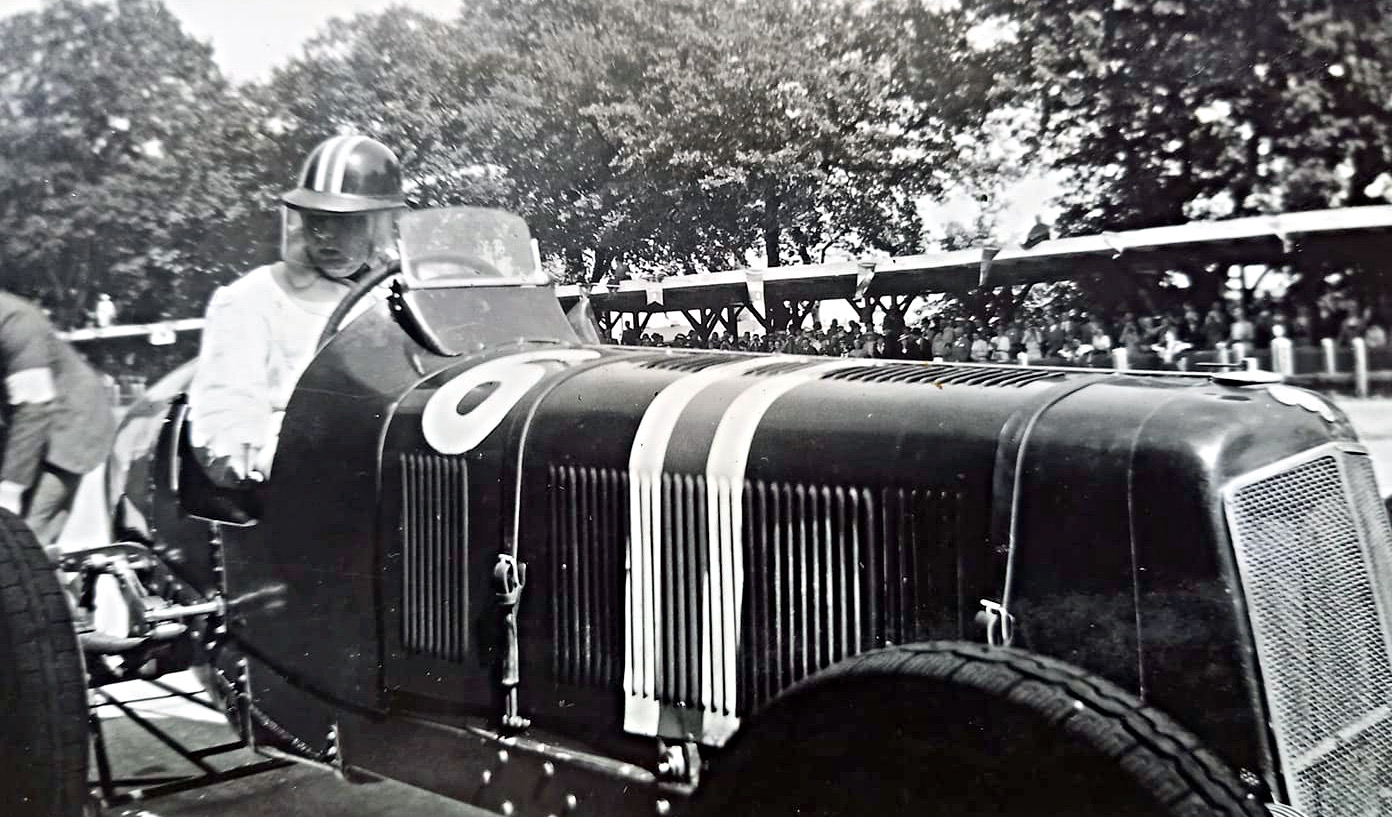
The 1937 season was evenly split, eight wins each for ERA and Maserati, but the survey noted that Maserati "had beaten the older E.R.A.s every time on the Continent, after the Avusrennen". At the Avus Charlie Martin won from Castelbarco's Maserati, lapping at 122.7 mph. Eugen Bjørnstad had won at Turin in R1A. Bira won the Isle of Man race in Romulus with ERAs in the first five places, and the new works C-types, with independent front suspension and a Zoller supercharger behind the engine, won at Péronne and Albi with Mays (the second shared with Cook) and at Berne, where Dobson beat Mays by about half a car's length.
1938: the Alfa Romeo 158 arrives
Bira, now with the C-type "Hanuman", won the 1½-litre race at Cork with a lap record of 3 min 56 sec and the Nuffield Trophy at a record 72.54 mph, and the newest works R-type won at Péronne. At Livorno the new Alfa Romeo 158 won the Coppa Ciano on its first appearance, a race the survey called "a most important stage in 1½-litre history". ERA scored three 1½-litre wins all season, by the survey's count. At the Crystal Palace Bira's Romulus won the Coronation Trophy and the London Grand Prix.
1939: the works team splits, Cook withdraws
For 1939 ERA announced a team of Mays, Dobson and Tony Rolt in four new cars with tubular chassis (Motor Sport, May 1939). Mays left the stable and raced R4D as an independent. The R-types' only 1½-litre win of the year was Bira's in the Nuffield Trophy, with R4D second. At the end of the season "Humphrey Cook reluctantly had to state that he must withdraw the financial support from E.R.A. Ltd.", the survey reported.
After the war: the first World Championship race
ERA R-types were still racing in Grand Prix company in 1950. In the first round of the new drivers' championship, the British Grand Prix at Silverstone on 13 May 1950, Bob Gerard finished sixth in a B-type and Cuth Harrison seventh in a C-type, three laps behind the winner, according to the results in the Motor Sport database. Leslie Johnson's works E-type retired after one lap with supercharger failure.
Who drove the ERA R-type?
The ERA R-type was raced by the works team of Raymond Mays, Humphrey Cook, Pat Fairfield, Earl Howe and Arthur Dobson, and by customers who included Prince Bira, Dick Seaman, Charlie Martin, Reggie Tongue, Peter Whitehead and Johnnie Wakefield. The ERA Club's ownership and driver histories list every owner and driver chassis by chassis.
Raymond Mays
The works team's leader drove the development car, R4B and then R4D. Boddy's obituary lists his ERA wins as the Eifelrennen, Picardie twice, Albi with Cook as co-driver, the International Trophy at Brooklands, the Empire Trophy and Nuffield Trophy at Donington, the Formule Libre race at Phoenix Park and the Brooklands Mountain Championship twice. Simon Taylor, who drove R4D at Shelsley for Motor Sport in November 2016, records that by 1938 relations with Cook had become strained over the cost, and he resigned from the ERA board, bought R4D and took Berthon with him.
Prince Bira and the White Mouse cars
Prince Chula Chakrabongse of Siam gave R2B to his cousin Bira for his 21st birthday, 15 July 1935, and it was delivered "within three weeks of the order being placed", Chula wrote. When Chula bought R5B in 1936 Bira named the first car Romulus, so that it would be a twin of Remus. At the end of 1937 Chula bought the works C-type R12C, painted it blue and named it Hanuman ("The development of the E.R.A.", Motor Sport, October 1938). The White Mouse Garage, Chula's own, ran the cars and fitted Romulus with De Ram dampers from 1937 (ERA Club). From 1939 Romulus was painted blue and yellow, "the new established colours of Thailand".
The sources give Romulus different records. Chula counted 36 races in Romulus's five-year career, to Albi in July 1939, with ten firsts, nine seconds, eight thirds and five retirements. Boddy's note to "'Romulus' unveiled" (Motor Sport, June 1965) gives 30 long-distance races with ten firsts, eight seconds and five thirds. Wouter Melissen, in the Revs Institute's "English Racing Automobiles Live On" (3 June 2021), credits Bira with sixteen wins in it. Only Bira ever raced Romulus, Boddy wrote in "The E.R.A. affair" (October 1976), and its last international race was in 1946.
Dick Seaman
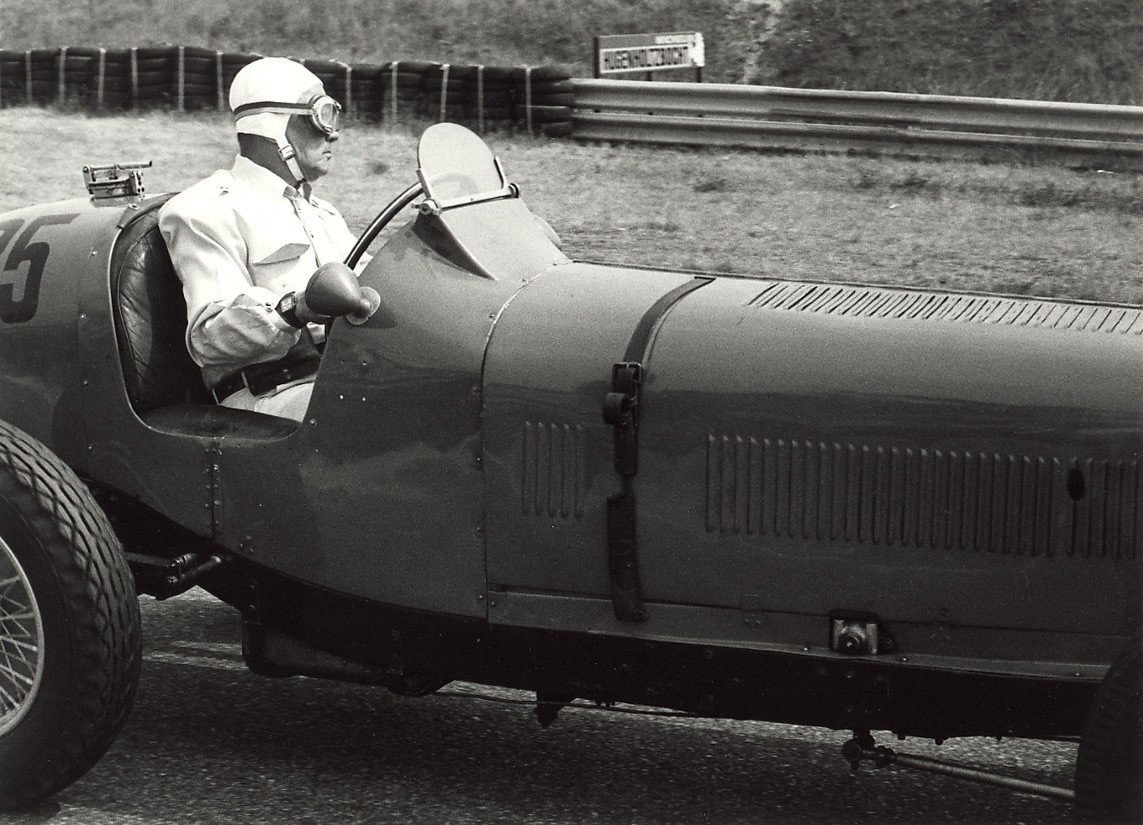
Richard Seaman ordered a new 1½-litre ERA after the 1934 season, but R1B was late, and he raced the works car R1 on loan at Donington first, says Motor Sport's 2004 account. After a row over preparation he took R1B away from Bourne, made Jock Finlayson his head mechanic and, in the black car, won the Grossglockner hill-climb and the races at Pescara, Berne and Brno. Melissen gives a different version: Seaman's mother bought R1B, and it was prepared by Giulio Ramponi. In the 2004 account Ramponi joined Seaman for 1936, to prepare the Delage, when R1B was sold to Jock Manby-Colegrave. The British driver joined Mercedes-Benz for 1937, in the W125, and won the 1938 German Grand Prix in a W154.
Fairfield, Dobson, Martin and the privateers
Fairfield joined the works team in 1936 and won the 1937 South African and Rand Grands Prix in R4A, by Motor Sport's 1938 account; he died after the multiple crash in the Le Mans 24-hour race later that year, which Motor Sport called "a tremendous blow for British motor-racing". Dobson bought R7B new in 1936 and raced it until August 1939; it was famous for its nickel-plated radiator and high tail (Jenkinson, 1976). Charlie Martin won the 1936 Nuffield Trophy in Scribbans's R9B and the 1937 Avus race in R3A. Tony Rolt bought Remus, R5B, in 1937 and "smashed the Limerick course record very thoroughly" with it, Motor Sport reported in 1938. Marcel Lehoux, driving the works R3B, died in it at Deauville in July 1936, and Cook had the car broken up, the ERA Club records.
ERA R-type design and engineering
The ERA R-type combined a much-modified Riley six-cylinder engine with a Roots-type supercharger and a conventional ladder-frame chassis on beam axles and half-elliptic springs. Motor Sport's description of 1934 is the fullest period account, and the details below come from it unless another source is named.
The R-type's engine and supercharger
The engine was based on the six-cylinder Riley unit, with a bore of 57 mm and a stroke of 95.2 mm, which works out at 1,458 cc (Motor Sport's 1934 text gives 1,458 cc; its 1984 reprint prints 1,488). It kept Riley's layout of a camshaft on each side of the engine, working the valves through rockers and short pushrods, with the valves at 90 degrees in an aluminium hemispherical head that was new. The crankshaft ran in three bearings, rollers in the centre, and lubrication was by dry sump. The head, the crankshaft, the changes for the supercharger and the general chassis layout were "the work of Mr Peter Berthon", Motor Sport said.
A two-vane Murray Jamieson supercharger stood upright at the front of the engine, driven by bevel gears from the crankshaft and fed by a single SU carburettor. On Shell racing fuel, with a 6 to 1 compression ratio and 15 lb boost, the 1,500 cc engine gave "over 160 hp at 7,000 rpm", which Motor Sport noted was only 20 hp less than "the 2.3 Grand Prix Alfas of a year ago", the Alfa Romeo 8C 2300 Monza. The 1,100 cc version had a shorter-throw crankshaft and the two-litre a larger bore.
R-type chassis, gearbox and brakes
Reid Railton's chassis design was built by Thomson and Taylor at Brooklands. Melissen calls the whole package "a wholly conventional design". The frame ran straight at the front and swept up over the rear axle, braced by an elektron engine support and dash. The front axle was an I-section beam on short half-elliptic springs with radius rods, damped by Hartford friction shock absorbers, two at the front and four at the rear. The gearbox was a self-changing Armstrong Siddeley pre-selector gearbox, the brakes were Girling rod-operated drums in ribbed elektron, and the fuel tank, holding 23 gallons, formed the tail. The aluminium body is credited to a Mr Piercy, who, Melissen notes, is reported to have styled Malcolm Campbell's Blue Bird record breaker too, and the ERA Club records that the Gray brothers built the original bodies. The bodywork, Motor Sport wrote in 1934, "consists simply of light aluminium panels secured to the chassis through small brackets". Chris MacAllister, who bought R14B in 2015, described the look to the Revs Institute as a "wide stance, a low, classic body shape, distinctive radiator, and small diameter wide wire wheels".
Melissen quotes the historic racer Mark Gillies on the pre-selector gearbox: "the preselector gearbox is also great, allowing you to downshift in all sorts of circumstances that you couldn't do with a manual 'box."
From the Jamieson blower to the Zoller
A works 1,100 cc R-type already had a Zoller compressor in the 1935 Mannin Beg race in the Isle of Man, and later that season the works ran a very large Zoller, mounted behind the engine and drawing from twin SU carburettors, the 1940 survey records. On the C-type the Zoller became standard on the works cars, "straddled by the driver's legs", as Motor Sport described it in October 1938. The same article records that Jamieson, who designed the original blowers and later joined ERA, was fatally injured at the 1938 International Trophy at Brooklands "when the Delage hit the spectators".
ERA R-type specifications
The ERA R-type in its 1934–35 form was a 1½-litre single-seater of about 13 cwt (660 kg) with roughly 160 to 180 bhp, depending on the source and the year.
| Item | Figure | Source |
|---|---|---|
| Engine | Six cylinders in line, Riley-based, two block-mounted camshafts, pushrods, hemispherical head | Motor Sport, June 1934 |
| Bore × stroke | 57 × 95.2 mm (1,458 cc) | Motor Sport, June 1934 |
| Other capacities | 1,100 cc and two litres (1,980 cc in R4D, 1939) | Motor Sport, June 1934; July 1939 |
| Supercharger | Murray Jamieson two-vane Roots type, single SU carburettor; Zoller vane type on works and C-type cars | Motor Sport, June 1934; October 1938 |
| Compression and boost | 6 to 1; 15 lb | Motor Sport, June 1934 |
| Power | Over 160 hp at 7,000 rpm (1934); 180 bhp (1935); "something like 210 b.h.p." (C-type, 1937) | Motor Sport, June 1934; August and September 1940 |
| Gearbox | Armstrong Siddeley (Wilson-type) pre-selector | Motor Sport, June 1934; August 1940 |
| Front suspension | Beam axle, half-elliptic springs (A, B); trailing arms and transverse torsion bars, Porsche type (C, D) | Motor Sport, June 1934; October 1938 |
| Brakes | Girling rod-operated drums (A, B); Lockheed hydraulic (C, D) | Motor Sport, June 1934; October 1938 |
| Wheelbase / track | 7 ft 10 in (2,388 mm) / 4 ft 3 in (1,295 mm) | Motor Sport, June 1934 |
| Tyres | Dunlop 16 × 6.00 | Motor Sport, June 1934 |
| Fuel tank | 23 gallons (105 litres) | Motor Sport, June 1934 |
| Weight | About 13 cwt (660 kg) | Motor Sport, August 1940 |
Melissen gives "close to 170 hp" for the 1½-litre engine and 240 hp for the two-litre Zoller engine of the works C-type.
How fast was the ERA R-type?
Seaman's black B-type was timed at 143 mph (230 km/h) over the flying kilometre in practice for the 1935 Coppa Acerbo at Pescara, against 124 mph for Bianco's Maserati, according to the 1940 survey. At Péronne in 1938 the latest works R-type "got up to some 155 m.p.h." (249 km/h) on the straight to Brie. On the hills, R4D climbed Shelsley Walsh in 37.37 seconds in 1939, a record covered under the D-type below.
ERA A-, B-, C- and D-types
The ERA R-type came in four types, A, B, C and D, and the letter at the end of a chassis number shows the type the car was built or rebuilt as. Jenkinson set out the numbering in 1984: "Each car was given a chassis number identification beginning with 'R' and ending in a serial letter."
A-type: R1A to R4A
Four A-types were built, the first three for the works team and the fourth, R4A, for the first private owner, the South African Pat Fairfield, Jenkinson wrote in 1976. R4A had the 1,100 cc engine and was sold new in April 1935, by Motor Sport's 1938 account. The prototype went to Brooklands for testing in the company's van in May 1934, and it was withdrawn from its first entry, the Mannin Moar in the Isle of Man, after practice because Mays was unhappy with the handling and steering. Berthon traced the problems to the spring rates and the steering geometry, and the steering drop arm was moved inside the chassis frame (Jenkinson, 1984).
B-type: R1B to R14B
The B-type of 1935 had extra frame bracing below the driver's seat and more flexible rear springs, Motor Sport recorded in 1938. Thirteen were built, R1B to R14B, with no R13B. "By today's standards, a production run of 13 cars does not sound very great," Jenkinson wrote, "but for the time it was quite a fair output." They were the customer cars: R1B for Dick Seaman, R2B and R5B for Chula Chakrabongse to be driven by his cousin Bira, R6B for Dr Dudley Benjafield, R7B for Arthur Dobson, R8B for Earl Howe, R9B for Denis Scribbans, R10B for Peter Whitehead, R11B for Reggie Tongue and R14B for Johnnie Wakefield. R3B, R4B and R12B were works cars. R14B, the last, had a Zoller supercharger in place of the usual Jamieson unit (Jenkinson, 1976).
C-type: Porsche-type front suspension
The C-type of 1937 added independent front suspension on the Porsche principle, with trailing arms and transverse torsion bars, Lockheed hydraulic brakes and the big Zoller supercharger behind the engine. Three cars were converted: R4B became R4C over the winter of 1936–37, R12B became R12C at the same time, and Earl Howe's R8B became R8C in 1938, using R4C's discarded frame, according to the ERA Club's ownership histories. The C-types were "probably somewhat heavier than the earlier Murray-Jamieson blown cars", the 1940 survey judged.
D-type: R4D
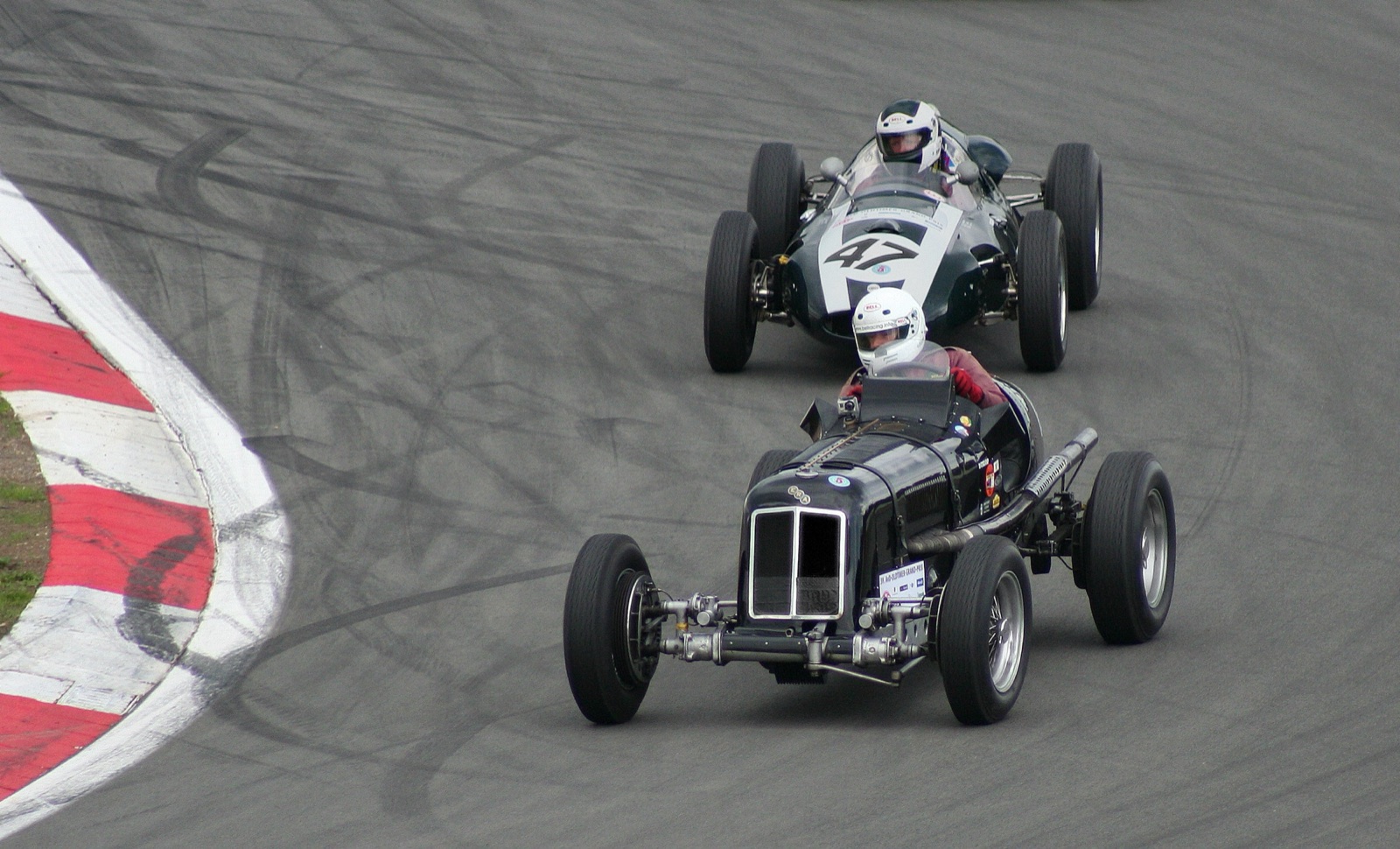
R4D, the only D-type, is R4C rebuilt in March 1938 around a new chassis frame in place of Railton's original, the ERA Club records. Motor Sport listed its 1938 changes: two-leading-shoe Lockheed brakes, short radius arms for the front suspension, Luvax hydraulic shock absorbers and "extensively-drilled side members". Its steering box is on the left and its steering wheel angled to the left, the only R-type built that way, because Mays's left arm was slightly shorter than his right after a childhood accident (Jenkinson, 1976). The sources disagree on where the car began. The ERA Club, Motor Sport's 1938 article and Jenkinson in 1976 all trace R4D to the 1935 B-type R4B; Jenkinson's 1984 article says R4A went through "four phases of development, A, B, C, and D".
R4D's hill-climb and sprint records
R4D set the Shelsley Walsh record at 37.37 seconds in June 1939, with Mays now racing it as an independent in "the 2-litre E.R.A., purchased from Humphrey Cook, now black and silver", Motor Sport's "A sunny Shelsley" reported. It beat Mays's own record by 0.49 seconds and was his twelfth fastest time of the day there, nine of them in ERAs. (The report's results list prints 37.87, but its headline and table of fastest climbs give 37.37.) Joe Fry beat it by 0.02 seconds in June 1949, Howard Stockley recalled in a letter to Motor Sport in October 2001. At Prescott on 30 July 1939 R4D set an absolute record for the course of 46.14 seconds, 1.71 seconds under George Abecassis's 1938 time (Motor Sport, September 1939).
After the war R4D won the RAC's British hill-climb championship in its first two years, 1947 and 1948, Motor Sport reported in February 1999. Taylor wrote that it set best time of the day there 16 times between 1935 and 1956, with Mays and then Ken Wharton. Melissen credits it with 26 victories, the most of any ERA. Mays sold R4D to Ron Flockhart in 1952, and Wharton, who owned it from 1954 to 1957 (ERA Club), used it in 1954, the fourth year running in which he won the British hill-climb championship, according to Motor Sport in June 1997; in the 1980s it was "unbeatable in VSCC racing with the late Anthony Mayman", Motor Sport wrote in 1999.
The E-type that followed
The E-type of 1939 was a new design, "a complete breakaway from the A, B, C, D, series" in Jenkinson's words of 1976, and its chassis numbers, GP1 and GP2, drop the R. The 1940 survey describes a six-cylinder engine with the Zoller beside the block at 28 lb boost, "some 220-250 b.h.p. at about 8,000 r.p.m.", a tubular frame, torsion-bar suspension and a de Dion rear axle, at about 14 cwt. Overheating in practice kept GP1 out of the Reims race in 1939, and a pit signal ended its run at Albi, where Arthur Dobson hit a straw bale and split the fuel tank. Jenkinson's verdict in 1984 was that "the E-type was a disaster for various reasons", and the war stopped the project.
How many ERA R-types were built, and where are they now?
Seventeen ERA R-types were built, four A-types and thirteen B-types, three of which became C-types and one the D-type, and sixteen survive (Jenkinson, 1976). Counting the E-types and the post-war G-type, the company built twenty cars between 1934 and 1952; eighteen exist, twelve of them in Britain, four in the United States, one in Switzerland and one in Thailand, according to the club's ownership histories. The club notes that every one of the twenty has a known ownership history at every point of its life, and its histories build on the standard book on the company, David Weguelin's The History of English Racing Automobiles Limited (White Mouse Editions, 1980). When the Vintage Sports Car Club ran a race for ERAs at Silverstone on 14 July 1984, fifty years after the marque's first car, every car but R3A and R4D came to the paddock, Jenkinson reported. It was not the first such event: the BARC had run races for ERAs only at Brooklands in October 1936, won by Mays, and in August 1938, won by Dobson.
| Chassis | Type | First owner | Name | Today |
|---|---|---|---|---|
| R1A | A | Works | Same owner since 2008 auction | |
| R2A | A | Works | Same owner since 2014 | |
| R3A | A | Works | Same owner since 2014 | |
| R4A | A | Pat Fairfield | Same owner since 2012 | |
| R1B | B | Dick Seaman | Same owner since 2007 | |
| R2B | B | Chula Chakrabongse | Romulus | Same owner since 2007 |
| R3B | B | Works | Broken up after Lehoux's accident, 1936 | |
| R4B / R4C / R4D | B, then C, then D | Works | Same owner since 2020 | |
| R5B | B | Chula Chakrabongse | Remus | Same owner since 2022 |
| R6B | B | Dr Dudley Benjafield | Same owner since 2013 | |
| R7B | B | Arthur Dobson | Same owners since 2014 | |
| R8B / R8C | B, then C | Earl Howe | Same owner since 2013 | |
| R9B | B | Denis Scribbans | Same owner since 2014 | |
| R10B | B | Peter Whitehead | Same owner since 2022 | |
| R11B | B | Reggie Tongue | Humphrey | Same owner since 2006 |
| R12B / R12C / R12B | B, then C, then B | Works | Hanuman | King Vajiralongkorn of Thailand since 2016 |
| R14B | B | Johnnie Wakefield | Chris MacAllister since 2015 |
The B-types' first owners are from Jenkinson's articles of 1976 and 1984. R11B was named Humphrey, after Cook, while Reggie Tongue owned it, the ERA Club records.
Romulus and the museum years
Romulus was the one R-type kept out of racing. In 1947 Chula Chakrabongse gave up racing and exchanged it with Bira for the White Mouse Stable and its Maserati; with the two Princes on "separate paths", in Boddy's phrase, Chula kept the car at his house at Bodmin, in Cornwall. After his death Princess Chula lent it to the Montagu Motor Museum at Beaulieu, where it was unveiled on 25 April 1965 (Boddy, 1965 and 1976). Bill Morris overhauled it in the mid-1970s for its return to competition, without altering its appearance or specification, the ERA Club records, and drove it in historic racing until 1994. Boddy regretted the car's return in 1976: "there is only one 'Romulus' and he was unique." The ERA Club records that Narisa Chakrabongse owned it from 1971 to 2007, and that a new owner has had it since 2007.
Hanuman: one chassis number, two cars
Bira crashed R12C badly at Reims in July 1939, and White Mouse rebuilt it on R8B's spare B-type frame, without independent front suspension, as R12B, raced from 1946 as the second Hanuman, under Chula Chakrabongse's ownership until 1949. The damaged C-type frame went with R12B at every sale, and between the mid-1960s and 1982 Bill Morris, David Kergon and Tony Stephens reconstructed R12C around it, so there are now two cars, the ERA Club's technical histories explain. Jenkinson called the reconstruction a "bitza" in 1984. The rebuilt R12B passed to King Bhumibol of Thailand in 2007 and to King Vajiralongkorn in 2016.
ERA R-type replicas
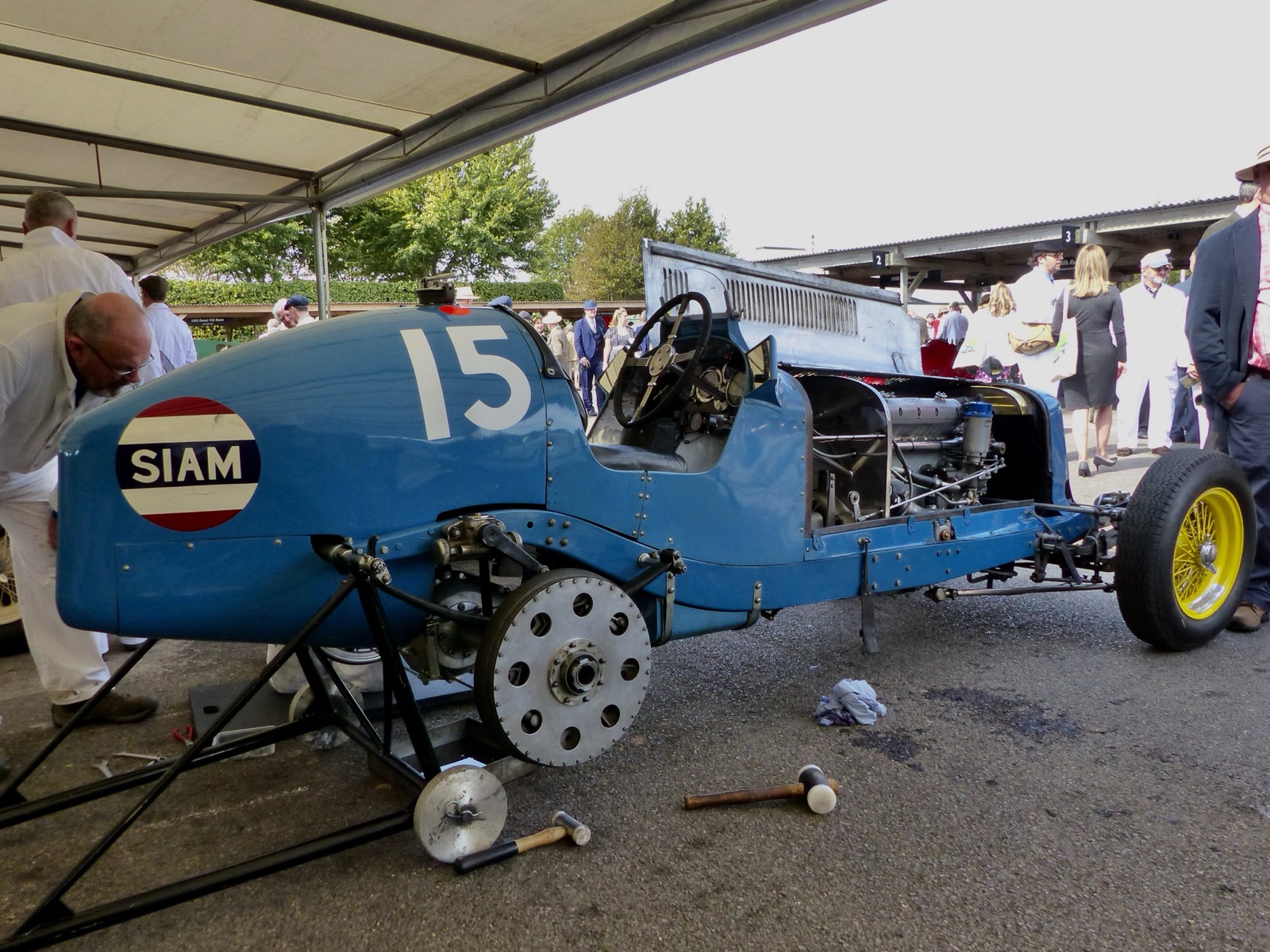
The one recognised B-type replica is AJM1, built by Tony Merrick between 1984 and 1986 from original ERA spares that Sandy Murray had bought from Thomson and Taylor's stock in the 1960s, the ERA Club records. It has always had a 1½-litre engine.
How much is an ERA R-type worth?
ERA R-types change hands rarely, and the published sale prices are from the late 1990s and 2000s. Brooks sold R4D for £406,300 after the brewer Vijay Mallya had owned it since 1993, Motor Sport reported in February 1999 (the ERA Club dates the sale to 1998); the same report said R1A and R3A had changed hands in 1998. Bonhams offered R1A without reserve at its Goodwood Festival of Speed sale on 11 July 2008, with an estimate of £400,000 to £500,000, according to Motor Sport's auction column of May 2008; the ERA Club says the car has not been seen in public since that sale. Racing Romulus cost Chula "some £10,000", his widow said at its unveiling in 1965.
ERA R-type rivals
Maserati was the ERA R-type's main rival throughout, joined by Seaman's rebuilt Delage in 1936 and the Mercedes-Benz W165 in 1939, whose two cars beat every Alfa Romeo and Maserati at Tripoli that May; Alfa Romeo entered the class in 1938 with the 158. In 1935 Maserati's cars had four cylinders; the six-cylinder cars of 1936 gave 175 bhp at 6,550 rpm, and the 1939 four-cylinder, 16-valve car gave 200 bhp at 7,000 rpm and weighed about 11 cwt, the 1940 survey records. The 158 had a straight-eight twin-cam engine of 195 to 210 bhp. Seaman's Delage, estimated at about 200 bhp, could run 200-mile races without refuelling.
The survey's verdict on 1937 was that the ERA had lost its edge abroad, and by 1938 "E.R.A. was less in the picture, on account of mechanical troubles and less participation in Continental events". Jenkinson put it in 1984: "the ERAs were surpassed by the latest Maseratis and Alfa Romeos, while Mercedes-Benz were joining in and Auto Union were considering the category."
Questions and answers
Why is there no ERA R13B?
The number was never used. Jenkinson wrote in Motor Sport in 1976 that there were thirteen B-series cars and "there was no R13B", so the series runs from R12B to R14B; the Revs Institute's history says the number was skipped for superstitious reasons.
What colour were the ERA R-types?
The works cars were light green at first, and the works R4B was painted black towards the end of 1936. Seaman's R1B was black, Dobson's R7B white, Fairfield's R4A white until he joined the works team in 1936, and Bira's cars blue, with yellow added in 1939, according to Motor Sport in 1938 and 1940.
What does Hanuman mean on Bira's ERA?
Hanuman is the monkey god of Hindu and Siamese legend. Motor Sport wrote in October 1938 that Chula Chakrabongse named R12C after "a Siamese monkey-god" and that the car carried a silver emblem of him on the scuttle.
What fuel does an ERA R-type run on?
Methanol in historic racing today: the American owner of R14B, Chris MacAllister, told the Revs Institute in 2021 that "the methanol was an exotic element" when he first watched ERAs warm up. In 1934 Motor Sport reported the first engines running on Shell racing fuel.
Where can you see ERA R-types race?
At Vintage Sports Car Club meetings in Britain and at historic events such as the Goodwood Revival, Monaco and Monterey. Jenkinson wrote in 1984 that "you don't find ERAs in museums, you must go to a racing circuit to see them".
Sources
- Motor Sport, "First E.R.A. racing car completed", June 1934: the company's aims, engine, chassis and planned capacities.
- Motor Sport, "The Prince Rainier Cup race", May 1936: the date and field of Bira's Monaco win.
- Motor Sport, "Lessons of Le Mans", July 1937: Fairfield's death.
- Motor Sport, "The development of the E.R.A.", October 1938: chassis by chassis to 1938, the B-, C- and D-type changes, Jamieson's death.
- Motor Sport, "The E.R.A. team for 1939", May 1939: the 1939 team and new car.
- Motor Sport, "A sunny Shelsley", July 1939: Mays's 37.37-second record.
- Motor Sport, "Record day at Prescott", September 1939: the 46.14-second record.
- Motor Sport, "1½-litre racing from 1935", August 1940, and part two, September 1940: race results, season scores, power outputs, top speeds, rivals.
- Prince Chula, "The history of the E.R.A. 'Romulus'", Motor Sport, November 1940: Romulus's delivery, names and record.
- Bill Boddy, "'Romulus' unveiled", Motor Sport, June 1965: Beaulieu, the cost of racing it, its record.
- Denis Jenkinson, "English Racing Automobiles–E.R.A.", Motor Sport, October 1976: numbers built, first owners, R4D's steering.
- Bill Boddy, "The E.R.A. affair", Motor Sport, October 1976: Romulus's single driver and its return to racing.
- Bill Boddy, "Raymond Mays CBE", Motor Sport, February 1980: Mays's ERA wins.
- Denis Jenkinson, "English Racing Automobiles", Motor Sport, September 1984: the 1934 debut, chassis numbering, the B-type customers, the E-type.
- Motor Sport, "ERA R4D sells for £400,000", February 1999: the £406,300 sale, the 1947–48 championships.
- Howard Stockley, "Harking back to a classic ERA", letter, Motor Sport, October 2001: Fry's 1949 Shelsley time.
- Motor Sport, "Recalling a fine partnership", December 2004: Seaman's 1935 season and R1B.
- Motor Sport, "Auctions", May 2008: the R1A sale estimate.
- Simon Taylor, "Hold tight, I'm taking a supercharged bomb up the Shelsley Esses", Motor Sport, November 2016: R4D's best times at Shelsley and Mays's departure.
- Motor Sport, "British hillclimb champions celebrate Golden Jubilee", June 1997: R4D in Wharton's 1954 championship.
- Motor Sport database, 1950 British Grand Prix: Gerard's and Harrison's finishes.
- ERA Club, "ERAs and ERA-engined cars: technical histories and specifications" (read 31 October 2026): each chassis's changes, R12C, AJM1, R1A since 2008.
- ERA Club, "ERAs and ERA-engined cars: ownership and driver histories" (read 31 October 2026): owners, conversion dates, survivors by country.
- Wouter Melissen, "English Racing Automobiles Live On", Revs Institute, 3 June 2021: power figures, R4D's wins, Seaman's R1B, Gillies on the gearbox.