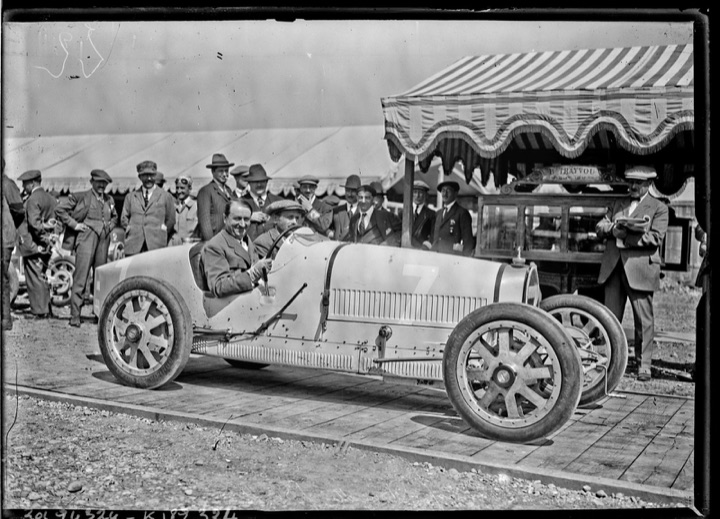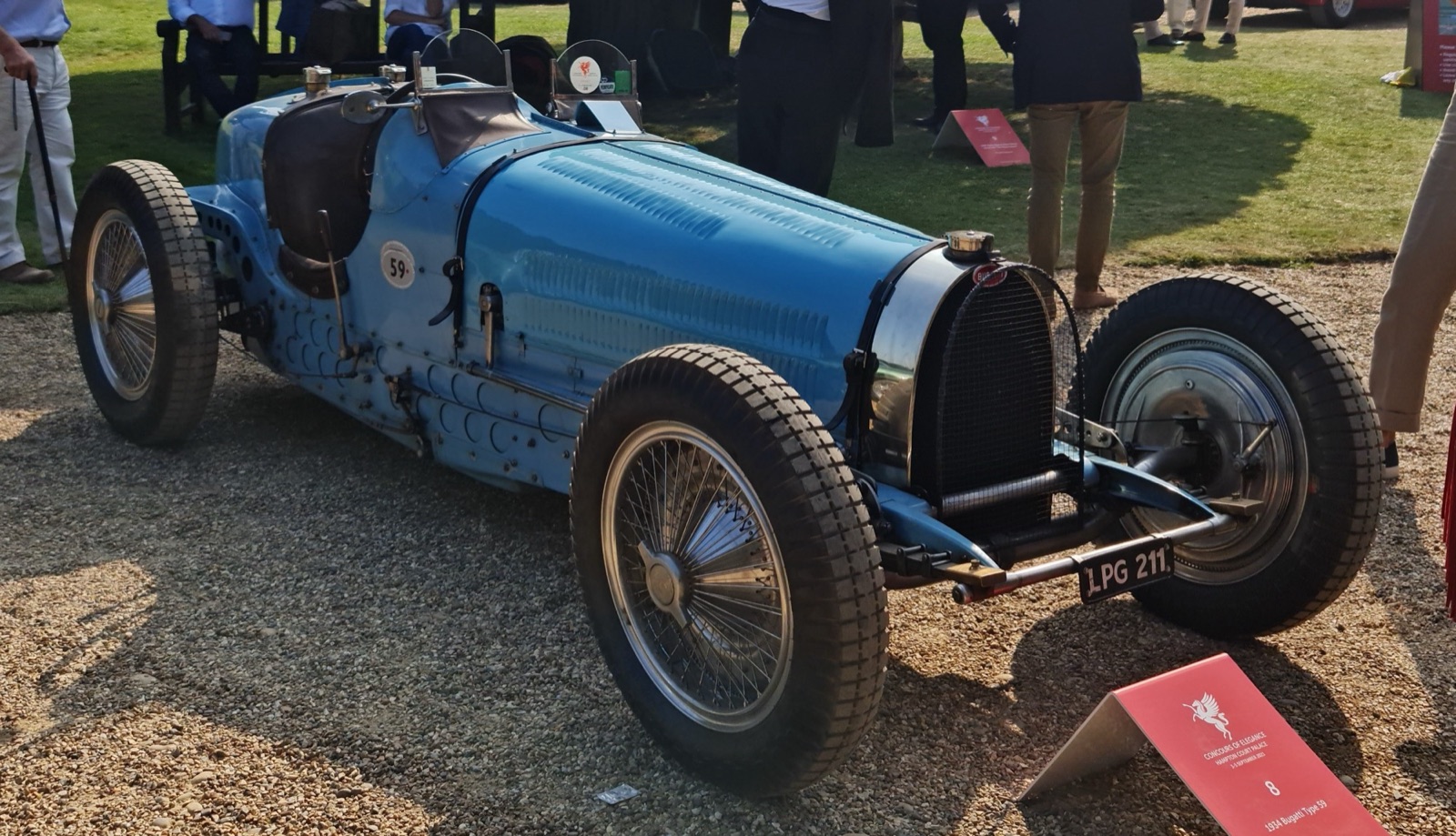
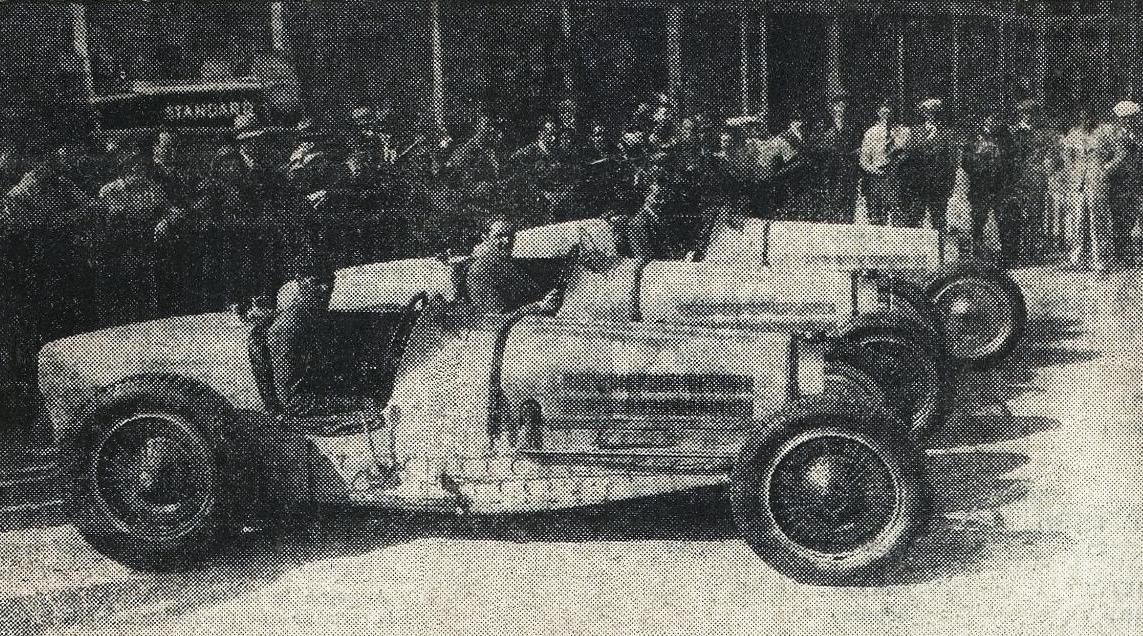
The Bugatti Type 59 is the last two-seater Grand Prix car from Ettore Bugatti's factory at Molsheim, raced by the works team from 1933 to 1936: a supercharged twin-cam straight-eight of 2.8 litres, enlarged to 3.3 litres for 1934, in a chassis of two-seater width on piano wire wheels. It first raced at San Sebastián in September 1933, and its best day came on 29 July 1934, when René Dreyfus won the Belgian Grand Prix at Spa with Antonio Brivio second in another Bugatti, by the Motor Sport database's results. In 1935 the factory sold four of the works cars to the British drivers Earl Howe, Brian Lewis, Charlie Martin and Lindsay Eccles, and in 2020 the ex-King Leopold III Type 59 Sports sold for £9,535,000, then an auction record for the marque; in 2024 the same car won Best of Show at the Pebble Beach Concours d'Elegance as an unrestored classic.
Who designed the Bugatti Type 59, and why?
The Bugatti Type 59 was designed at Molsheim from 1932 by Ettore Bugatti and his son Jean, to replace the 2.3-litre twin-cam Type 51 and answer Alfa Romeo's new monoposto, the Tipo B, Denis Jenkinson wrote in Motor Sport's "Historic Grand Prix cars" of June 1982. The factory's own account, reprinted by Radical in 2022, says Jean was "instrumental in designing" it and calls it "the ultimate evolution of the Bugatti Grand Prix racing car era which began with the Type 35". To the historian Julius Kruta, who ran the company's heritage department until 2018, it was "the swansong of the Bugatti Grand Prix car", the Type 35 of 1924 "updated with a more powerful blown double-overhead-cam engine and a lower bodyline" (Classic Driver, 2019).
The car was late. "The project was started in 1932 to try to combat the 'monoposto' Alfa Romeo but was not completed until the end of 1933," Jenkinson wrote in Motor Sport's study of the Bugatti Type 59 in March 1976, by which time the Alfa Romeo P3 had dominated a season. In 1982 he set the two engines side by side: Vittorio Jano's eight was 2.6 litres and the Molsheim engine 2.8, "both double overhead-camshaft 8-cylinders supercharged, but as different as chalk and cheese".
The 750 kg formula of 1934
The Bugatti Type 59 appeared at the last race before the 750 kg formula came into force for 1934, which limited a Grand Prix car's weight without fuel, oil, water and tyres. The factory had to drill the chassis side members to bring the cars under the limit, Jenkinson wrote, and at scrutineering for the 1934 French Grand Prix Dreyfus's car "scraped through at 749.5 kilogrammes". The team's chief mechanic, Robert Aumaître, later told him the team often took the cars to the scales without the magneto, which sat out of sight under the scuttle: "you could tell when they were cheating for they pushed the car to scrutineering!"
Bugatti Type 59 design and engineering
The Bugatti Type 59 kept the layout of the earlier Molsheim Grand Prix cars: a channel-section frame deepest in the middle of the wheelbase, a tubular front axle on half-elliptic springs and a live rear axle on reversed quarter-elliptics, with the driver sitting low beside the propeller shaft in a body two seats wide (Jenkinson, 1976 and 1982). Ettore Bugatti did not believe in the single-seat layout, Jenkinson wrote, "because of the need to sit the driver high over the propeller shaft". The chassis was essentially a shortened version of the chassis of the 4.9-litre Bugatti Type 54, according to the Bonhams catalogue of 2005 as New Atlas reported it.
Chassis, axles and gearbox
The front axle beam was split in the middle and joined by a threaded sleeve over a tapered slug, so that one half could turn slightly against the other when a bump changed one wheel's kingpin angle. "In no way did it remotely resemble anything in the way of independent suspension, as many journalists thought at the time," Jenkinson wrote in 1976. The rear axle had double-reduction gearing in the final-drive casing, which lowered the drive line below hub height and let the engine and gearbox sit lower in the frame, for a lower centre of gravity. The four-speed gearbox was separate from the engine and worked by an outside lever. The fuel tank filled the tail, under a pointed cover made in two halves and riveted along a central spine.
The piano wire wheels
The Bugatti Type 59's wire wheels carried no driving or braking torque: the drive went through a plate joining the hub to the rim, and the thin radial spokes only held the rim in place (Jenkinson, 1976). The description of the car by the book's authors, quoted by Acquire in 2025, is that "driving and braking forces were taken through a thin disc attached from hub to rim by gear teeth; side and vertical loads could thus be taken through fine radial wires"; the gear teeth work as splines. Jenkinson noted in 1982 that each brake drum was riveted to its radially spoked wheel. The Bugatti Trust's data sheet lists the piano wire wheels, the lightening holes in the frame, an external multi-tube oil cooler and De Ram shock absorbers among the car's identifying features.
The twin-cam straight-eight
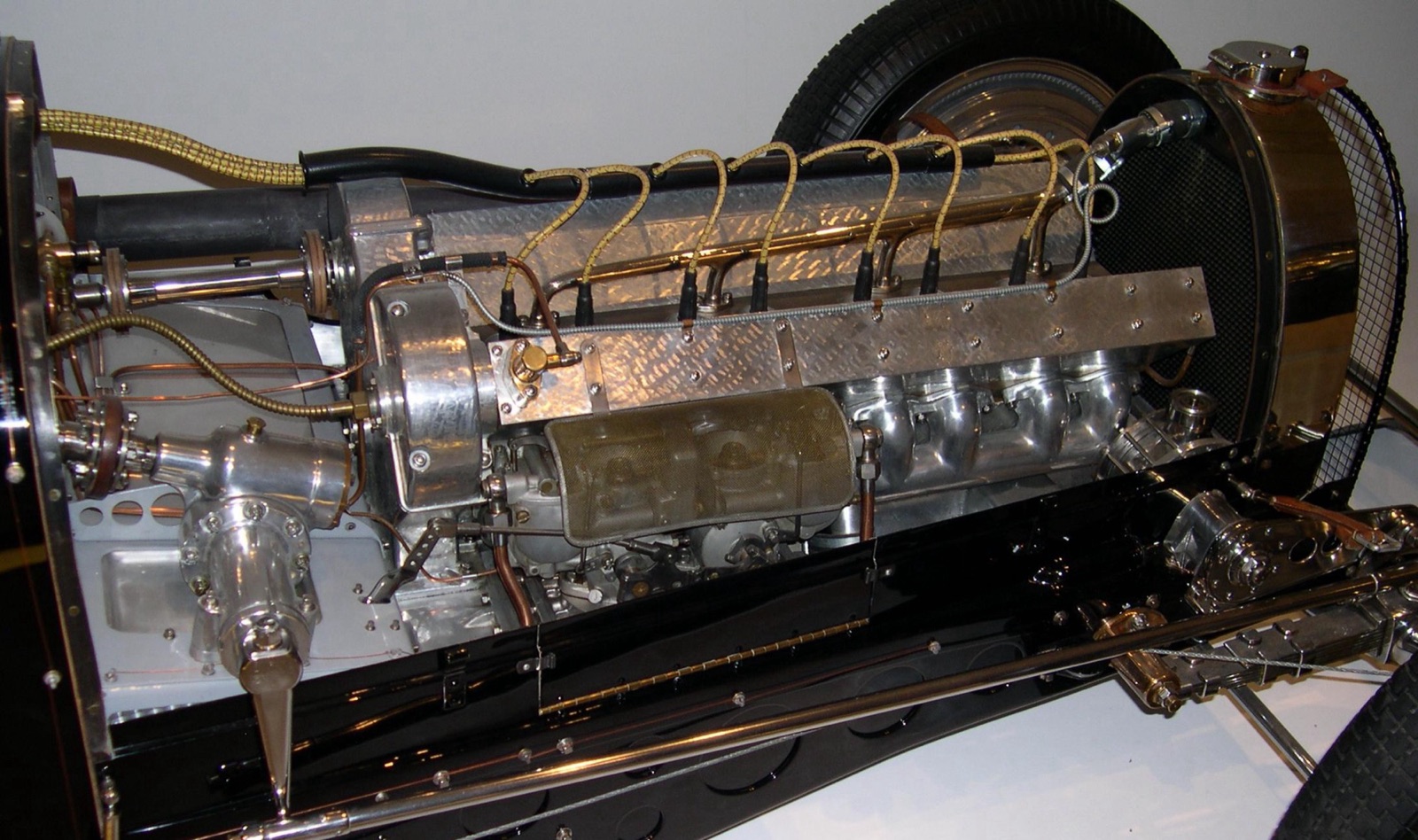
The engine is a straight-eight with two overhead camshafts driven by a train of gears from the back of the crankshaft, which also drove the supercharger, a Roots type built at Molsheim, on the right of the engine, with two downdraught Zenith carburettors on top (Jenkinson, 1976). It ran on plain main and big-end bearings, with a dry sump and its oil tank in the space a passenger would use. An eight-branch exhaust fed a single large pipe, which gave "an uncharacteristic deep booming note" in place of the "tearing-calico sound" of earlier Bugattis. Starting was by a handle in the left side of the car, through bevel gears at the back of the engine. For 1934 the factory fitted the 100 mm-stroke crankshaft of the new Type 57 road car, which took the capacity from 2.8 to 3.3 litres, according to the company's release for the car's 80th anniversary at Rétromobile in 2013.
Bugatti Type 59 specifications and performance
The Bugatti Type 59 in its 1934 form had a 3,257 cc supercharged straight-eight of about 250 bhp and weighed about 750 kg, by the Trust's figures; the first cars of 1933 had 2,866 cc.
| Item | Bugatti Type 59 |
|---|---|
| Engine | Straight-eight, two overhead camshafts driven by gears from the rear of the crankshaft, two valves per cylinder |
| Bore × stroke | 72 × 88 mm (1933); 72 × 100 mm (1934 on) |
| Capacity (displacement) | 2,866 cc (1933); 3,257 cc (1934 on) |
| Induction | Roots-type supercharger built at Molsheim, two Zenith carburettors (52 mm) |
| Power | About 250 bhp; prudent limit 5,500 rpm |
| Bearings and lubrication | Plain main and big-end bearings; dry sump |
| Ignition | Scintilla Vertex magneto, one plug per cylinder |
| Gearbox | Four-speed transmission, separate from the engine, outside lever |
| Suspension | Split tubular front axle on half-elliptic springs; live rear axle on reversed quarter-elliptics; De Ram shock absorbers |
| Brakes | Cable-operated drums on all four wheels |
| Wheels and tyres | Piano wire wheels; 5.25 to 6.00 × 19 tyres |
| Wheelbase and track | 2.60 m and 1.25 m |
| Weight | About 750 kg; Dreyfus's car 749.5 kg at the 1934 French Grand Prix |
Sources: the Bugatti Trust's data sheet, and Jenkinson (1976) for the engine's gear drive, the gearbox, the axles and the weighing.
How much horsepower did the Bugatti Type 59 have?
The Bugatti Type 59 had about 250 bhp in its 3.3-litre version. The company's review of 2020's auction records gives "around 250 PS" and adds that "other engine variants reached up to 380 PS in the Type 59".
How fast was the Bugatti Type 59?
The Bugatti Type 59 could reach about 160 mph: Mick Walsh called it an "uncompetitive 160mph GP machine" in Classic & Sports Car's history of the ex-King Leopold car, first published in November 2008 and republished in 2020. Earl Howe lapped the Brooklands Outer Circuit in 59123 at 138.34 mph, which Jenkinson recorded in 1976 as the fourth-fastest lap ever achieved at the track. Motor Sport's report of the 1934 Belgian Grand Prix put Robert Benoist's "usual gait" on the descent after Burnenville at 130 mph.
Bugatti Type 59 racing history
The Bugatti Type 59 won three Grands Prix for the works team, the Belgian and Algerian races of 1934 and, with Jean-Pierre Wimille, the Deauville Grand Prix of 1936, by the Motor Sport database's results; in British hands it took one more victory, Lewis's in the 1935 Mannin Moar. Kruta counts only the Belgian race: the car "won just a single race, the Belgian Grand Prix in 1934", he told Classic Driver in 2019, and Walsh counted "just two proper Grands Prix", the Belgian and the Algerian.
| Date | Race | Bugatti Type 59 results | Winner |
|---|---|---|---|
| 24 Sep 1933 | Spanish Grand Prix, Lasarte | Varzi 4th, Dreyfus 6th | Chiron (Alfa Romeo P3) |
| 2 Apr 1934 | Monaco Grand Prix | Dreyfus 3rd, Nuvolari 5th | Moll (Alfa Romeo P3) |
| 1 Jul 1934 | French Grand Prix, Montlhéry | Benoist 4th | Chiron (Alfa Romeo P3) |
| 15 Jul 1934 | Vichy Grand Prix | Dreyfus 4th | Trossi (Alfa Romeo P3) |
| 29 Jul 1934 | Belgian Grand Prix, Spa-Francorchamps | Dreyfus 1st, Brivio 2nd, Benoist 4th | Dreyfus (Bugatti) |
| 15 Aug 1934 | Coppa Acerbo, Pescara | Brivio 3rd | Fagioli (Mercedes-Benz W25) |
| 26 Aug 1934 | Swiss Grand Prix, Bremgarten | Dreyfus 3rd | Stuck (Auto Union) |
| 23 Sep 1934 | Spanish Grand Prix, Lasarte | Nuvolari 3rd, Wimille 6th | Fagioli (Mercedes-Benz W25) |
| 28 Oct 1934 | Algerian Grand Prix, Bouzaréah | Wimille 1st | Wimille (Bugatti) |
| 31 May 1935 | Mannin Moar, Douglas | Lewis 1st, Martin 2nd | Lewis (Bugatti) |
| 30 Jun 1935 | Lorraine Grand Prix, Nancy | Wimille 2nd | Chiron (Alfa Romeo P3) |
| 7 Jul 1935 | Marne Grand Prix, Reims | Lewis 5th, Martin 6th | Dreyfus (Alfa Romeo P3) |
| 21 Jul 1935 | Dieppe Grand Prix | Wimille 3rd | Dreyfus (Alfa Romeo P3) |
| 14 Jul 1935 | Belgian Grand Prix, Spa-Francorchamps | Benoist 5th, Taruffi 6th | Caracciola (Mercedes-Benz W25) |
| 8 Sep 1935 | Italian Grand Prix, Monza | Taruffi 5th | Stuck (Auto Union) |
| 22 Sep 1935 | Spanish Grand Prix, Lasarte | Wimille 4th | Caracciola (Mercedes-Benz W25) |
| 5 Oct 1935 | Donington Grand Prix | Howe 2nd, Martin 3rd, Eccles and Fairfield 6th | Shuttleworth (Alfa Romeo P3) |
| 13 Apr 1936 | Monaco Grand Prix | Wimille 6th | Caracciola (Mercedes-Benz W25) |
| 19 Jul 1936 | Deauville Grand Prix | Wimille 1st | Wimille (Bugatti) |
| 12 Oct 1936 | Vanderbilt Cup, Roosevelt Raceway | Wimille 2nd | Nuvolari (Alfa Romeo 12C-36) |
| 1 Jan 1937 | South African Grand Prix, East London | Howe 6th | Fairfield (ERA) |
Dates and results from the Motor Sport database's race pages. The database lists the cars of 1936 as Type 59s; Wimille's car at the Vanderbilt Cup was the single-seat Type 59/50B (see below), according to the factory's account reprinted by Radical in 2022.
1933: San Sebastián
Three Type 59s were entered for the Spanish Grand Prix at Lasarte on 24 September 1933, Jenkinson wrote: Achille Varzi finished fourth, Dreyfus sixth, and the third car did not start after a practice accident. The database lists W. Williams as that car's non-starter. Dreyfus's car carried race number 26 and was registered to the company as 4619-NV2, the 2013 release says.
1934: the works team
The cars came back for the Monaco Grand Prix on 2 April 1934 with Dreyfus, Wimille and Benoist in the works team and Tazio Nuvolari in a fourth car run as an independent with factory support (Jenkinson, 1976). Benoist damaged his car in practice and did not start; Dreyfus finished third and Nuvolari fifth. At the French Grand Prix at Montlhéry the engines were 3.3 litres, and Nuvolari and Dreyfus retired while Benoist finished "a long way behind", in fourth place. Motor Sport's review of the season, "Looking back on 1934", said the factory had been "engrossed in the manufacture of rail-cars, with consequent neglect of the racing department", and that after a few races "all future engagements were cancelled and a thorough investigation began".
The 1934 Belgian Grand Prix
The 1934 Belgian Grand Prix was the Bugatti Type 59's best win, and in Kruta's words "the last major Grand Prix win for Bugatti". Mercedes-Benz and Auto Union withdrew 48 hours before the race, after Belgian customs demanded 180,000 francs duty on 3,000 litres of German fuel, according to Motor Sport's report in September 1934. That left Louis Chiron and Varzi in Scuderia Ferrari Alfa Romeos against Brivio, Benoist and Dreyfus in the Bugattis, with Raymond Sommer's Maserati and Charles Montier's Ford special. All three Bugattis stopped early with faulty plugs, and at half distance the Alfas led them by ten minutes. Chiron then rolled his car near Eau Rouge and walked back unhurt, and Varzi's engine filled his cockpit with blue smoke: the Ferrari pit blamed a fractured oil pipe, while "everyone suspected a broken piston". Dreyfus won from Brivio, and Brivio set the lap record at 5 min 45 sec.
The accounts differ on what stopped the Alfas. Jenkinson wrote in 1976 that "the two works Alfa Romeos blew up", and Kruta told Classic Driver in 2019 that "the two leading Alfa Romeos crashed into each other and the Mercedes team got stopped at the border". The database gives Varzi's retirement as a piston and Chiron's as an accident.
Algiers, 1934
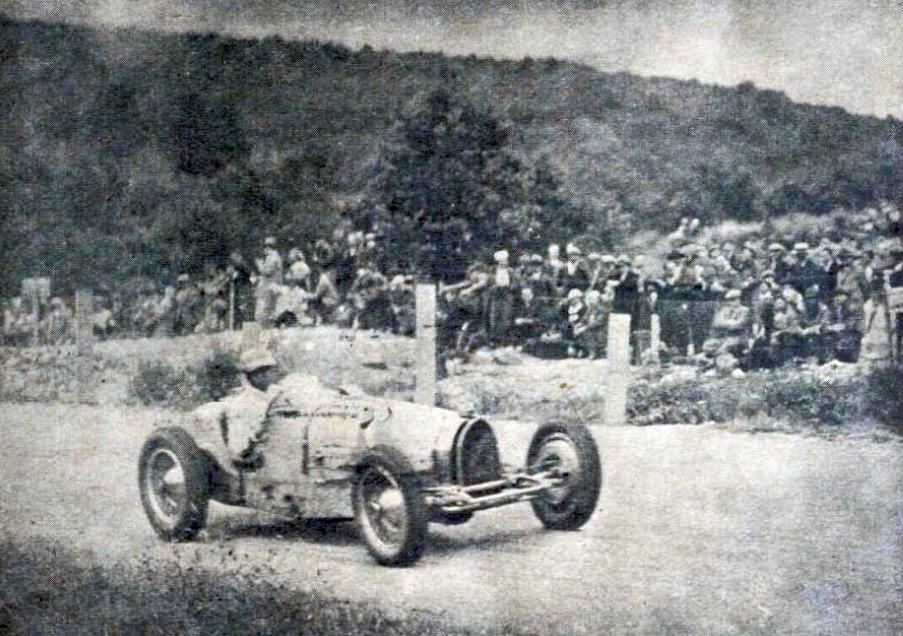
Wimille ended the 1934 season by beating the Italian cars in the Algerian Grand Prix at Bouzaréah on 28 October, more than five minutes ahead of the Scuderia Ferrari Alfa Romeo shared by Brivio and Chiron. By then the cars were "little slower than the German cars, and their road holding is extremely good for a normally sprung car", Motor Sport's 1934 review judged.
1935 and 1936: the last works cars
With four cars sold to Britain, the factory kept entering Wimille and Benoist in French and Spanish races in 1935 (Jenkinson, 1976). Wimille was second at Nancy, third at Dieppe and fourth in the Spanish Grand Prix behind three Mercedes-Benz W25s. On 19 July 1936 he won the Deauville Grand Prix by almost a minute and a half from Charlie Martin, by then in an Alfa Romeo P3; Marcel Lehoux was killed in an ERA in the same race (database).
The four British Bugatti Type 59s
In 1935 the factory sold four Bugatti Type 59s to British drivers: Earl Howe, the Hon. Brian Lewis, Charlie Martin and Lindsay Eccles. The company's 2013 release names the same four, gives the cars the chassis numbers 59121 to 59124, and says the price was 220,000 francs, "almost double the price of a Type 35B". Jenkinson wrote in 1982 that it was the last pure racing car Ettore Bugatti sold to customers, and Walsh that "tight finances meant Ettore never missed a chance to sell off or recycle competition cars".
| Chassis | Engine | First British owner or driver | Later history |
|---|---|---|---|
| 59121 | 3 | Charlie Martin | Duke of Grafton (killed in it, 1936), Arthur Baron, George Abecassis, Kenneth Bear (killed in it, Jersey, 1949), Stafford East; sold at Bonhams in 2005 |
| 59122 | 1 | Lindsay Eccles | Jack Lemon Burton, who took the engine to 3.8 litres and fitted hydraulic brakes; registered DBL 241 and still in England in 1976 |
| 59123 | 7 | Earl Howe | Sold in South Africa after the 1937 South African Grand Prix; back in Britain by the mid-1960s and owned by Neil Corner in 1976 |
| 59124 | 6 | Brian Lewis | Imported on French plates; to the United States in 1936, back to England, rebuilt by C. I. Craig, then a road car registered LPG 211; later with an American collector |
Sources: Jenkinson, Motor Sport, March 1976 and June 1982; the factory's 2013 release; New Atlas, March 2005. Motor Sport's digitised 1976 text gives "59121" for both Martin's and Eccles's cars; the 2013 release and the 2005 Bonhams sale identify Martin's car, "Voiture Moteur No. 3", as 59121, which leaves 59122 for Eccles.
The 1935 season
Lewis, Eccles and Martin all retired from the JCC International Trophy at Brooklands, and then Lewis won the Mannin Moar round the streets of Douglas on 31 May with Martin second and Luis Fontes third in an Alfa Romeo 8C 2300 Monza (Jenkinson, 1976; database). Whose car Lewis drove is told three ways: Jenkinson wrote in 1976 that 59124 was imported "for the Hon. Brian Lewis to drive"; in 1982 he called it "a similar Type 59, owned by Noel Rees"; and the database lists Earl Howe as the entrant. In the BRDC 500 Miles at Brooklands, won by the Napier-Railton, Lewis shared Howe's 59123, fitted for the race with an unsupercharged Type 57 sports engine, and they finished third. At the Donington Grand Prix on 5 October Martin led near the end, spun at Starkey's Hairpin, and finished third behind Richard Shuttleworth's Alfa Romeo P3 and Howe (Jenkinson, 1982; database).
Charlie Martin's car, 59121
Martin collected his car at Molsheim and drove it back across France to the Channel, which he later called "an awful journey and a bit of a mistake" (Jenkinson, 1982). A chassis lug broke at Brooklands, and in France he managed third in the second heat of the Marne Grand Prix at Reims and fifth in the final; the database has him sixth. "Fairly disenchanted with his acquisition", he sold it before the 1936 season to the Duke of Grafton, a Cambridge undergraduate who was killed in it in an Irish road race. Arthur Baron of Dorking rebuilt the car with an ENV pre-selector gearbox and painted it deep purple; George Abecassis raced it after the war, and Kenneth Bear died in it after its brakes failed in practice for the 1949 Jersey Road Race. Stafford East, who was in business with Bear, stored the wreck and rebuilt it; it ran again in 1982 for the first time since 1949. New Atlas reported in July 2005 that East's car, "preserved over five decades by its former mechanic, now in his 93rd year", had been bought at the Bonhams Goodwood Festival of Speed sale by Thomas Bscher, then president of the revived company in France.
Earl Howe's car, 59123
Earl Howe raced 59123 "on occasions", set his 138.34 mph Brooklands lap in it, took it to South Africa and sold it there to a local driver (Jenkinson, 1976). He was sixth in the South African Grand Prix at East London on 1 January 1937. Jenkinson wrote that the car came back to Britain about ten years before 1976 and was then the only one of the four "remaining in original condition and in full racing trim", owned by Neil Corner, who helped Motor Sport with Tony Matthews's cutaway drawing.
Lewis's and Eccles's cars
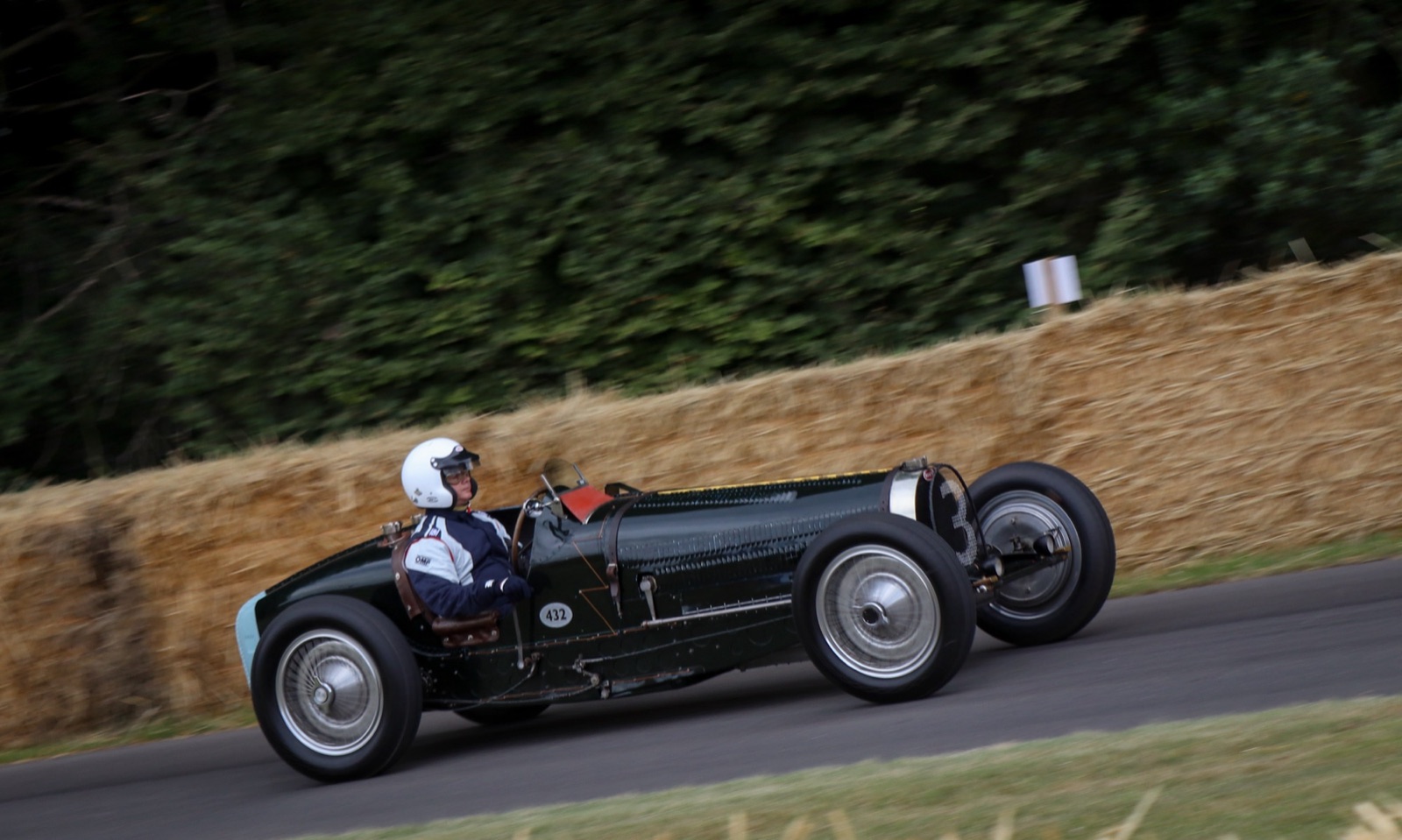
The Lewis car went to the United States in 1936, came back to England, and was rebuilt by C. I. Craig in black and white for sprints and hill climbs; both it and the Eccles car were later made into road cars "with mudguards, lights, starters and other necessities for road-use", Jenkinson wrote. Craig's car, repainted Bugatti blue and registered LPG 211, went to an American collector. A 2024 issue of the Bugatti Revue identifies LPG 211 as chassis 59124 in its road form, reproducing Ken Purdy's article in Sports Cars Illustrated of April 1957.
Who drove the Bugatti Type 59?
The Bugatti Type 59 was driven for the works team by René Dreyfus, Jean-Pierre Wimille, Robert Benoist, Achille Varzi, Antonio Brivio and Tazio Nuvolari, and in Britain by Earl Howe, Brian Lewis, Charlie Martin, Lindsay Eccles and Pat Fairfield, by the database's entry lists; Piero Taruffi drove one in four races in 1935, with fifth in the Italian Grand Prix his best. William Grover-Williams, entered as W. Williams, was the San Sebastián non-starter of 1933 and finished ninth at Monaco in 1936.
Dreyfus was the team's best driver in 1934: "Chez Bugatti, Rene Dreyfus was the star performer," Motor Sport's review said, with the Belgian win and thirds at Monaco and Bremgarten. The drivers did not like the car: it was "disliked by all of the team drivers because of its unpredictability", according to Motor Sport's profile of Dreyfus in July 1991. The historic racer Neil Corner, who raced Howe's car and a P3 decades later, told Classic & Sports Car it was "a superlative car that's superb on fast corners and drifts beautifully. It handled so much better than my Alfa P3."
The Bugatti Type 59 Sports and King Leopold III
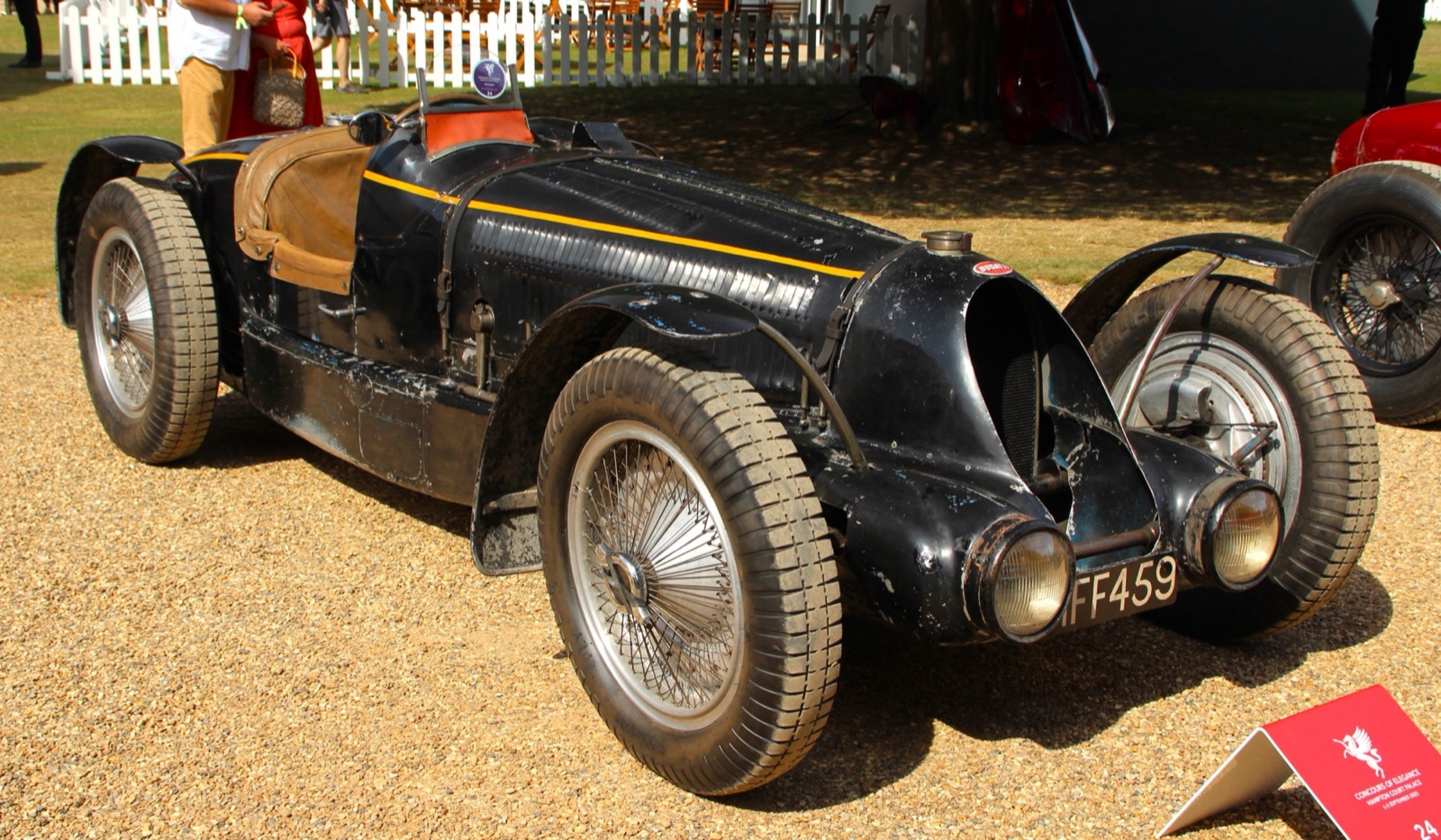
The Bugatti Type 59 Sports is the works Bugatti Type 59 that the factory rebuilt as a sports car, renumbered 57248, raced with Wimille in 1937 and sold to King Leopold III of Belgium. The company's own press release on the car calls it the only Grand Prix car the factory converted into a sports car, with new bodywork.
From Grand Prix car to sports car
The idea came from the 1936 Grand Prix du Comminges, a sports-car race, where the team arrived with two Type 59s fitted with unsupercharged Type 57G engines; the Delahaye drivers talked of a boycott, the race director Charles Faroux let them run, and Wimille won both races, Walsh wrote in Classic & Sports Car. For 1937 the car got a four-speed, all-synchromesh gearbox with a central change, twin-pump lubrication from an oil tank in the tail, a new body from the scuttle back with shallow doors and a rounded tail, cycle wings, small headlamps, the production number 57248 and the registration 344 NVV. The mechanics called it "La Grand-Mère".
The 1937 season
Walsh's race-by-race account has Wimille winning at Pau on 21 February "a lap up on the entire field", running out of fuel in sight of the finish in Tunisia, winning at Bône in Algeria a week later, losing to a Talbot with engine failure at Miramas, and winning the Marne Grand Prix at Reims on 18 July nearly three minutes ahead of Albert Divo's Talbot. The company's press release lists Pau, Tunis and Marseille among the car's 1937 wins, with the Algerian Grand Prix and the Marne; Walsh has it beaten at Tunis and Marseille.
King Leopold III and later owners
King Leopold III bought the car in 1937 and had it painted black, his favourite colour, with a yellow stripe for Belgium's racing colours, according to that release; the Gooding catalogue of 2020, as Sports Car Market reprinted it, dates the sale to 1938. Whether it was a sale, a gift, or a part-exchange for the King's Type 51 is "unclear", Walsh wrote. In 1967 the Belgian enthusiast Stéphane Falise bought it from the royal household, and in 1989 he sold it to the American collector Bob Rubin, whose restorers overhauled the mechanicals and left the body alone; the Ferrari collector Anthony Wang owned it from the late 1990s. Walsh wrote that the car had had five owners in 75 years, and of its Grand Prix career only that "Bugatti experts reckon that '57248' was one of the four-car team at Spa in 1934". The company's 2021 review of the year's records and the Belgian broadcaster VRT, reporting the car's display at the Zoute Grand Prix in 2026, both say it won the Belgian Grand Prix, while its press release on the Type 59 Sports puts Benoist fourth at Spa in it.
On 18 August 2024 the car won Best of Show at the Pebble Beach Concours d'Elegance, the first preservation-class car to do so, shown by Fritz Burkard of The Pearl Collection in Zug, Switzerland, according to the Concours's announcement. Its chairman, Sandra Button, called it "the first Type 59 built".
The Bugatti Type 59/50B single-seaters
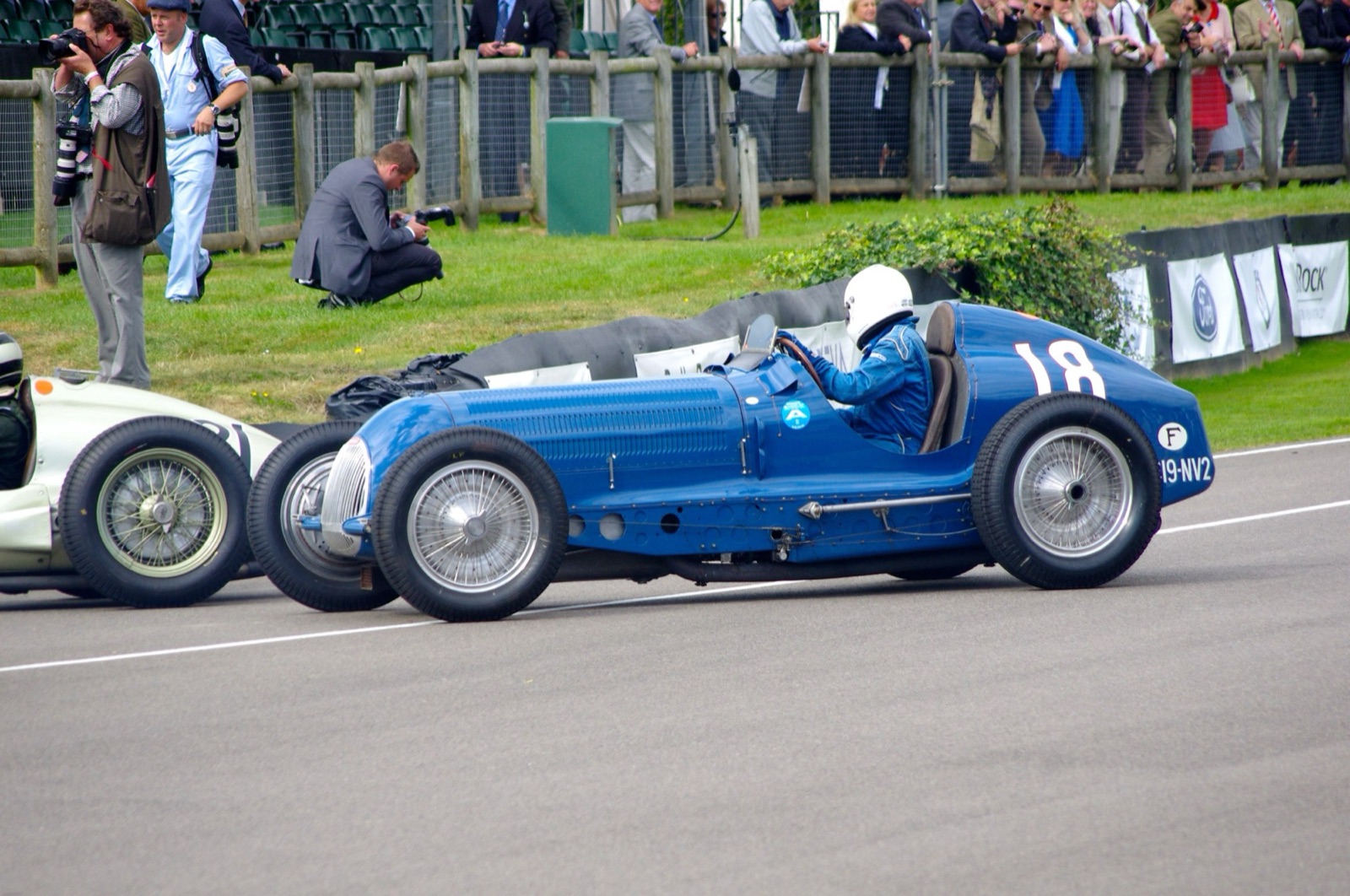
The Type 59/50B is the single-seat development of the Bugatti Type 59 that the works team raced from 1936 to 1939, with a new alloy-block straight-eight. One works frame ran in the 1935 French Grand Prix at Montlhéry with an almost five-litre engine, then got a 4.7-litre 50B engine of more than 400 hp and a single-seat body for 1936, according to Radical's 2022 history of the "Cork car". It did not start at Monaco in April 1936, the race in which the Mercedes-Benz W25 beat the Auto Union Type C, and its gearbox failed at Bremgarten, Wouter Melissen wrote in 2011 in an article reprinted by the Vanderbilt Cup Races site. It then finished second in the Vanderbilt Cup. Bonhams's 2005 catalogue, as New Atlas reported it, numbered the frame of the 1935 Montlhéry car 2, where the factory's account gives 6.
The "Cork car" and the last Grand Prix Bugattis
For 1938 the same frame, number 6, took a 3-litre supercharged 50B III engine of 78 × 78 mm and 2,985 cc, and first raced at the Cork Grand Prix in April, hence its name (Radical; Melissen). Its last race was the French Grand Prix at Reims in July 1938, where Wimille started from the back, went off avoiding Rudolf Hasse's spinning Auto Union and retired with a damaged oil line: the marque's last Grand Prix before the war. The American enthusiast Ray Jones bought the rolling chassis in 1964 and spent decades finding its parts; the car, stamped with the Type 44 number 441352, was shown complete in 1995. A second 59/50B of 1939 won the Coupe de Paris at Montlhéry and, after the war, the 1945 Coupe des Prisonniers, Melissen wrote.
How many Bugatti Type 59s were built, and where are they now?
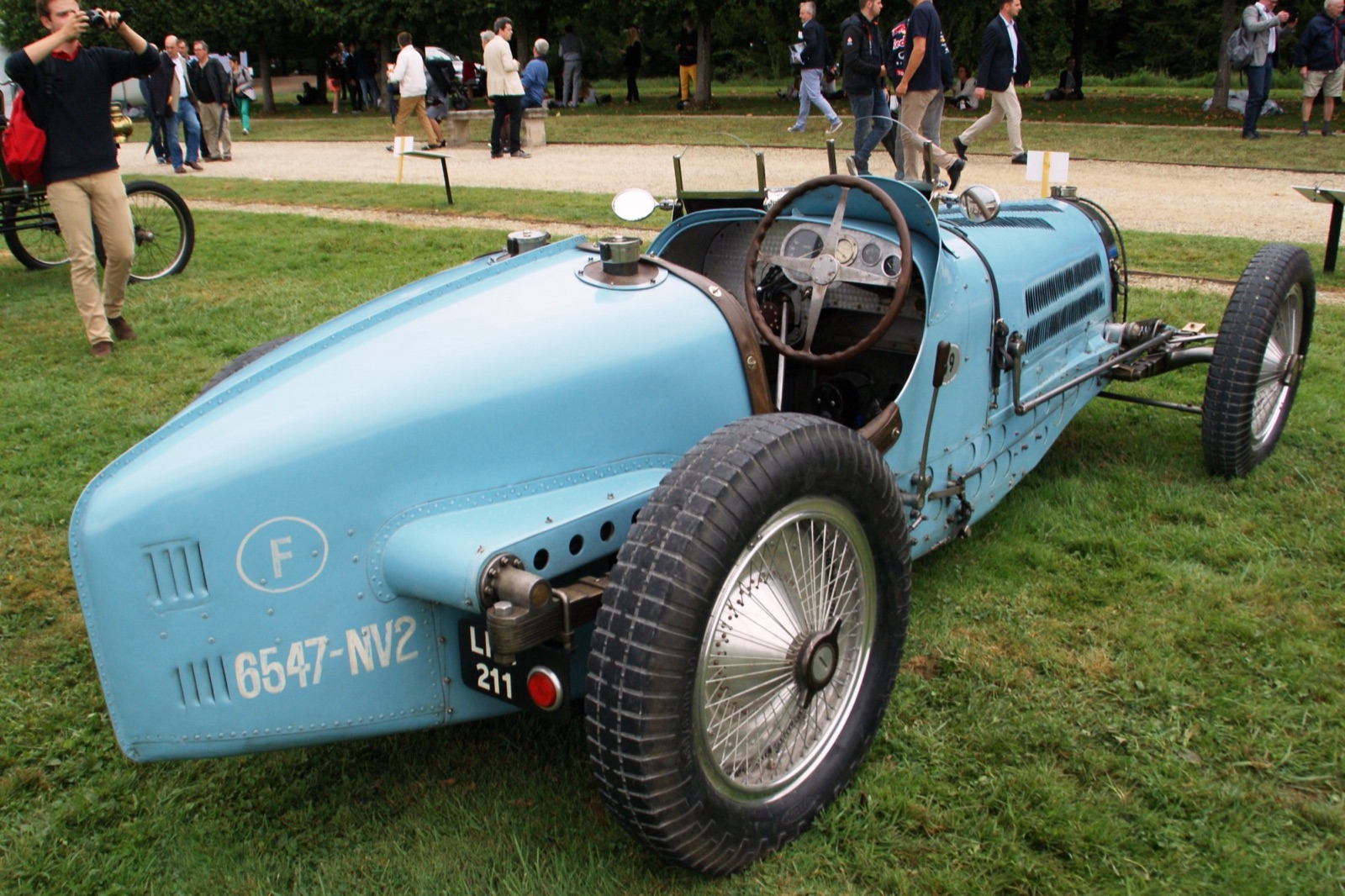
The number of Bugatti Type 59s built is given as six, seven or eight, and the factory listed its racing cars by engine number, not chassis. "Bugatti racers were listed by engine number rather than chassis details", Walsh wrote, and "it's impossible to work out the individual early histories of the six Grand Prix Type 59s". The Trust gives six or seven; Classic Driver's Alex Easthope wrote in 2019 that seven were built in Grand Prix form; and New Atlas, reporting the Bonhams catalogue in March 2005, said eight, of which five survived, and "no more than eight" after the sale.
The surviving cars
All four British cars survive. Kruta gathered them at Pebble Beach in August 2019, "for the first time since 1935", and told Classic Driver that December that one was in England, one in Germany and two on the East Coast of the United States; Ralph Lauren's was among them. The Pebble Beach Concours's notice of Kruta's book describes photographs of "the five surviving cars" taken there in 2019, and names the industrial designer Marc Newson as an owner. The fifth is the Type 59 Sports, 57248, in The Pearl Collection. The Type 59/50B III Cork car, built on a works frame, passed into British hands after a long spell in the United States, Melissen wrote in 2011.
The Bugatti Type 59 book
Kruta, the Grand Prix Bugatti specialist Mark Morris and the journalist Mick Walsh wrote the history of the car, published in three volumes of 920 pages and presented at Rétromobile in Paris in 2025, with Marc Newson designing its special-edition cases (Classic Driver; Pebble Beach Concours; Acquire).
How much is a Bugatti Type 59 worth?
The highest price paid for a Bugatti Type 59 at auction is £9,535,000, for the Type 59 Sports 57248 at Gooding & Company's Passion of a Lifetime sale at Hampton Court Palace on 5 September 2020, a world auction record for the marque at the time, according to Gooding's announcement. The company's 2021 review gave the price as $12.681 million. The estimate was £10 million (Gooding lot page).
The first Bugatti Type 59 offered at public auction, Martin's 59121, sold for £1.32 million (US$2.32 million) at Bonhams' Festival of Speed sale in June 2005, New Atlas reported, the highest price of that sale.
Bugatti Type 59 rivals and successor
The Bugatti Type 59 was built to race the Alfa Romeo P3, and in 1934 and 1935 it also met the Mercedes-Benz W25, the Auto Union and the Maserati 8CM. By the French Grand Prix of 1934 "even the illustrious 'monoposto' Alfa Romeos were looking obsolete in the face of the new designs from Mercedes-Benz and Auto-Union, so that the Type 59 Bugattis had little hope of being more than also rans", Jenkinson wrote in 1976. Alfa Romeo also enlarged the P3's engine, to 2.9 and then 3.2 litres (Jenkinson, 1982).
Alfa Romeo P3
Alfa Romeo P3s won 8 of the 21 races in the results table above, and Martin sold 59121 to buy one (Jenkinson, 1982). In Britain the P3 beat the Type 59s at Donington in 1935 with Shuttleworth.
Mercedes-Benz W25 and Auto Union
The German cars won the 1934 Coppa Acerbo, Swiss and Spanish Grands Prix in which Type 59s finished third (database). In the 1935 Spanish Grand Prix Wimille was fourth, 41 seconds behind von Brauchitsch's third-placed W25.
Bugatti's own successors
The Bugatti Type 59's Grand Prix successors were the Type 59/50B single-seaters. In sports-car racing the factory turned to the Type 57G engine it had tried in the Type 59s at Comminges in 1936; the Type 59 Sports "had never faced up to the Alfa 8C-2900A Spider Corsas", the Alfa Romeo 8C 2900, Walsh wrote.
Questions and answers
Why does the Bugatti Type 59 have holes in its chassis?
Bugatti drilled the frame's side members to bring the cars under the 750 kg maximum weight of the 1934 Grand Prix formula, Denis Jenkinson wrote in Motor Sport in 1976; Bugatti's 2013 release says the change is recorded in the factory books.
Did Tazio Nuvolari race a Bugatti Type 59?
Yes. Nuvolari drove a fourth Type 59 at Monaco in April 1934, run as an independent entry with factory support, and finished fifth; he was third in the Spanish Grand Prix at Lasarte that September, by the Motor Sport database.
Was the Bugatti Type 59 a single-seater?
No. The Type 59 had a body of two-seater width, with the oil tank where a passenger would sit. Its 1936 development, the Type 59/50B, was the first Bugatti Grand Prix car with a single seat, Wouter Melissen wrote in 2011.
What colour is King Leopold's Bugatti Type 59?
Black with a yellow stripe, the colours Leopold III ordered; Bugatti blue shows through where the black has worn, Mick Walsh wrote in Classic & Sports Car.
Why is the Type 59 Sports called La Grand-Mère?
"La Grand-Mère" (Grandmother) was the name Bugatti's mechanics at Molsheim gave the car, according to Bugatti's press release on the Type 59 Sports.
Who owns a Bugatti Type 59 today?
Ralph Lauren and the designer Marc Newson own Type 59s, Classic Driver reported in 2019, and Fritz Burkard's Pearl Collection in Switzerland owns the Type 59 Sports that won Best of Show at Pebble Beach in 2024.
Sources
- Denis Jenkinson, "The Bugatti 3.3 litre Type 59", Motor Sport, March 1976 (the 1932 start, San Sebastián, the 750 kg formula and the weighing, the 1934 races, the four British cars by chassis and engine number, their 1935 seasons and later owners, Howe's Brooklands lap, the design and engine).
- Denis Jenkinson, "Historic Grand Prix cars", Motor Sport, June 1982 (the Type 59 against the Alfa Romeo Tipo B, the last Bugatti racing car sold to customers, Charlie Martin's car 59121 from 1935 to its rebuild by Stafford East).
- Motor Sport, report of the 1934 Belgian Grand Prix, September 1934 (the German withdrawal and fuel duty, the race, Benoist's speed after Burnenville, the lap record).
- Motor Sport, "Looking back on 1934", December 1934 (Bugatti's season, the rail-cars, Dreyfus as the team's star).
- Motor Sport, "Veteran to classic: René Dreyfus", July 1991 (the drivers' view of the Type 59, Dreyfus's 1934 results).
- Motor Sport database, race pages for the 1933 Spanish, 1934 Monaco, French, Vichy, Belgian, Coppa Acerbo, Swiss, Spanish and Algerian Grands Prix; the 1935 Mannin Moar, Lorraine, Marne, Dieppe, Spanish and Donington Grands Prix; the 1936 Deauville Grand Prix, Monaco Grand Prix and Vanderbilt Cup, the 1935 Eifelrennen, German, Belgian and Italian Grands Prix; and the 1937 South African Grand Prix, read 31 October 2026 (dates, entrants, results).
- Bugatti Automobiles, "Salon Rétromobile: Bugatti celebrates 80th anniversary of the Type 59 Grand Prix", press release, 6 February 2013 (the first three cars, chassis 59121 as "Voiture Moteur No. 3", the 3.3-litre crankshaft, the four British buyers and the price). Bugatti's release "Bugatti Type 59 Sports: sporting the battle scars of early Grand Prix racing" (dated 1 June 2022 on its newsroom) is cited in the text unlinked.
- Bugatti Automobiles, "Bugatti heritage: a year of records", press release, 2 February 2021 (the 2020 sale of 57248 in dollars, power outputs).
- The Bugatti Trust, "Bugatti Type 59", data sheet, 31 October 2014 (number made, dimensions, engine, wheels, weight).
- Mick Walsh, "Original is best: ex-King Leopold Bugatti Type 59", Classic & Sports Car, November 2008, republished 2020 (the conversion of 57248, the 1936 Comminges race, the 1937 season, King Leopold III, later owners, Neil Corner's view, top speed).
- Alex Easthope, "A glorious Grand Prix reunion with all four Bugatti Type 59s", Classic Driver, 25 December 2019, with an interview with Julius Kruta (seven built in Grand Prix form, the single win, the four survivors and where they are, Ralph Lauren and Marc Newson as owners, the book).
- Pebble Beach Concours d'Elegance, "Preservation Bugatti named Best of Show at the 73rd Pebble Beach Concours d'Elegance", 18 August 2024; and "The Bugatti Type 59 book", 18 July 2024 (the five surviving cars photographed in 2019, the three volumes, Rétromobile 2025).
- Acquire, "Bugatti Type 59 tells the story of the legendary race car across a 920-page, three-volume set", 2025 (the wheels as the book describes them).
- Gooding & Company, "Passion of a Lifetime achieves over £34 million; sets all-time auction record for a Bugatti", 6 September 2020 (the price of 57248). The estimate is from Gooding's lot page, and the catalogue's 1938 date for the sale to King Leopold from Sports Car Market's profile of the car; both are cited unlinked.
- New Atlas, "Bugatti Type 59 for sale", 12 March 2005 (the Bonhams catalogue: eight built, five survivors, Voiture Moteur No. 3 as 59121) and "Rare racing cars in Goodwood sales", 5 July 2005 (the £1.32 million sale and its buyer; "no more than eight"; the Type 59/50B frame No. 2).
- VRT NWS, "King Leopold III's rare Bugatti on display at the Zoute Grand Prix", 30 June 2026 (the Belgian Grand Prix claim, the 1937 sale, The Pearl Collection).
- Radical, "Bugatti Type 59/50 BIII: Cork car", 23 June 2022 (frame number 6 from 1935 to 1938, the 50B engines, the Vanderbilt Cup, Reims 1938, Ray Jones).
- Wouter Melissen, "Bugatti's last Grand Prix racer", 30 September 2011, as reprinted by the Vanderbilt Cup Races site (the 59/50B in 1936–39, the 50B III engine, the second 59/50B, the car's British owner).
- The Bugatti Revue, "Last of the legendary Bugs: the 3.3 Type 59", volume 29 (2024), issue 2, reproducing Ken W. Purdy's article in Sports Cars Illustrated, April 1957 (LPG 211 as chassis 59124).