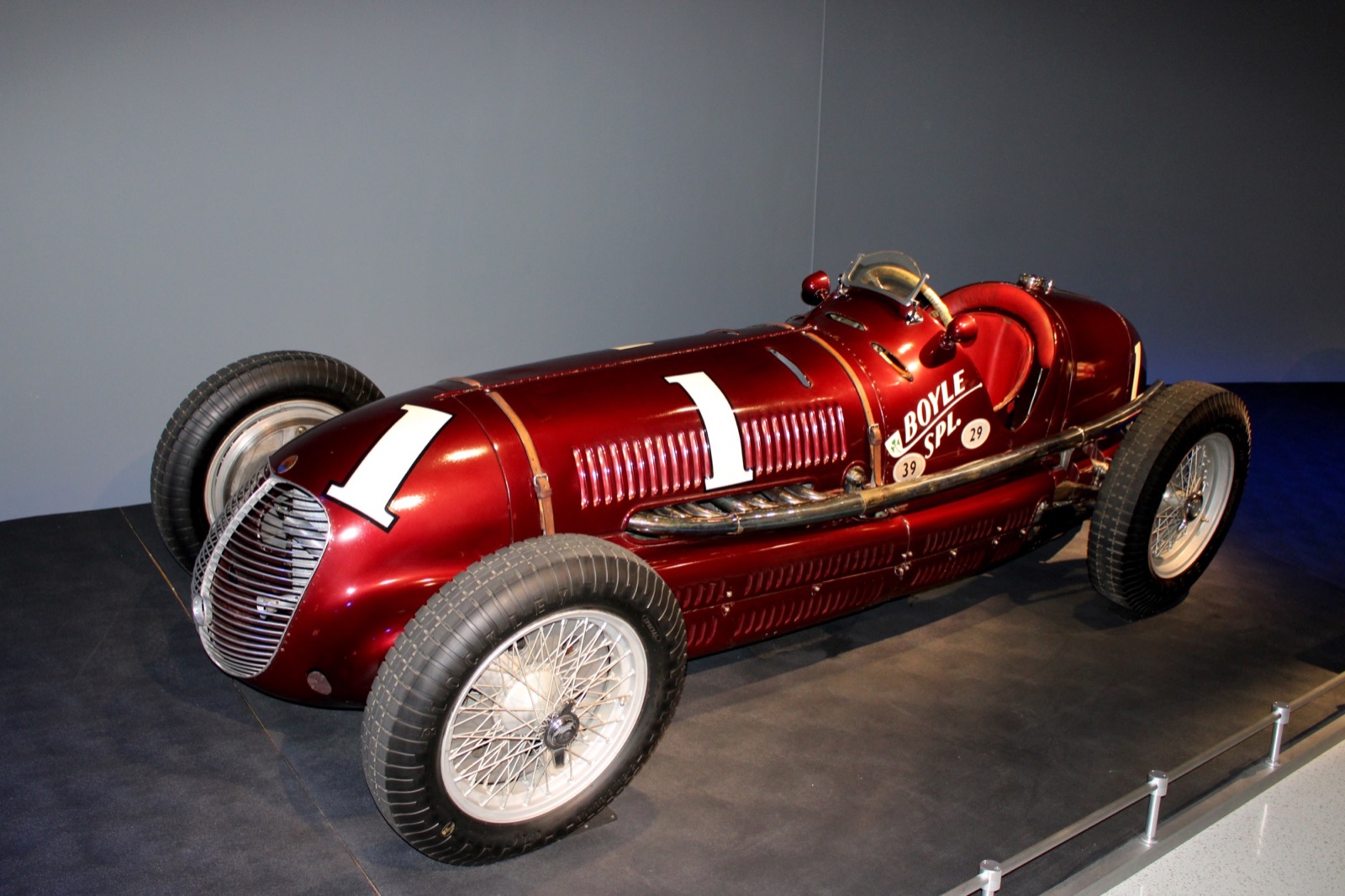
The Maserati 8CTF is the Grand Prix car Maserati built for the three-litre formula of 1938, with a supercharged straight-eight of 2,991 cc in a steel-framed single-seater. In Europe it was fast and fragile: Carlo Felice Trossi was fastest in practice at Livorno in 1938, ahead of the Mercedes-Benz team, and its best result was Paul Pietsch's third in the 1939 German Grand Prix. In America one car, chassis 3032, became the Boyle Special and won the Indianapolis 500 in 1939 and 1940 with Wilbur Shaw. Shaw was the first driver to win the race in consecutive years, by the Indianapolis Motor Speedway's own account.
Who designed the Maserati 8CTF, and why?
The Maserati 8CTF was designed by Ernesto Maserati for the Grand Prix rules that took effect in 1938, according to Maserati's account of the car, published on 30 May 2019. The brothers had sold their company's shares in May 1937 to the family of Adolfo Orsi, industrialists from Modena, and Maserati's press release of 25 May 2014 says the car was conceived "with the strong support" of the Orsis. Maserati's 2020 account calls the car its "bid to return to competitiveness against the other European constructors".
The three-litre formula of 1938
The 1938 regulations limited supercharged engines to three litres (3,000 cc) and tied the permitted capacity to the car's weight, as Maserati's 2019 account puts it. The German teams built new cars for it, Denis Jenkinson wrote in Motor Sport in April 1968. Every race the 8CTF started in Europe was won by the Mercedes-Benz W154 or the Auto Union Type D, by the Motor Sport database's results. The 8CTF was Maserati's first car for the formula; the 8CL that followed had four valves per cylinder, Jenkinson wrote.
From voiturette to Grand Prix car
Jenkinson explained the design again in Motor Sport in February 1982. Maserati's 1½-litre voiturette had a four-cylinder engine with head and block in one piece, two valves per cylinder and twin overhead camshafts. For 1938 the brothers "doubled-up on this basic design" to make a supercharged straight-eight, a layout with which Maserati had "accumulated considerable experience", Roberto Motta wrote for Veloce Today. Jenkinson gave the name as 8 for the cylinders, C for corsa (racing) and TF for testa fissa, the fixed head, to set it apart from the 8CM of 1934, whose head came off.
Maserati 8CTF design and engineering
The Maserati 8CTF has a front-mounted straight-eight made of two four-cylinder blocks end to end, two Roots superchargers, a four-speed gearbox and a steel chassis with torsion-bar independent front suspension and a one-piece rear axle. In 1968 Jenkinson found it "rather old fashioned" beside the German cars, with their tubular frames and V12 engines.
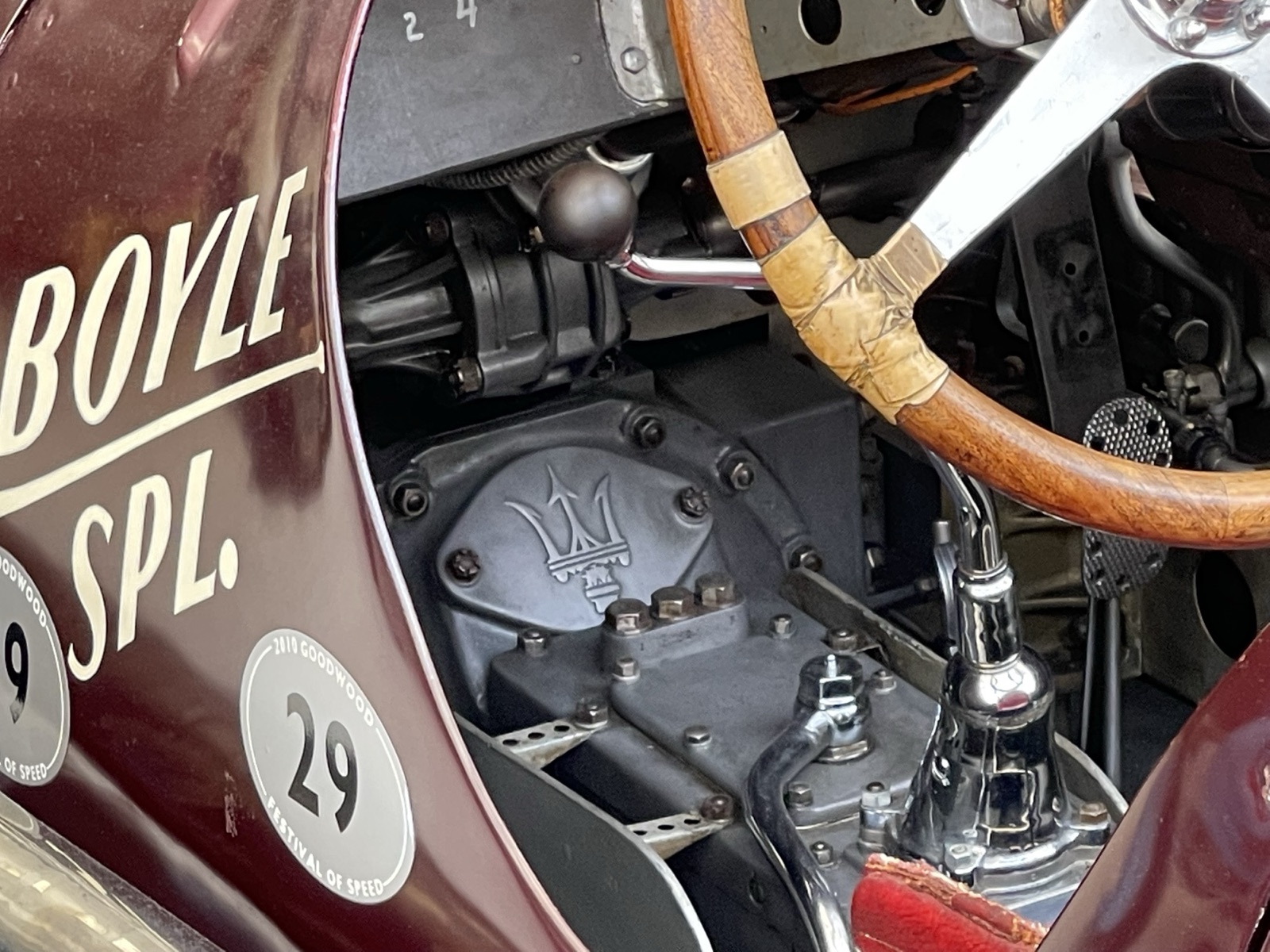
The straight-eight engine and its two superchargers
Maserati's 2019 account gives the engine a displacement of 2,991.4 cc and a compression ratio of 6.5:1. The cylinders are cast in two groups of four, each a monoblock with its cylinder head. Two valves per cylinder, set at 90 degrees, are worked by two overhead camshafts. The bore and stroke, 69 × 100 mm, are those of Maserati's earlier four-cylinder engines, Jenkinson wrote in 1968.
Both Roots-type superchargers sit at the front of the engine, one above the other, and each has its own carburettor. They feed a common manifold for all eight cylinders: "twin superchargers but not two-stage supercharging", in Jenkinson's words of 1982. Revs Institute's 2018 history of the three cars says the fixed head had no gasket.
Chassis, suspension and brakes
The frame is two steel side members with cross-members, a box-section frame that Revs says was stiffened by the oil tank, X-shaped and made of magnesium. The front wheels are independently sprung by wishbones and longitudinal torsion bars, and at the rear a one-piece axle sits on splayed quarter-elliptic leaf springs. Goodwood Road & Racing, writing in 2026, credits the car with 16-inch magnesium drum brakes, at a time when, it says, most Indianapolis cars used production brakes.
Maserati 8CTF specifications
The Maserati 8CTF is a 2,991 cc supercharged straight-eight single-seater that Revs Institute rates at 360 hp and 1,716 lb.
| Item | Figure | Source |
|---|---|---|
| Engine | Straight-eight, front-mounted, two blocks of four with fixed heads | Maserati, 2019; Jenkinson, 1968 |
| Capacity | 2,991.4 cc | Maserati, 2019 |
| Bore and stroke | 69 × 100 mm | Jenkinson, 1968 |
| Compression ratio | 6.5:1 | Maserati, 2019 |
| Valves | Two per cylinder, two overhead camshafts (twin-cam) | Maserati, 2019 |
| Supercharging | Two Roots blowers, one above the other, single-stage, one carburettor each | Jenkinson, 1982 |
| Power | 360 hp at 6,300 rpm | Revs Institute (2018 history; its page for 3030 gives the rpm) |
| Gearbox | Four speeds, in unit with the engine | Jenkinson, 1968; Revs Institute |
| Front suspension | Independent, wishbones and longitudinal torsion bars | Jenkinson, 1968 |
| Rear suspension | One-piece axle on quarter-elliptic leaf springs | Jenkinson, 1968 and 1982 |
| Weight | 1,716 lb (778 kg) | Revs Institute, 2018 |
How much horsepower did the Maserati 8CTF have?
The Maserati 8CTF had about 350 to 360 hp. Revs Institute rates the engine at 360 hp in its 2018 history, and its page for the car adds 6,300 rpm. Goodwood's 2026 article on the Schell cars says it made "in excess of 350PS".
How fast was the Maserati 8CTF?
The Maserati 8CTF lapped the fast Mellaha track at Tripoli at about 137 mph in its first race, on 15 May 1938, by Motor Sport's report of June 1938, which credited Trossi with the race's fastest lap. Jenkinson (1968) gave Lang the fastest lap at 136 mph, with Trossi second at 135. At Indianapolis Shaw qualified the Boyle Special at 128.977 mph in 1939 and 127.065 mph in 1940, according to the Indianapolis Motor Speedway Museum's page for the car. Goodwood's article on the Schell cars gives a maximum speed of 180 mph.
Maserati 8CTF racing history in Europe
The Maserati 8CTF started seven Grand Prix races on European circuits in 1938 and 1939 and won none; its one podium was Pietsch's third in the 1939 German Grand Prix, by the Motor Sport database's results. Motor Sport's December 1938 review called it a "dark horse", with "great speed but for the present lacking reliability". Goodwood's 2026 article on the Indianapolis wins thought it "might have been a Mercedes and Auto Union beater" had it been more reliable.
| Race | Date | 8CTF drivers and results | Winner |
|---|---|---|---|
| Tripoli Grand Prix | 15 May 1938 | Trossi retired after 15 laps; Achille Varzi retired after 11 (rear axle) | Lang (Mercedes-Benz W154) |
| Coppa Ciano, Livorno | 7 August 1938 | Trossi retired after 8 laps (engine); Goffredo Zehender retired after 30 laps (on the second lap by Motor Sport's notes) | Lang (Mercedes-Benz W154) |
| Coppa Acerbo, Pescara | 14 August 1938 | Trossi and Luigi Villoresi, sharing, retired after 10 laps (engine) | Caracciola (Mercedes-Benz W154) |
| Italian Grand Prix, Monza (EC) | 11 September 1938 | Trossi disqualified after 56 laps; Villoresi retired after 29; Zehender retired after 15 | Nuvolari (Auto Union D) |
| Donington Grand Prix | 22 October 1938 | Villoresi retired after 18 laps (piston) | Nuvolari (Auto Union D) |
| German Grand Prix, Nürburgring (EC) | 23 July 1939 | Paul Pietsch 3rd, 21 laps; Villoresi retired after 6 laps | Caracciola (Mercedes-Benz W154) |
| Swiss Grand Prix, Bremgarten (EC) | 20 August 1939 | René Dreyfus 8th; Georges Raph out in his heat | Lang (Mercedes-Benz W154) |
Results and dates from the Motor Sport database's pages for each race, among them the 1938 Tripoli Grand Prix, the 1938 Italian Grand Prix and the 1939 German Grand Prix. Jenkinson (1982) put Trossi's Tripoli retirement down to the gearbox, where the database records the engine; Motor Sport's June 1938 report has him out on the eleventh lap, after Varzi, where the database and Jenkinson give 15 laps; the database calls the 1939 Mercedes the W163.
1938: Trossi leads the Mercedes-Benz team
The Maserati 8CTF made its debut at Tripoli with two cars, Varzi's 3030 and Trossi's 3031, by Jenkinson's 1982 account; in 1968 he had written of "a lone Maserati". Goodwood's 2019 article calls it "the return of Maserati to Grand Prix racing", and says gearbox and axle problems ended both cars' races. Trossi ran second, 37 seconds behind Lang after ten laps, and retired on the next lap, Motor Sport reported in June 1938; Maserati's 2019 account says he led for several laps.
At Livorno on 7 August Trossi was fastest in practice on both days, with 2 min 26.1 sec against 2 min 26.4 sec for Lang and Caracciola, wrote Motor Sport's Continental notes of September 1938. In the race he lay back for three laps, then passed both Mercedes to take the lead, and "the crowd nearly went mad". He kept up the pace until the engine began to fail. Mercedes-Benz Classic's entry for the 1938 W 154 also records him leading in the early laps, and Jenkinson (1968) for four.
A week later at Pescara only one 8CTF ran. Trossi spun, pulled a muscle push-starting the car and handed it to the reserve driver, Villoresi, by Jenkinson's 1982 account. Villoresi set the race's fastest lap, 10 min 57 sec by Motor Sport's September notes, before the engine began to misfire. Motor Sport's review of the 1938 season said he passed "the German cars one after another". Jenkinson wrote in 1968 that "if only Maserati had an organised team like the Germans they could have been winning races".
At Monza on 11 September, three 8CTFs started. Trossi finished fifth on the road, as Motor Sport's December review recorded, but was disqualified for taking help from a mechanic away from the pits, according to Jenkinson and the database. Villoresi took an 8CTF to Donington in October, where it retired after 18 laps with piston trouble.
1939: Pietsch at the Nürburgring and the Schell cars
"In 1939 the Italians decided to run all their races to a 1,500 c.c. limit, in a rather unsporting attempt to stop the Germans winning races," Jenkinson wrote in 1968, and Maserati "slowed up on development of the 8CTF". The factory raced it only once that year, in the German Grand Prix on 23 July, he wrote in 1982. Pietsch, in 3031, passed Caracciola on the first lap and took the lead on the second when Lang stopped at his pit, as Motor Sport reported in August 1939. Plug trouble and pit stops dropped him back, and he finished third behind Caracciola and Hermann Paul Müller's Auto Union.
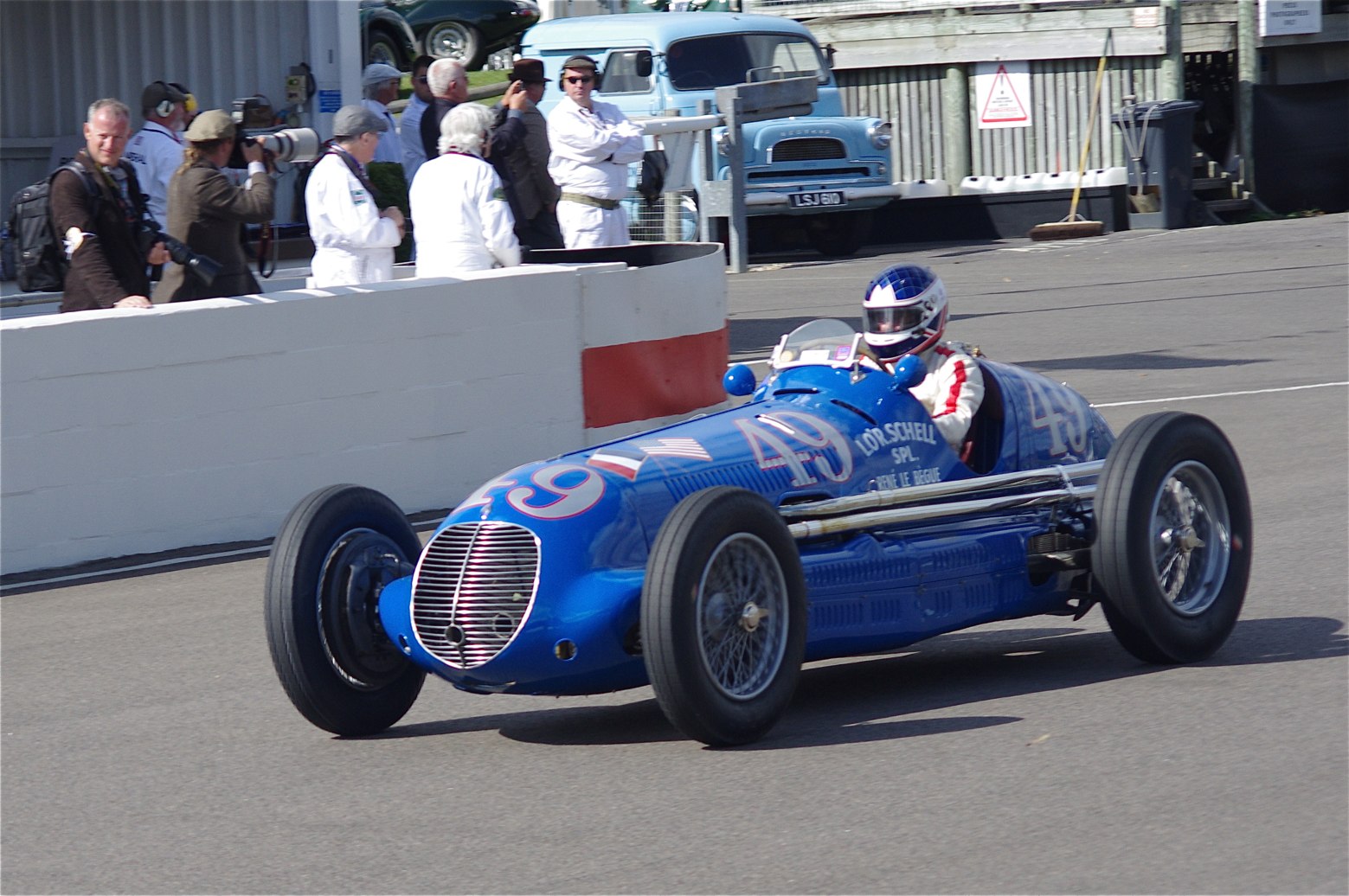
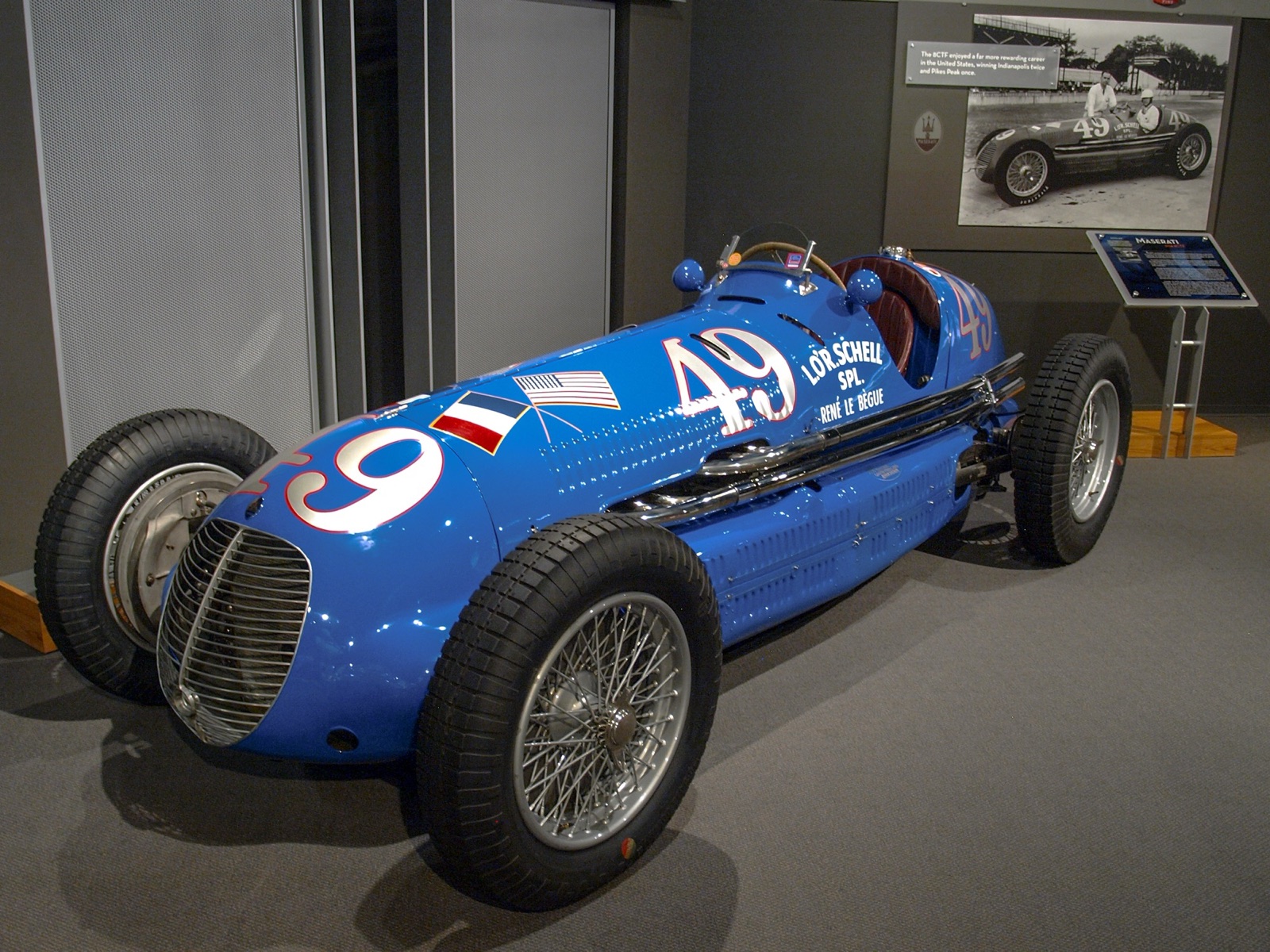
Maserati then sold 3030 and 3031 to Laury Schell and his American wife, Lucy O'Reilly Schell, whose Ecurie Bleue had raced Delahayes. Revs says they painted their cars in the racing colour of France, their adopted country. Dreyfus drove 3031 to eighth in the Swiss Grand Prix, and Raph's 3030 did not start after engine trouble in practice, by Jenkinson's 1982 account; the database has Raph eliminated in his heat. The Second World War cancelled a race at Zurich in October, and Laury Schell was killed in a road accident on 16 October 1939, Jenkinson wrote in 1968.
Maserati 8CTF in America: Indianapolis and Pikes Peak
The Maserati 8CTF won the Indianapolis 500 twice, in 1939 and 1940, both times with Wilbur Shaw in chassis 3032. 8CTFs also finished third in 1946 and 1947 and fourth in 1946 and 1948, by the Motor Sport database, which lists the race as a round of the AAA National Championship series.
How the Boyle Special was bought
Shaw had seen the European cars race at Roosevelt Raceway in 1936 and 1937, and believed he could win Indianapolis with one, Jenkinson wrote in 1968. Mike Boyle, a Chicago entrant who owned Boyle Racing Headquarters, agreed to buy a Maserati. The first car Boyle's mechanic Harry "Cotton" Henning brought back, in 1938, was a 1½-litre six-cylinder, the 6CM voiturette in Goodwood's account, and Shaw handed it to Mauri Rose. Early in 1939 Henning went to Bologna and bought an 8CTF, Maserati's 2019 account says; the car's performances in 1938 had brought orders from customers.
Goodwood says the car was said to have cost Boyle $15,000. It was shipped with water in its engine, which froze during the Atlantic crossing and cracked the cylinder blocks. Jenkinson (1968) wrote that a replacement engine, number 3033, was sent over in time for practice, with no chassis of that number. Goodwood has Henning rebuilding the engine at Boyle's shop in Gent Street. Maserati says the car was painted in Boyle's amaranth (dark red) livery.
1939: Shaw's first win in the 8CTF
From a starting position of third, Shaw led 51 laps and won the race on Tuesday 30 May 1939 at 115.035 mph, according to the IMS Museum and the database's page for the race. He passed Louis Meyer with 18 laps to go, and Meyer spun out of second place two and a half laps from the end, by the Speedway's own year-by-year history of the 1930s. Shaw crossed the line after 4 hr 20 min 47 sec, and the database times put Jimmy Snyder's Adams-Sparks second, 1 min 48 sec behind.
The defending winner, Floyd Roberts, was killed in an accident just past half distance. Motor Sport's report of July 1939 said the Maserati was the first European car to win since Howdy Wilcox's Peugeot in 1919, and put the crowd at 145,000.
1940: the second win, and the French team
Four three-litre Maseratis were entered in 1940: Shaw's Boyle Special, the two Schell 8CTFs for Dreyfus and René Le Bègue, and Raoul Riganti's 8CL, according to Jenkinson (1968). On the 2.5-mile oval Shaw started second and led 136 of the 200 laps, by the Speedway's 2020 feature on his career. Rain kept the caution flag out for the last 100 miles, and Shaw won at 114.277 mph from Rex Mays and Mauri Rose.
The Speedway's history of the 1940s says he became "the first person to win the '500' in consecutive years", and its second three-time winner after Meyer. Dreyfus had beaten Mercedes-Benz at Pau in 1938 in an Ecurie Bleue Delahaye, Revs says. At Indianapolis he failed to qualify his own car and broke a connecting rod trying again in Le Bègue's. The two shared the car Le Bègue had qualified, fitted with the other car's engine, and brought it to a tenth-place finish; Goodwood says they were the only non-American drivers to finish. Jenkinson's 1982 article and Revs both name that car as 3030; his 1968 history had said 3031.
1941: the hat-trick that failed
The 1941 race was the last until 1946 because of America's part in the Second World War, the Speedway's history says. Shaw was leading on the 152nd lap when a wheel collapsed and sent him into the wall at the first turn, the Speedway's 1940s history records. Maserati's 2020 account calls the cause a puncture. Rose started from pole in one of the former Schell cars, entered as the Elgin Piston Pin Special, and Duke Nalon finished 15th in the other.
Every Maserati 8CTF result in the Indianapolis 500
| Year | 8CTF drivers and results | Winner |
|---|---|---|
| 1939 | Wilbur Shaw 1st (B) | Shaw |
| 1940 | Shaw 1st (B); Le Bègue and Dreyfus 10th | Shaw |
| 1941 | Nalon 15th; Shaw 18th, accident (B); Rose 26th, spark plugs | Floyd Davis and Rose |
| 1946 | Ted Horn 3rd (B); Emil Andres 4th; Russ Snowberger and Nalon 12th, differential | George Robson |
| 1947 | Horn 3rd (B); Snowberger 19th, oil pump | Rose |
| 1948 | Horn 4th (B); Paul Russo 32nd, oil leak; Harry McQuinn 33rd, supercharger | Rose |
| 1949 | Lee Wallard 23rd, gearbox (B) | Bill Holland |
| 1950 | Spider Webb 20th, with an Offenhauser engine | Johnnie Parsons |
| 1951 | Johnny McDowell 32nd, fuel tank, with an Offenhauser engine | Wallard |
Results from the Motor Sport database's race pages, from the 1940 and 1946 races to the 1951 race; which car was the Boyle Special in each year follows Jenkinson's 1968 history.
Horn drove the Boyle Special from 1946, and in 1947 it became the Bennett Brothers Special, entered by Henning and painted black and gold, Jenkinson wrote in 1968. Horn led 74 laps in 1948 before a long pit stop left him fourth, and in 1949 Wallard led in the car before retiring, by the Speedway's 1940s history. Emil Andres finished fourth in 1946 in the former Schell car 3030, Jenkinson wrote in 1982. Jenkinson wrote that by 1951 the Maseratis' life "was now at an end as far as serious Indianapolis competition was concerned". Joe Barzda tried to qualify an 8CTF in 1952 and 1953 and failed both times, according to William Digney's list in Motor Sport's letters of March 1982.
Is the Maserati 8CTF the only Italian car to win the Indianapolis 500?
The Maserati 8CTF is the only Italian car to have won the Indianapolis 500 in Motta's history of Maserati at Indianapolis. Goodwood's 2026 article calls Maserati the only one of Italy's three grand marques, with Alfa Romeo and Ferrari, to have won the race. It also notes that Italian racing cars win it "all the time in the modern era thanks to the Dallara spec formula".
Pikes Peak, 1946 and 1947
Louis Unser made the fastest time of the day at the Pikes Peak hill climb in 1946 and 1947 in an 8CTF owned by Dick Cott. William Digney's list in Motor Sport in March 1982, which Jenkinson accepted, gives that car as 3031, and so do Revs's 2018 history and Goodwood's 2019 article on 3031 and the 8CL. Goodwood's two 2026 articles give it as 3030.
Who drove the Maserati 8CTF?
The Maserati 8CTF's works drivers were Trossi, Varzi, Zehender, Villoresi and Pietsch; the Schell team ran Dreyfus, Raph and Le Bègue; and Shaw, Horn and Wallard drove the Boyle Special, by the Motor Sport database and Jenkinson's 1968 history.
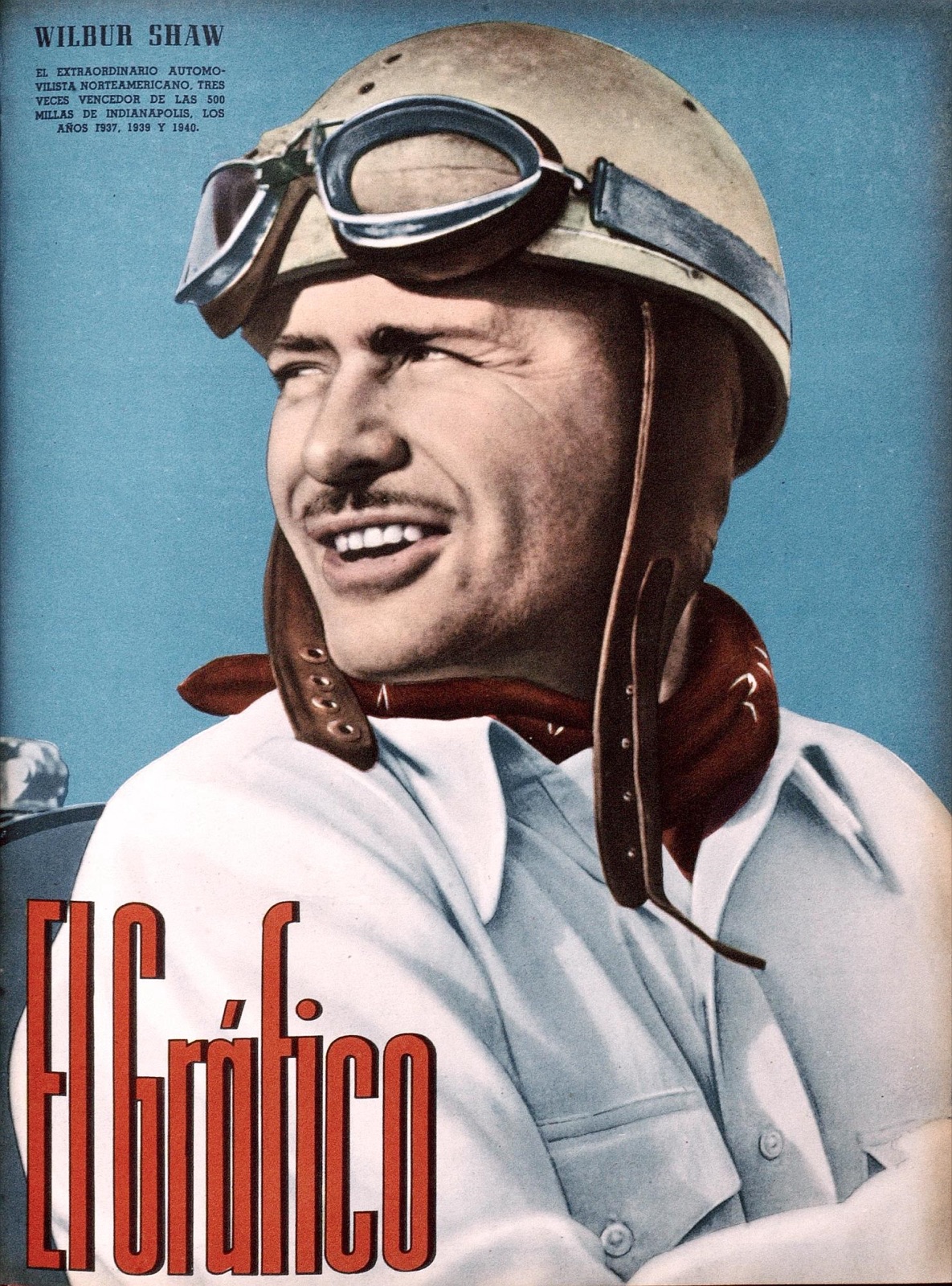
Wilbur Shaw
Shaw, born in Shelbyville, Indiana, finished first, second, first and first at Indianapolis from 1937 to 1940, according to the Speedway's 2020 feature. Goodwood says his 1937 victory came in an Offenhauser-engined car bearing his own name; his victories of 1939 and 1940 came in the 8CTF. After the war he persuaded Tony Hulman to buy the Speedway and ran it as president and general manager until he died in a plane crash in 1954.
Trossi, Villoresi and Pietsch
Trossi drove the 8CTF in four of its five races in 1938. Villoresi had never driven in a Grand Prix before Pescara, Jenkinson wrote, and raced the 8CTF again at Monza, Donington and the Nürburgring. Pietsch had raced Maseratis as a privateer; Jenkinson wrote in 1968 that his German Grand Prix car finished third only "because seven out of the nine German cars retired".
How many Maserati 8CTFs were built, and where are they now?
Three Maserati 8CTFs were built, chassis 3030, 3031 and 3032, and all three survive, by the accounts of Maserati (2019), Revs Institute (2018) and Jenkinson (1982). The two cars that followed, 3034 and 3035, were 8CLs with 32-valve engines, and engine 3033 never had a chassis, Jenkinson wrote in 1968.
| Chassis | Main races | Later history and today |
|---|---|---|
| 3030 | Tripoli 1938 (Varzi); Monza 1938 (Villoresi); 10th at Indianapolis 1940 | Revs Institute, Naples, Florida, in 1940 Schell livery |
| 3031 | Trossi's 1938 car; Pietsch's third, 1939; Rose's pole at Indianapolis, 1941; Pikes Peak 1946 and 1947 | To Britain in 1968 (Cameron Millar); raced at the Goodwood Revival in 2018 |
| 3032 | The Boyle Special: Indianapolis winner 1939 and 1940 | Indianapolis Motor Speedway Museum |
Chassis histories from Jenkinson (1982), Digney (March 1982), Revs Institute (2018) and Goodwood (2019). Digney's research reversed the American careers of 3030 and 3031 as Jenkinson's 1968 article gave them, and Jenkinson accepted it in 1982.
Chassis 3030 at Revs Institute
Chassis 3030 joined the Collier Collection in Naples, Florida, now Revs Institute, and still carries engine 3031, Revs says; it last raced in period at Watkins Glen in 1952, where it did not qualify. Revs calls it the only 8CTF that never had an Offenhauser engine fitted; Jenkinson (1968) wrote that the Boyle Special too was "unchanged from the Shaw days" in 1951. In 1982 Jenkinson placed it "still in America in private hands", and Digney wrote that it lay "dormant with a hole in the crankcase".
Chassis 3031: Cameron Millar's car
Chassis 3031 stayed in the United States until 1968, when Cameron Millar bought it and brought it to England, Jenkinson wrote in 1982. It came with a nose like a post-war Ferrari's, but Millar found the number 3031 stamped on the axle, engine, gearbox and steering. Digney's list has it running with a four-cylinder Offenhauser engine from 1948 to 1951. Goodwood reported that it raced the 8CL 3035 at the Goodwood Revival in 2018, the first time the two had raced together since 1950.
Chassis 3032: the Boyle Special at the Indianapolis Motor Speedway Museum
The Boyle Special is in the Indianapolis Motor Speedway Museum, in the livery it wore for its wins, Maserati says. Johnny Rutherford drove it on a lap of the Speedway in May 2014, 75 years after its first win, and the Historic Vehicle Association recorded it in the Library of Congress, as the 2014 release announced. Maserati's 2019 account calls it "the first non-American production car" given that place.
The sources count its Indianapolis starts differently. Jenkinson's 1968 history, read with the database's results, gives seven, from 1939 to 1949, with two wins, two thirds and a fourth. Digney in 1982 and Revs in 2018 both wrote that it competed eight times.
What is a Maserati 8CTF worth?
The prices on record for the Maserati 8CTF date from 1939 and 1940, and two of the three cars belong to museums. Goodwood says Boyle was said to have paid $15,000 for 3032 in 1939. The car then earned Shaw $27,375 for the 1939 race and $30,725 for 1940, Motta wrote. Jenkinson wrote in 1982 that the American dealer who sold 3031 to Millar claimed it had finished fourth at Indianapolis, a result that belonged to 3030, because "the truth would not have been worth so much money".
Rivals, predecessor and successor
The Maserati 8CTF's rivals in Europe were the Mercedes-Benz W154 and the Auto Union Type D, with Alfa Romeo behind them; at Indianapolis it raced American Offenhauser and Winfield cars.
Mercedes-Benz and Auto Union
Mercedes-Benz won five of the 8CTF's seven European races and Auto Union two. Motor Sport wrote in February 1940 that the three-litre Maserati "was not in the picture except for a burst of speed at Nurburg".
Alfa Romeo and the 1½-litre races
Giuseppe Farina's Alfa Romeo 312 and 316 finished second at Livorno, Pescara and Monza in 1938. In 1939 Italy's races moved to the 1½-litre class, where the Alfa Romeo 158 and Maserati's own four-valve 4CL raced, and where Mercedes-Benz ran the W165 at Tripoli.
American rivals at Indianapolis
Maserati's 2019 account says the wins "bestowed unique prestige on Maserati", and that 8CTFs also raced on other American ovals after the war. At Indianapolis they met other European cars: Alfa Romeo 308s, Don Lee's Alfa Romeo P3 and, in 1947 and 1948, his Mercedes-Benz W154, by the database.
From the 8CM to the 8CL
Before the 8CTF, Maserati raced the 8CM of 1934, which had a detachable head, and a V8 built for the previous formula, Jenkinson wrote in 1982. Its successor was the 8CL, built on the 16-valve 4CL with 32 valves.
Questions and answers
Who was Mike Boyle?
Michael Joseph Boyle, an Irishman, owned the Chicago team Boyle Racing Headquarters, according to Maserati; Revs Institute calls him a labour boss nicknamed "Umbrella Mike".
What colour was the Boyle Special?
Dark red, which Maserati calls amaranth. In 1947, as the Bennett Brothers Special, it was painted black and gold, Jenkinson wrote in Motor Sport in 1968.
Which Maserati won the Indianapolis 500?
The 8CTF chassis 3032, entered as the Boyle Special, won in 1939 and 1940 with Wilbur Shaw, according to the Indianapolis Motor Speedway Museum.
Did a Maserati 8CTF ever start the Indianapolis 500 from pole?
Yes. Mauri Rose started from pole in 1941, the Speedway's history records, in one of the former Schell cars, and Jenkinson wrote in 1968 that Ted Horn took pole in the old Boyle car in 1947.
Sources
- Maserati, "Maserati 8CTF: fantastic win at the Indianapolis 500 in 1939", 30 May 2019 (the Orsi sale, Ernesto Maserati, the engine, the purchase by Boyle, the livery, three cars built, the Boyle Special today). Maserati's later account, "Maserati 8CTF victories at Indianapolis", 29 May 2020, is cited in the text unlinked.
- Maserati North America, "Maserati 8CTF Boyle Special runs historic lap", press release, 25 May 2014 (Johnny Rutherford's lap, the Historic Vehicle Association and the Library of Congress).
- Indianapolis Motor Speedway Museum, "1939/1940 Boyle Special" (capacity, qualifying speeds, starting positions, race speeds, laps led).
- Indianapolis Motor Speedway, Donald Davidson's year-by-year histories: the 1930s (the 1939 race) and the 1940s (1940, 1941, Ted Horn, 1948, 1949), 2020.
- Indianapolis Motor Speedway, "Shaw writes history, caps amazing string of Indy 500 success in 1930s", 3 April 2020 (Shaw's record, the 1940 race, his years as president).
- Motor Sport database, race pages: 1938 Tripoli Grand Prix, 1938 Coppa Ciano, 1938 Coppa Acerbo, 1938 Italian Grand Prix, 1938 Donington Grand Prix, 1939 German Grand Prix, 1939 Swiss Grand Prix, and the Indianapolis 500 of 1939, 1940, 1941, 1946, 1947, 1948, 1949, 1950 and 1951 (results, dates, entrants, retirements).
- Motor Sport, "Easy for Mercedes-Benz", June 1938 (the Tripoli Grand Prix).
- Motor Sport, "Continental notes and news", September 1938 (practice and the race at Livorno, Villoresi at Pescara).
- Motor Sport, "The Grand Prix races of 1938", December 1938 (Pescara, Trossi fifth at Monza).
- Motor Sport, "Maserati wins at Indianapolis", July 1939.
- Motor Sport, "Caracciola completes Mercedes' hat trick", August 1939 (the German Grand Prix).
- Motor Sport, "The trend of racing-car design", February 1940.
- Motor Sport, Denis Jenkinson, "The Maserati 8CTF and 8CL cars", April 1968 (the design, the Boyle purchase and engine 3033, the Indianapolis entries to 1953, the 8CL).
- Motor Sport, Denis Jenkinson, "Historic Grand Prix cars", February 1982 (the name, the superchargers, chassis 3031 and its races, Cameron Millar).
- Motor Sport, William B. Digney and Denis Jenkinson, "Letters from readers", March 1982 (3031 in America, Pikes Peak, 3030, the Boyle Special's starts).
- Mercedes-Benz Classic, "Mercedes-Benz Grand-Prix racing car W 154, 1938" (Trossi at Livorno).
- Revs Institute, "French blue at Indy: the 1938 Maserati 8CTF", May 2018 (360 hp, weight, frame, the head, the 1940 race, Pikes Peak, chassis 3030 today). Its page for chassis 3030 is cited in the text unlinked.
- Goodwood Road & Racing, "Reunion: Maserati 8CTF meets 8CL", April 2019 (the Tripoli debut, 3031 at Pikes Peak and at the 2018 Revival).
- Goodwood Road & Racing, "The Maserati that conquered the Indy 500, twice", 2026 (the price, the frozen engine, the brakes, Italian marques at Indianapolis).
- Goodwood Road & Racing, "The other Maserati at the 1940 Indy 500", 2026 (power, top speed, Dreyfus and Le Bègue).
- Veloce Today, Roberto Motta, "Maserati's Indy interludes" (the only Italian winner, Shaw's prize money).