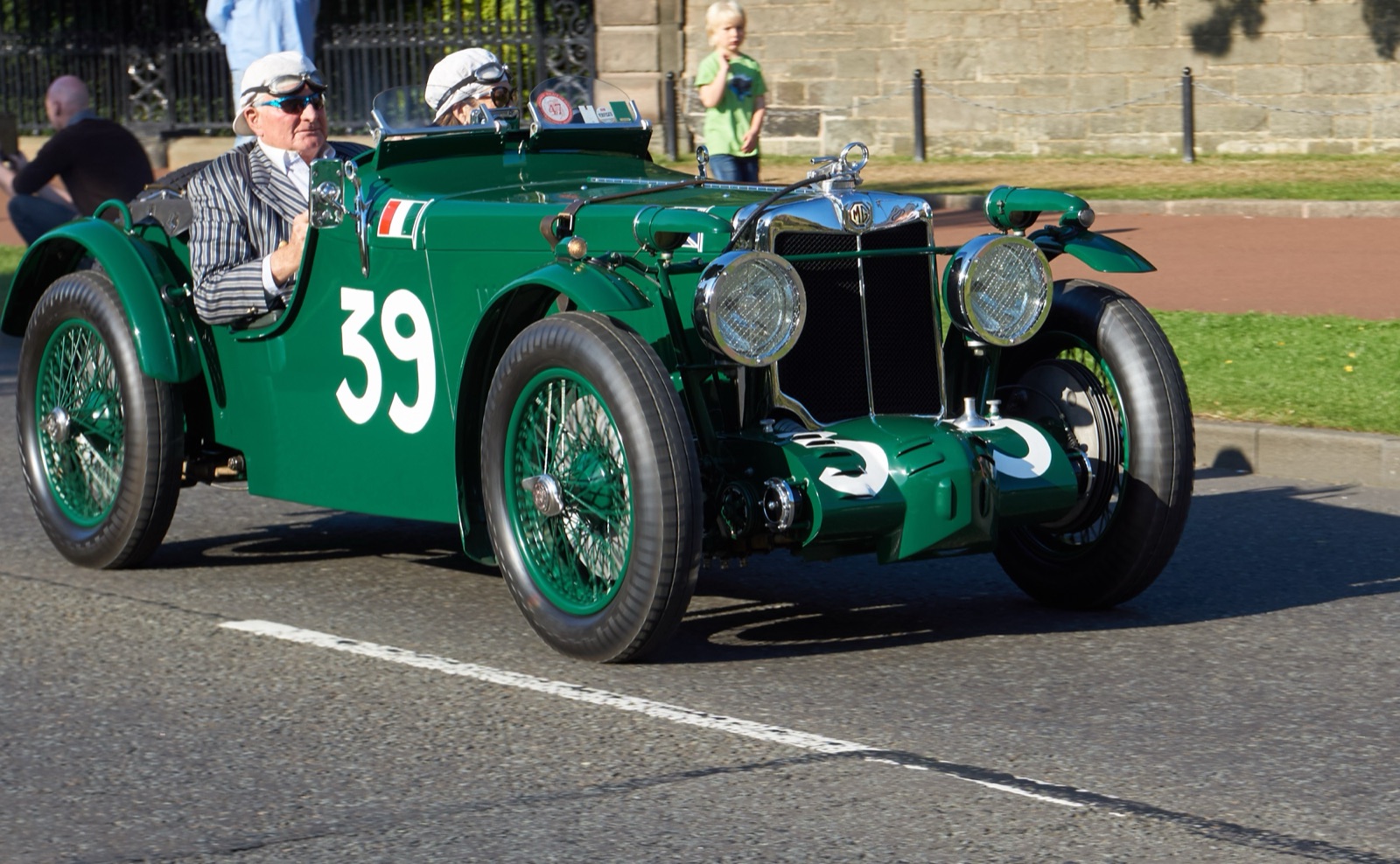
The MG K3 Magnette is the supercharged 1,087 cc six-cylinder racing car built at Abingdon in 1933 and 1934, about 33 of them, for the 1,100 cc class of sports-car and voiturette racing. On its first race the MG K3 Magnette won the 1,100 cc class and the team prize at the 1933 Mille Miglia for Earl Howe's works team, and in September 1933 Tazio Nuvolari won the Tourist Trophy in one. Eddie Hall won the BRDC 500 Miles at Brooklands in a K3 Magnette that month, and in 1934 a K3 Magnette finished fourth overall at Le Mans.
Who built the MG K3 Magnette, and why?
The MG K3 Magnette racing car was built at Abingdon because Earl Howe, president of the British Racing Drivers' Club, wanted a British team in the 1933 Mille Miglia and offered to pay for it. He raced Bugattis, Mercedes-Benz and Alfa Romeos "only because there was no suitable British product", Bill Boddy wrote in his history of the 1933 season for the MG Car Club's magazine Safety Fast! (April 1961). In the 1932 race Howe had watched Lord de Clifford's supercharged 746 cc MG Midget average 52 mph for nearly three-quarters of the course before its camshaft drive sheared, Motor Sport recorded in "Great British achievements" (September 1943).
Earl Howe's offer to Cecil Kimber
He "returned to England and to Abingdon and persuaded Cecil Kimber, of the M.G. Car Company, Ltd., to let him bear the expense of an M.G. team", the 1943 account says. Kimber was cautious, according to the 1961 history: no K3 Magnette had yet raced and only one supercharged car existed. The answer was a practice car for a winter run over the route; if it proved promising, three team cars would be built and lent to the Earl, who would pay to enter them and take them to Italy and back. Lord Nuffield, the company's governing director, gave his support.
The K-type Magnette series: K1, K2 and K3
The K3 Magnette was the racing version of the MG K-type Magnette, a series launched in 1932 as the K1 saloon, the K2 sports car and the K3 racing car, says the Haynes Motor Museum, and the 1,087 cc road car "had just gone into production" when Howe chose it (1943). The K3 Magnette used the shorter wheelbase of the K2 and a supercharged version of the single-camshaft six derived from Wolseley's Hornet engine, Andrew Frankel wrote in Motor Sport in June 2010. The March 1934 survey traces the idea to the 1,250 cc six-cylinder Magna, which created "a demand for a supercharged version which could be driven in the under 1,100 c.c. events". That survey of 1934 racing cars in Motor Sport said the factory had to build a car that "must also comply with the international sports car regulations in order to be eligible for the Ulster T.T. race", so every K3 Magnette left Abingdon as a two-seater that could carry wings and lamps.
The two prototypes and the 1933 Monte Carlo Rally
Two prototypes came first. The earlier, a short-chassis car, ran in the Monte Carlo Rally from 21 January 1933 and then made fastest time of the day in the Mont des Mules hill-climb with C. R. Wright (March 1934; Safety Fast!, 1961). The second was the practice car, which, by the 1943 account, met the team in Milan on 19 January 1933; on the way out it cruised at 60 to 65 mph with a fuel consumption of 18 mpg. On the route its plugs oiled up, it boiled on the Raticosa Pass and its rear wheels were found "on the point of collapse" at Rome. Eyston asked for a rigid steering wheel, and all agreed the team cars needed more steering lock. Boddy told the front-axle story two ways: in 1943 Tim Birkin "wanted a stronger front axle beam, which the team cars had"; in 1961 Ettore Bugatti, seeing the car at Molsheim, "remarked on the frailty of its front axle", which "was later re-designed".
MG K3 Magnette design and engineering
The MG K3 Magnette was a two-seater racer on a conventional chassis of its time, with a small, highly supercharged engine and a Wilson pre-selector gearbox, described in detail in the March 1934 survey.
The supercharged six-cylinder engine
The six-cylinder engine has a bore of 57 mm and a stroke of 71 mm, giving 1,086 cc by the 1934 figure and 1,087 cc in most later accounts. A single overhead camshaft, driven by a vertical shaft and bevel gears, works two valves per cylinder through fingers; the head and block are of high-chromium cast iron, and the crankshaft runs in four plain bearings, with a B.T.H. magneto for the ignition. The first engine gave 100 bhp on test, and the first team engine only 72 bhp at 4,500 rpm until bearing and gasket trouble was cured (1943). In 1933 the cars used a Powerplus No. 9 eccentric-vane supercharger in front of the radiator, drawing from a single SU carburettor. For 1934 the works kept the Powerplus for track races and fitted a Marshall two-vane blower for road racing, running at engine speed "in order to prevent the oiling of plugs at low speeds", with a compression ratio of about 5.75 to 1 and about 12 lb of boost; "No definite horse-power figure is given by the makers, but it is over 100 b.h.p.", the survey said.
The Wilson pre-selector gearbox
The K3 Magnette has no clutch: "the friction bands in the Wilson preselective gear-box also serve to take up the drive", the 1934 survey explained. The driver picks the next gear on a short lever and engages it with the pedal where the clutch pedal would be. Apart from Sir Malcolm Campbell's rebuilt four-litre Sunbeam, the pre-selector gearbox "was an innovation" (1943), and after the 1933 Mille Miglia the race report in Motor Sport said it had been "triumphantly vindicated as a definite improvement in the design of a racing car". S. C. H. Davis, trying a K3 Magnette at Brooklands in 1933, called the pre-selector a "self-change" box and its changes "happy and beautiful" and recorded 0 to 75 mph in 14.6 seconds, according to Motor Sport in October 1984.
Chassis, brakes and bodies
The frame is upswept over the front axle and underslung at the rear, with a K-shaped centre strut and flat semi-elliptic springs bound with cord. The cable-operated brakes have 13-inch drums by the 1943 account (11 inches in the March 1934 survey), made largely of elektron, a magnesium alloy, with cast-iron liners. The production specification given in 1943 includes a 23-gallon rear fuel tank, a 12-volt electrical system, Hartford shock absorbers and 19-inch rims. The 1933 cars had a slab-tank two-seater body with the spare wheel at the back, and for 1934 the factory planned light racing bodies "similar to the one used by Nuvolari in Ulster". The Simeone Foundation Automotive Museum, which owns K3027, says K3020 was the first with the two-seater pointed-tail body that "all subsequent stock K3s" took.
Racing changed the car. At the 1933 Mannin Beg on the Isle of Man every K3 retired, three with rear-axle failures that the 1934 survey put down to "the increased power and the constant use of the differential on the right-handed course"; later cars had a four-star differential.
MG K3 Magnette specification and performance
The MG K3 Magnette had a supercharged 1,087 cc six-cylinder engine of about 100 to 124 bhp, depending on the source and the year, and a top speed of about 110 mph in road trim.
| Item | K3 Magnette |
|---|---|
| Engine | Six cylinders in line, single overhead camshaft, two valves per cylinder |
| Bore × stroke, capacity | 57 × 71 mm, 1,086 cc (1,087 cc in later accounts) |
| Supercharger | Powerplus No. 9 (1933); Marshall two-vane for road racing (1934) |
| Compression and boost | 6.6 to 1 (1933 team cars); about 5.75 to 1 and 12 lb (1934) |
| Power | "Over 100 b.h.p." (no factory figure); 124 hp at 6,500 rpm |
| Gearbox | Wilson four-speed pre-selector, no clutch |
| Brakes | Cable-operated, elektron drums with cast-iron liners: 13 in (1943) or 11 in (March 1934) |
| Suspension | Beam axles, semi-elliptic springs, Hartford friction shock absorbers |
| Wheelbase | 7 ft 10 in (2,388 mm) |
| Fuel tank | 23 gallons (production car) |
| Top speed | Over 110 mph in road trim; 108 to 110 mph at 6,200 rpm on the 4.89 axle |
| Price new | £795 with two-seater body; £675 chassis only |
Sources: Motor Sport (March 1934, September 1943, October 1984), Safety Fast! (1961), RM Sotheby's (2013) and the Royal Automobile Club (2026).
How fast was the MG K3 Magnette?
An MG K3 Magnette in road-racing trim did about 110 mph, and the track and record cars went much faster. Davis lapped Brooklands at 104.8 mph in a works Mannin Beg car in 1933, on the low 4.89 axle ratio, and estimated 108 to 110 mph at 6,200 rpm. Ron Horton set a class lap record of 115.55 mph on the Brooklands Outer Circuit in his K3 in the 1933 British Empire Trophy (March 1934). EX135, a single-seater, averaged 128.70 mph for the flying mile at Montlhéry in 1934, and as Goldie Gardner's record car it reached 203.5 mph in 1939.
How much did an MG K3 Magnette cost new?
A K3 Magnette with the two-seater body cost £795 in 1934; from late 1933 the public could buy "replicas of the team-cars" as a catalogue model (October 1984). The Royal Automobile Club, in its 2026 display note on K3020, gives the price new as £675 for the chassis alone.
MG K3 Magnette racing history in 1933
In 1933 the MG K3 Magnette won the 1,100 cc class and team prize at the Mille Miglia, the Coppa Acerbo Junior, the Ulster Tourist Trophy and the BRDC 500 Miles.
The 1933 Mille Miglia: class win and team prize
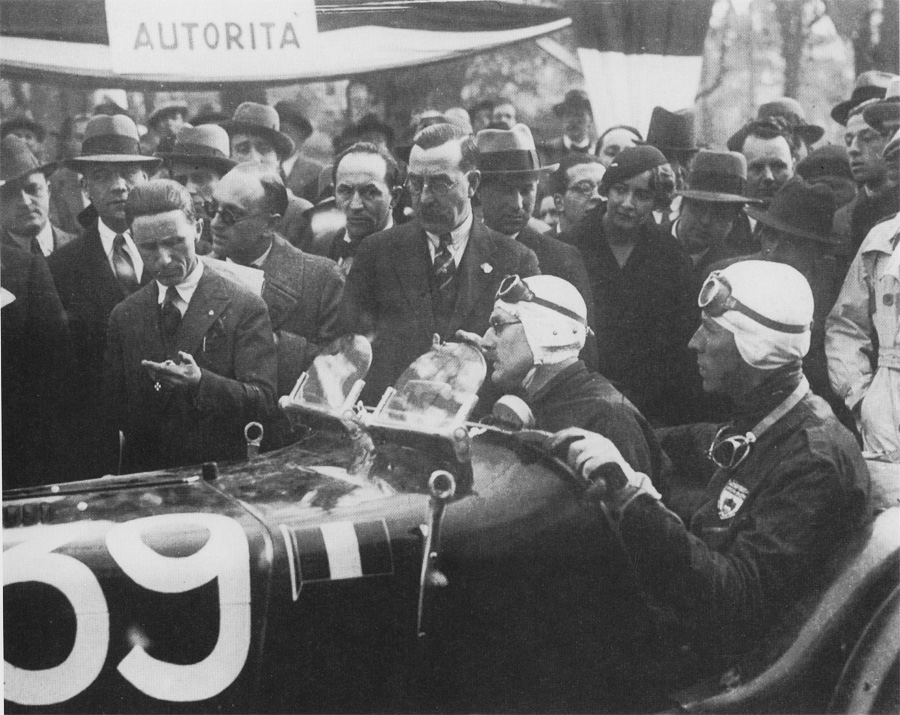
Two of the three works K3 Magnettes finished first and second in the 1,100 cc class of the 1933 Mille Miglia, the 1,000-mile event on open Italian roads, and won the team prize. The crews were Tim Birkin, who had raced the supercharged Blower Bentley, with Bernard Rubin; Captain George Eyston with Count Lurani, an Italian who knew the route; and Earl Howe with Hugh Hamilton. Hugh McConnell, the Brooklands scrutineer, managed the team. The 1943 account is the source for the team's journey and the race below unless another is named. Work on the team cars began with barely six weeks to go; on 12 March they went by train to Fowey and by ship to Genoa among "the cargo of china clay and fish". The Earl's own Mercedes-Benz, driven by Clifton Penn-Hughes, ran in the race as a travelling spares tender; Frankel wrote in 2010 that it was a Mercedes-Benz SSK.
Birkin set the pace to break the Maseratis. He averaged 87.95 mph for the 130 miles to Bologna and broke every 1,100 cc record to Florence, averaging 61.7 mph over 228 miles, before a burnt valve stopped him near Siena; by then Tuffanelli's Maserati was out with gearbox failure. The race report in Motor Sport, "The seventh Mille Miglia" (May 1933), describes Eyston's car arriving at Brescia at two in the morning, "dusty and mud-stained", winner of the 1,100 cc class at 56.89 mph. At the Bologna control Eyston fitted new batteries after his dynamo failed (May 1933). Eyston and Lurani took 18 hours 1 minute 4 seconds for the 1,024 miles; Howe and Hamilton finished 90 seconds later, and as no complete team of any other make finished, MG won the team prize, the Gran Premio Brescia, which had never before gone to a non-Italian team (1961). Both cars lost time changing oiled plugs; Eyston and Lurani "are reputed to have changed 157". Nuvolari won the race outright in an Alfa Romeo 8C 2300 Monza at 67.45 mph, and the two MGs finished 21st and 22nd overall, according to Racing Sports Cars' K3 results, which give the chassis as K3003 (Eyston and Lurani), K3001 (Howe and Hamilton) and K3002 (Birkin and Rubin).
Brooklands and the Mannin Beg
Back in England K3 Magnettes finished second, third and fourth in the JCC International Trophy at Brooklands, behind Brian Lewis's Alfa Romeo, driven by Hall, Mrs Elsie Wisdom and Howe (March 1934; Safety Fast!, 1961). Manby-Colegrave was third in the British Empire Trophy at 106.88 mph. The Mannin Beg was run over 4.6 miles of public roads closed in Douglas; six K3s started and none finished: three broke their rear axles, Eyston's broke its camshaft drive, Kaye Don's had valve trouble and Hall crashed (1961).
Whitney Straight and the Coppa Acerbo Junior
Whitney Straight, who also raced his own Maserati, bought a K3 Magnette as a chassis, had Thomson and Taylor build it a racing body at Brooklands and won the Coppa Acerbo Junior at Pescara in August 1933 at 75.4 mph (1961). The March 1934 survey says he beat Barbieri's Maserati by a fifth of a second; Barbieri protested, and Straight was not given the race until his engine had been measured at 1,087 cc. The success came in the first race he ran in K3011, painted in his colours of black with silver wheels (October 1984).
Nuvolari and the 1933 Tourist Trophy
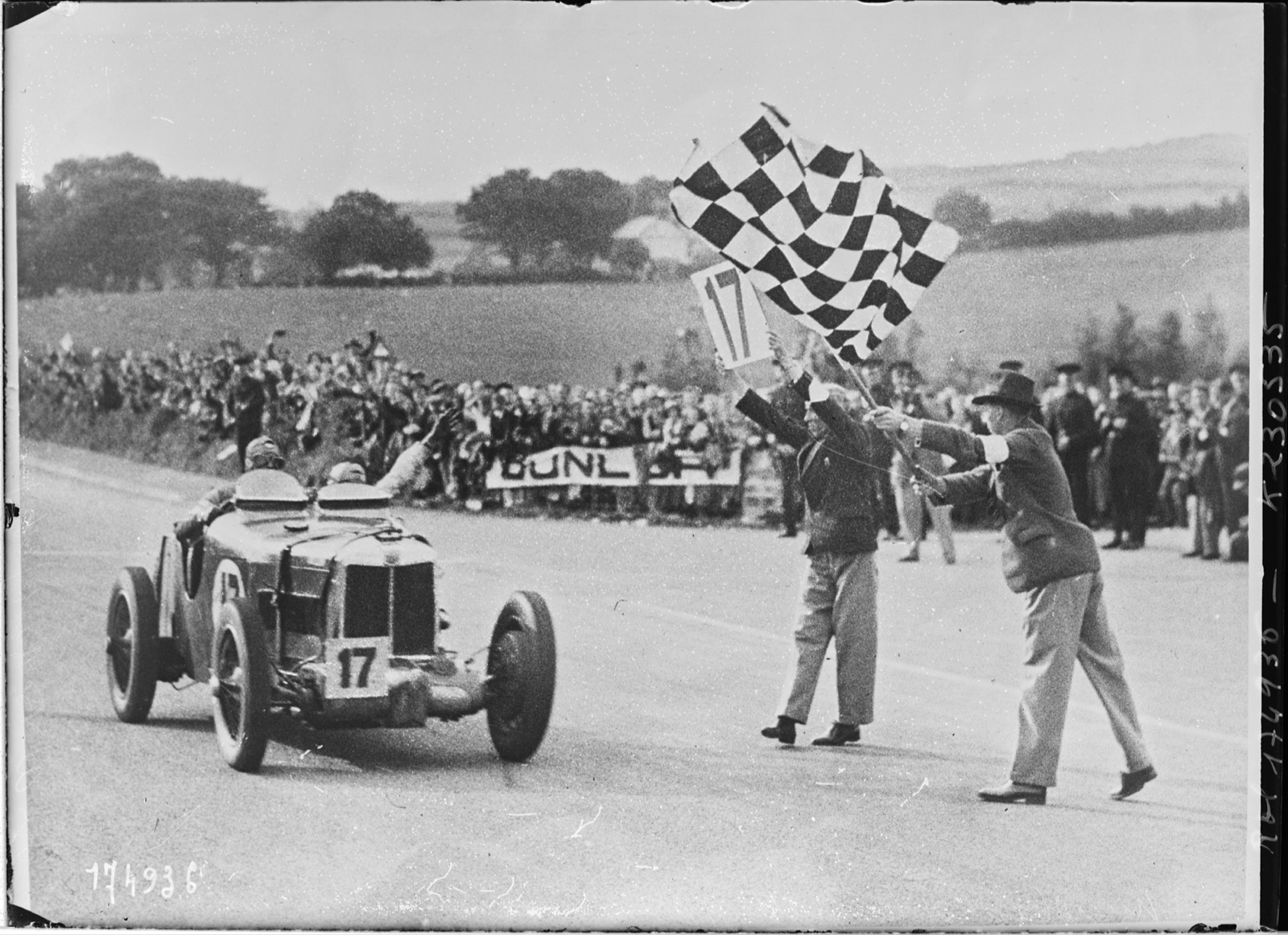
Tazio Nuvolari won the 1933 Tourist Trophy, the RAC's race on the Ards circuit in Ulster, on 2 September at 78.65 mph, 40 seconds ahead of Hugh Hamilton's MG Midget, on handicap over 35 laps and 478 miles. Motor Sport announced in September 1933 the "nomination of the famous Italian driver, Tazio Nuvolari, to pilot the M.G. Magnette entered by Whitney Straight", the first time he had driven a British car in a road race. The 1961 history says doctor's orders ruled Straight out, "but this enabled Kimber to nominate a works car" for Nuvolari. Racing Sports Cars gives the car as K3003, the Mille Miglia class winner, and Bonhams catalogued the car it sold in 2024 as K3003, "credited with winning the 1933 RAC Tourist Trophy"; RM Sotheby's 2013 catalogue for K3001 says K3001 inherited "the lightweight body from Nuvolari's Tourist Trophy winner" in 1934.
Motor Sport's race report (October 1933) says Nuvolari "sat in a Magnette for the first time in his life on Wednesday" and asked for a high seat cushion and a high-backed seat, and that the car's tyres were smooth after two laps of practice. Just before one o'clock he lapped at 80.09 mph, a speed beaten only by Birkin's Alfa Romeo in 1932, and later at 80.48 mph. Hamilton's 750 cc Midget led on handicap for much of the race and lost time when its starter failed at a pit stop; Nuvolari "passed his rival filling up, with only five laps to go". By the 1961 history, Nuvolari's victory came after he broke the class lap record seven times; Hall's K3 finished fourth and Manby-Colegrave's seventh. Hounslow, the works mechanic who rode with him, recounted how he "flung the cart-sprung MG into corners, scarcely using the brakes".
Eddie Hall and the BRDC 500 Miles
Eddie Hall won the BRDC 500 Miles at Brooklands on 16 September 1933 at 106.53 mph in his Tourist Trophy K3, refitted with a higher axle and a long-tailed single-seater body and held to about 110 mph a lap (March 1934; Safety Fast!, 1961). Racing Sports Cars gives his car as K3006. Hall was a Yorkshire textile manufacturer who raced his own cars, RM Sotheby's wrote in its 2024 catalogue for K3016.
MG K3 Magnette racing history from 1934
From 1934 the MG K3 Magnette raced mostly in private hands; its victories that year included the Mannin Beg, the British Empire Trophy, the Coppa Acerbo Junior and the Prix de Berne, with fourth overall at Le Mans.
| Date | Race | Driver(s) and chassis | Result |
|---|---|---|---|
| 8–9 April 1933 | Mille Miglia | Eyston and Lurani (K3003); Howe and Hamilton (K3001) | 1st and 2nd in the 1,100 cc class, team prize |
| August 1933 | Coppa Acerbo Junior, Pescara | Whitney Straight (K3011) | 1st |
| 2 September 1933 | Tourist Trophy, Ards | Tazio Nuvolari (K3003 by Racing Sports Cars) | 1st at 78.65 mph |
| 16 September 1933 | BRDC 500 Miles, Brooklands | Eddie Hall (K3006) | 1st at 106.53 mph |
| 8 April 1934 | Mille Miglia | Lurani and Penn-Hughes (K3015) | 11th overall, 2nd in class |
| May 1934 | Mannin Beg, Douglas | Norman Black; Charles Dodson (K3020); Capt. G. E. T. Eyston (EX135) | 1st, 2nd and 3rd |
| 16–17 June 1934 | 24 Hours of Le Mans | Roy Eccles and Charlie Martin (K3027) | 4th overall, 197 laps |
| 15 August 1934 | Coppa Acerbo Junior, Pescara | Hugh Hamilton; Raffaele Cecchini; Dick Seaman (K3011) | 1st, 2nd and 3rd |
| 26 August 1934 | Prix de Berne, Bremgarten | Dick Seaman (K3011) | 1st |
| 22 September 1934 | BRDC 500 Miles, Brooklands | Gardner and Benjafield (K3015); Everitt and Wisdom (K3020) | 3rd and 4th |
Sources: Motor Sport (1933 to 1984) and its database, Racing Sports Cars, Leif Snellman's Golden Era of GP Racing and RM Sotheby's catalogues for K3016 and K3020.
The 1934 Mille Miglia
Earl Howe took a second team to the 1934 Mille Miglia, with new chassis K3015, K3016 and K3017 registered JB 3180 to JB 3182, low-mounted exhausts and armoured fuel lines, RM Sotheby's wrote in its catalogue for K3016 (London, 2024). Lurani and Penn-Hughes finished 11th overall and second in class; Howe crashed, and Hall, with his wife Joan as riding mechanic, retired with a blown core plug after half distance. Theodor Fork, a German privateer, finished 21st in K3003 (Racing Sports Cars).
The Mannin Beg and the British Empire Trophy
K3 Magnettes took six of the first seven places in the 1934 Mannin Beg, Norman Black winning from Charles Dodson, with EX135 third, RM Sotheby's wrote in its catalogue for K3020 (Woodcote Park, 2026). Dodson's car, K3020 (JB 4184), was one of three that Eyston prepared for 1934. Eyston then won the British Empire Trophy at Brooklands in EX135, according to "Racing car development: the K3 MG Magnette" (Motor Sport, October 1980).
Dick Seaman's 1934 season
Dick Seaman began his racing career in 1934 in Straight's black K3011. The October 1984 article says he "entered into an arrangement with Straight"; Leif Snellman's history of the 1934 Prix de Berne says Seaman had bought the car from Straight for £650 but raced it officially for Whitney Straight Ltd "not to upset his father". At Berne on 26 August he started from the back row in rain and won by 23 seconds from Pierre Veyron's Bugatti, an 1,100 cc car against a 1,500 cc field, his first international win (Snellman); the 1984 article gives his average as 74.76 mph. He was second to Raymond Mays's ERA in the Nuffield Trophy at Donington Park and took the class lap record on the Brooklands Mountain circuit at 72.87 mph (1984). The next season he moved to the ERA R-type, in 1936 to a Delage 15 S8, and in 1937 to the Mercedes-Benz works team (Motor Sport, December 2004); the K3 "had served as an excellent apprenticeship" for Straight and Seaman (1984).
The sources differ on Seaman's car in the Masaryk junior race at Brno in September, which he finished fifth. The 1984 article lists it among K3011's results; RM Sotheby's 2026 catalogue says he drove Eyston's team car there, and again in the East London race in South Africa, where the 1984 piece has him in "a 'works' K3".
Hugh Hamilton and the 1934 Coppa Acerbo Junior
Hugh Hamilton won the 1934 Coppa Acerbo Junior at Pescara on 15 August in a K3 entered by Whitney Straight, after stalling at the start and being push-started, Snellman wrote in his history of the 1934 Coppa Acerbo. He set the fastest lap, 12 min 46.4 sec, and led Cecchini's K3 and Seaman's home, three K3 two-seaters ahead of the single-seater Maseratis. At Berne, eleven days later, Hamilton raced a streamlined silver single-seater K3 in the Prix de Berne, retiring on the seventh lap with engine trouble, and was killed in Straight's Maserati in the Swiss Grand Prix the same day (Snellman).
Le Mans 1934: fourth overall
The MG K3 Magnette K3027 finished fourth overall in the 1934 24 Hours of Le Mans, 197 laps, behind the winning Alfa Romeo and two Rileys, driven by Roy Eccles and Charlie Martin, according to the Motor Sport database. The second K3, J. L. Ford and Maurice Baumer's, retired after 85 laps with a fuel-tank failure. The Simeone Foundation Automotive Museum in Philadelphia, which owns the car, calls it "the best-ever result for MG" at Le Mans and names its owner-driver as Lindsay Eccles; the March 1934 survey and RM Sotheby's 2013 catalogue name Roy Eccles, as the database does. The museum says a story that the fourth-placed car was K3025 arose because Martin owned K3025 but drove K3027.
The supercharger ban and the NE Magnette
For the 1934 Tourist Trophy the RAC banned superchargers and "alternative fittings", so the K3 Magnette could not run, and the works won the race with Dodson in an unsupercharged Magnette, Motor Sport reported in October 1934. The October 1984 article identifies that car as "the 1934 TT-winning MG NE Magnette".
Private owners after 1934
Private owners kept K3 Magnettes in competition through the rest of the 1930s. Racing Sports Cars lists Philippe Maillard-Brune's win in the 1935 Bol d'Or and his ninth place at Le Mans in 1935 in K3029, and Eddie Hertzberger's win in the 1936 Grand Prix des Frontières. K3016 went to Lyster Jackson in Victoria, Australia, by 1935 and ran in the Australian Grand Prix in 1937 and 1938. In 1940 Jackson fitted a replacement, an unnumbered cylinder block, which Victoria Police stamped V40009P because the state registered vehicles by engine number; Otto Stone of Melbourne then raced the car for 26 years from 1947 (RM Sotheby's, 2024). Dodson's car went to Flight Lieutenant L. R. Briggs of Belfast in 1936 for the Cork and Limerick Grands Prix (RM Sotheby's, 2026).
EX135 and the MG K3 Magnette speed records
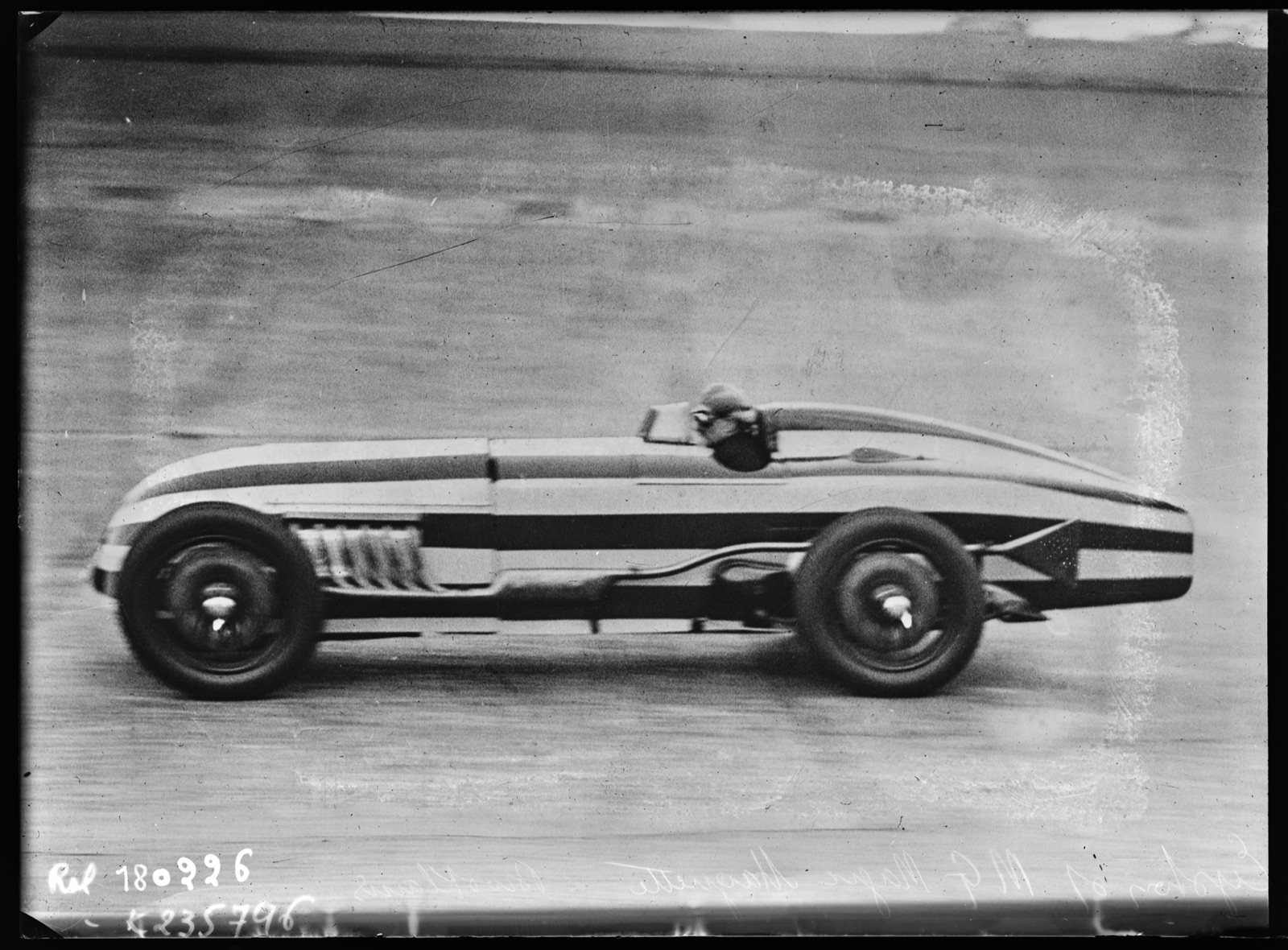
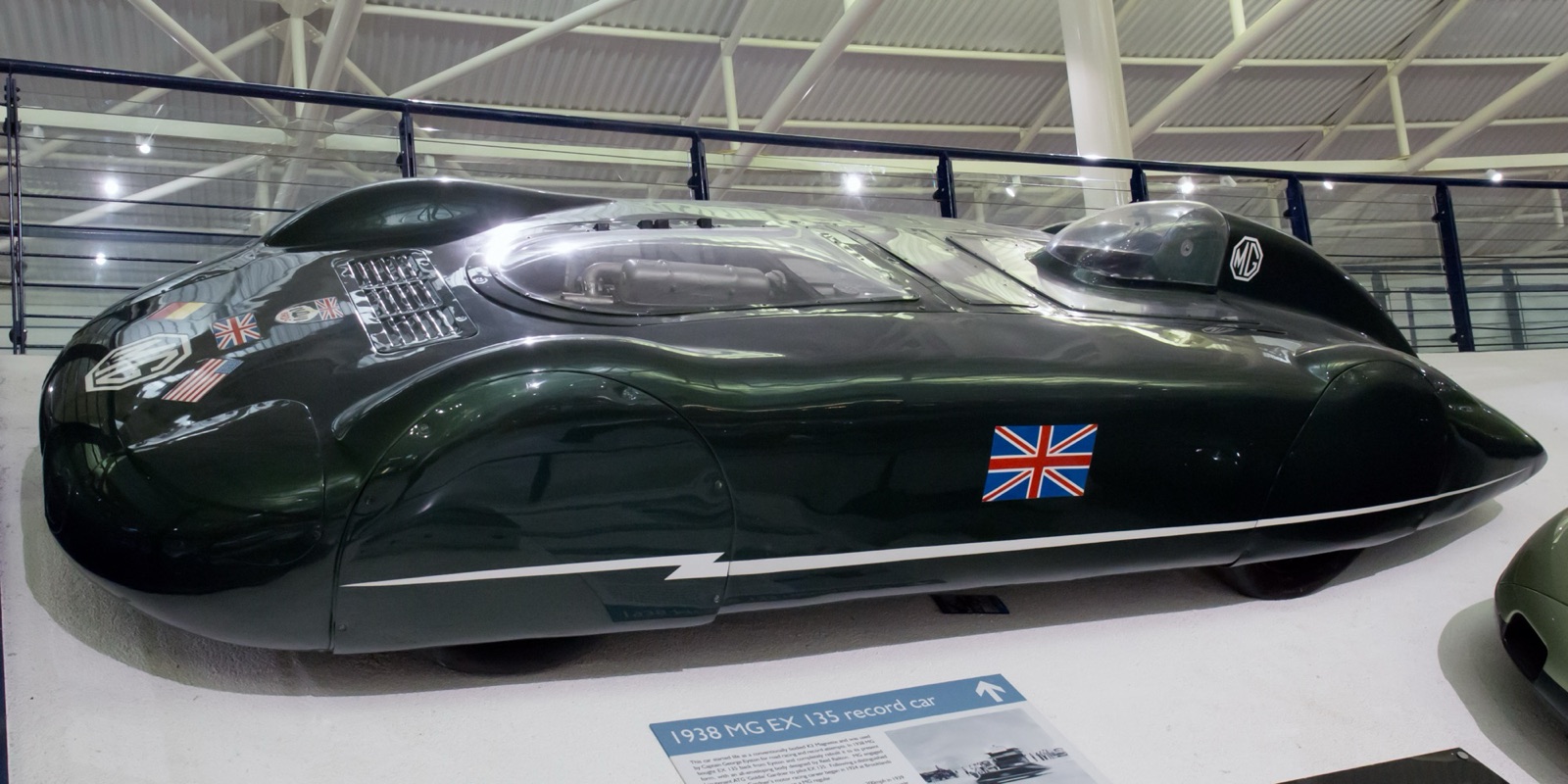
EX135 was K3023, an MG K3 Magnette built from scratch as a single-seater for George Eyston in 1934, and it set class speed records at Montlhéry in 1934 and then, rebodied, for Goldie Gardner up to 1939. Its engine was set at 6 degrees to the centre line, so that the propeller shaft ran diagonally to a rear axle with an offset differential and the driver sat low beside it (October 1980). It had a simple road-racing body and a sleek track body in cream and brown stripes, the works racing colours, which earned it the nickname "Humbug"; the magazine first called it the "Magic Magna", and it became the "Magic Magnette".
Montlhéry, 1934
EX135 led the 1934 BRDC 500 Miles at an average of 116 mph until a ball race seized in the rear axle and the car spun off. At Montlhéry that autumn Eyston took twelve Class G (1,100 cc) records with it, Motor Sport reported in "A month of record-breaking" (December 1934): the flying mile at 128.70 mph, ten miles at 128.53 mph and the hour at 120.88 mph, all from Amilcars. As the magazine went to press, Furmanik's four-cylinder Maserati had already taken the flying kilometre from the K3 at 136.40 mph.
Goldie Gardner's record car
Major A. T. G. "Goldie" Gardner set Class G records at 148 mph on the Frankfurt–Darmstadt autobahn in October 1937 in K3007, Ron Horton's former narrow single-seater. With the factory's support Gardner then had the K3007 engine put into EX135, which the works acquired from the Bellevue Garage, and Reid Railton drew an all-enveloping body; its first run reached 186.58 mph for the flying mile. At Dessau in 1939 Gardner raised the Class G records to 203.5 mph, and after the engine was bored out by 20 thou, set 1,500 cc records at 204.2 mph (1980). The factory kept the car, and by 1980 it had passed to British Leyland Heritage.
Who drove the MG K3 Magnette?
The MG K3 Magnette's drivers were Earl Howe's works teams of 1933 and 1934, George Eyston's 1934 team and private owners, and Tazio Nuvolari drove one once, to win the 1933 Tourist Trophy. Howe chose men who were "experienced and very fit, able to stand acting as passengers in the race, and possessed of plenty of spare time" (1943): Hamilton, Birkin, Rubin, Eyston and Lurani. Birkin and Rubin had both won Le Mans for Bentley, Frankel noted. Eyston had made the MG Midget the first 750 cc car to exceed two miles a minute, just before Christmas 1932 (1961). Among the private owners, Bobby Kohlrausch in Germany planned about 25 events in 1934 for his white Magnette and Midget (March 1934).
How many MG K3 Magnettes were built?
Abingdon built 33 MG K3 Magnettes in 1933 and 1934 by the most common count, but the sources differ on whether the two prototypes are included. RM Sotheby's catalogues give "just 33"; the October 1984 article says "some 35 were made, if you include the two prototypes"; Sports Car Market's profile of K3003 (October 2024) gives "31 cars (plus two prototypes)"; and the Simeone museum says the factory made "only about 31 sequential cars". The numbers run from K3001, the Howe and Hamilton car, through K3023 (EX135) to at least K3031, Hertzberger's car in the Racing Sports Cars results.
Famous MG K3 Magnette chassis
| Chassis | Known for | Later history |
|---|---|---|
| K3001 | Howe and Hamilton, 2nd in class, 1933 Mille Miglia | Car of this number sold in 2013; Sports Car Market says the original "appears to have been broken up in 1943" |
| K3002 | Birkin and Rubin, 1933 Mille Miglia | Shipped to Australia in 1934; "survived without issues" |
| K3003 | Eyston and Lurani's class win; Nuvolari's Tourist Trophy | Disputed identity; sold by Bonhams in 2024 |
| K3006 | Hall's 1933 BRDC 500 Miles win | - |
| K3011 | Straight's 1933 Coppa Acerbo Junior; Seaman's 1934 Berne win | To the United States; back in Britain from 1979 with Peter Green |
| K3016 | Hall's 1934 Mille Miglia works car | Australia 1935 to 1999; sold in 2024 |
| K3020 | Eyston team car, 2nd in the 1934 Mannin Beg | United States from 1958; sold in 2026 |
| K3023 | EX135, Eyston's single-seater, then Gardner's record car | Kept by the factory and its successors |
| K3027 | 4th overall, Le Mans 1934 | Unrestored at the Simeone museum, Philadelphia |
Sources: Racing Sports Cars, Motor Sport (1980, 1984) and its database, RM Sotheby's (2013, 2024, 2026), Sports Car Market (2024) and the Simeone museum.
Where are the MG K3 Magnettes now?
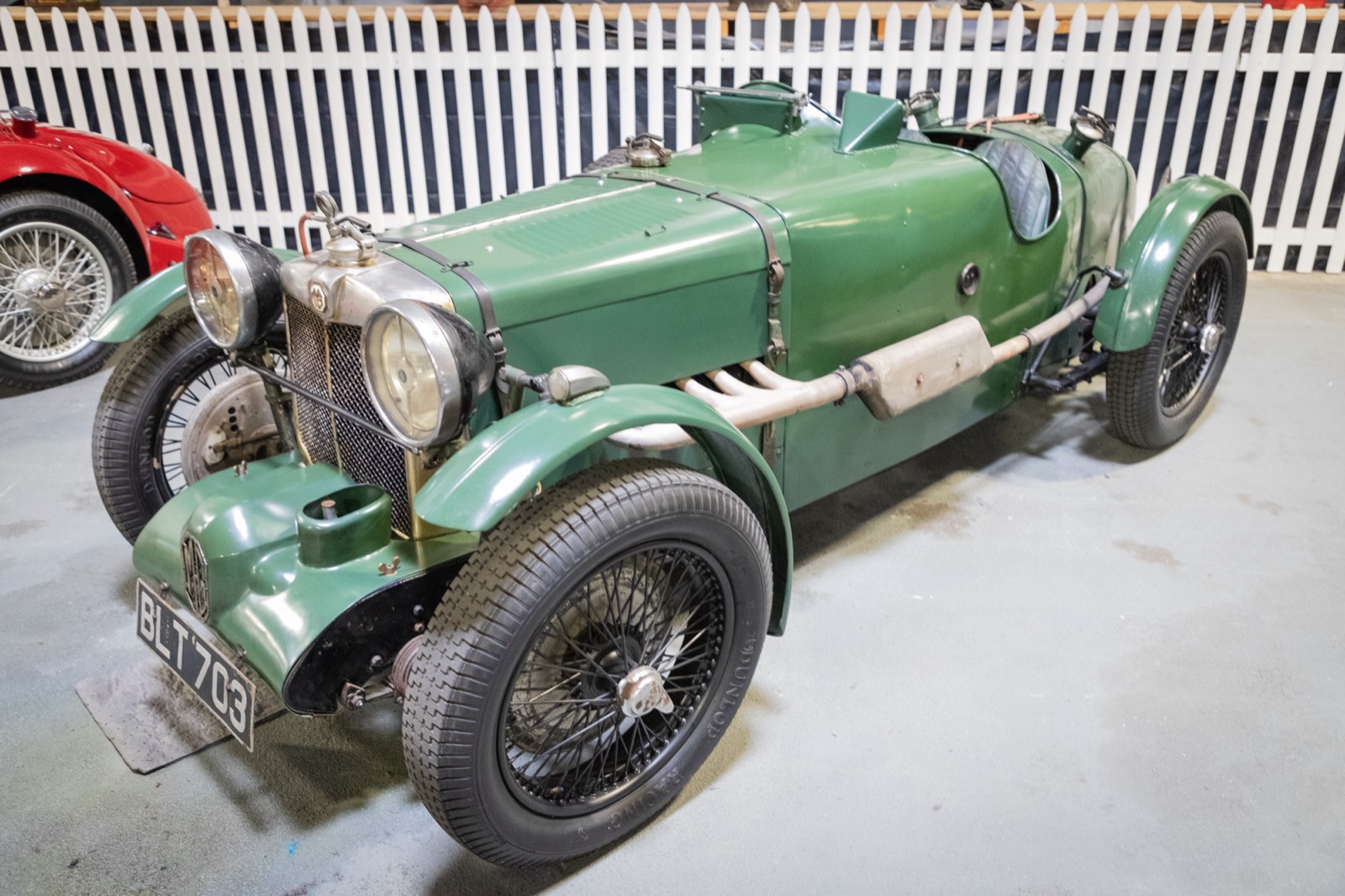
The Simeone museum's K3027 is in "unrestored, original condition": it went to Canada in 1968 and then lay for years in a Chicago restorer's workshop, until George Ktsanes reassembled it for the museum with an original magnesium-cased Marshall supercharger from the restorer Chris Leydon. The museum, drawing on M. F. Hawke's K3 Dossier, says that "most of them had new bodies, engine changes, or destroyed". K3011 survives "in more or less unchanged guise" with a non-original cylinder block and a 1934-specification N-type head (October 1984), and its original black paint still lies beneath later coats. RM Sotheby's described K3016 in 2024 as "the most original surviving example of MG's celebrated Works K3 cars", with its original body panels and Marshall supercharger. Several still compete: K3020 has run twice in the Mille Miglia Storica, the modern retrospective of the race, and at the Le Mans Classic in 2002 (RM Sotheby's, 2026), and K3001 won the Index of Performance at the 2008 Le Mans Classic (RM Sotheby's, 2013).
The disputed identities of K3001 and K3003
Sports Car Market's 2024 profile says that of the three 1933 team cars only K3002 "has survived without issues". K3001 "appears to have been broken up in 1943, though a car claiming that number still exists"; RM Sotheby's 2013 catalogue for that car traces it through H. Williams, the bandleader Herman Darewski and Michael Crowley-Milling to Peter Gregory, who finished its restoration in 1998. For K3003, the profile says that by one account the car was sold to Germany in 1934, and that Hawke's history has it crashed there in 1951; the car sold in 2024 appeared in London in about 1939 as "K33", stamped "K3 . . 3" with blanks in the middle, and its catalogue gave forensic evidence for its identity as K3003.
MG K3 Magnette values and auction results
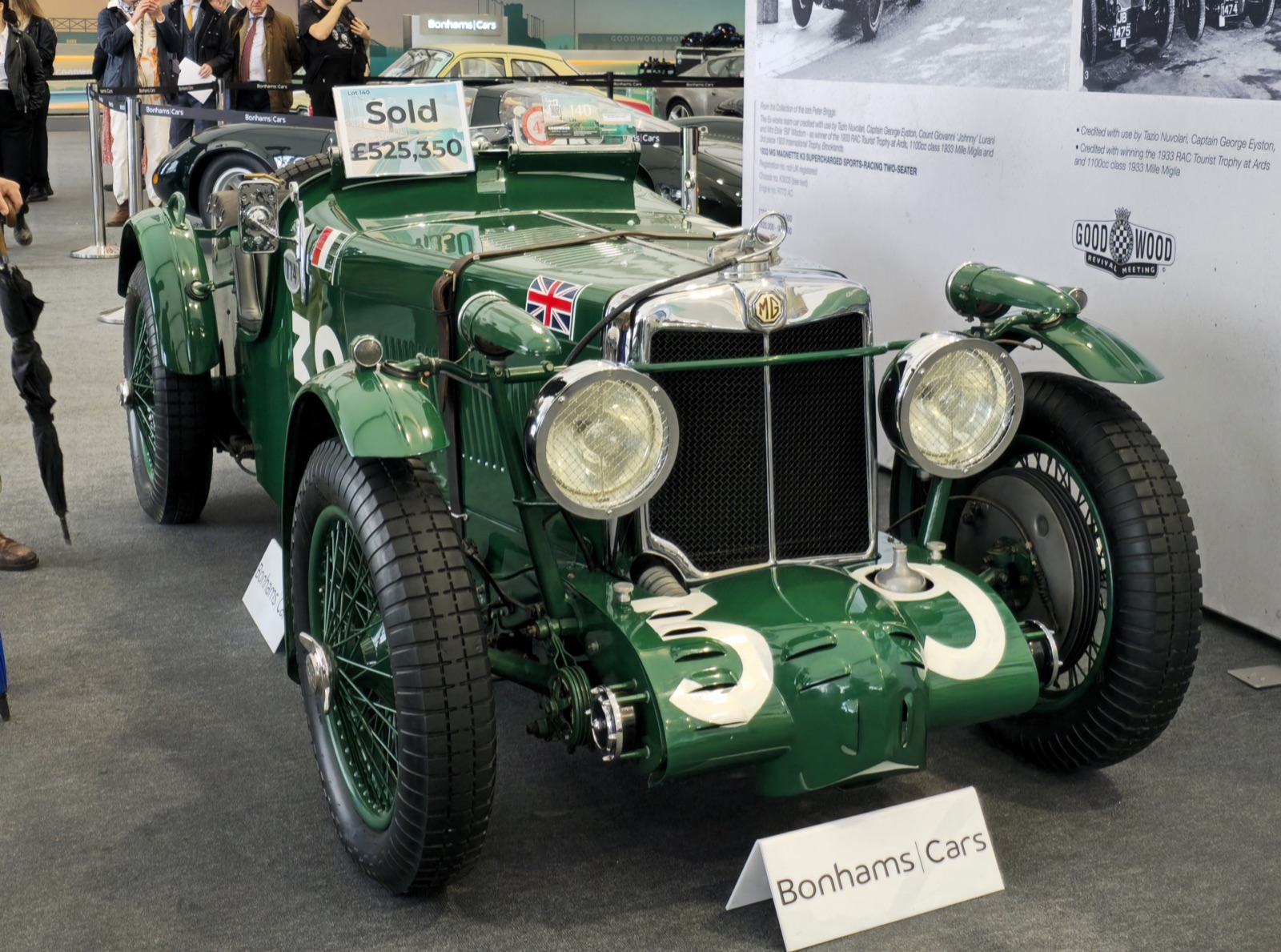
Works and well-documented MG K3 Magnettes have sold at auction for between €408,800 (2013) and £525,000 (2024). The table gives the sales with a source for the price; prices include the buyer's premium where the source says so.
| Sale | Chassis | Price | Source |
|---|---|---|---|
| H&H, Buxton, September 2009 | K3015-2 | £231,000 | Hemmings Motor News, via Just British |
| RM Sotheby's, Villa Erba, May 2013 | K3001 (claimed) | €408,800 | RM Sotheby's |
| RM Sotheby's, London, 2024 | K3016 | £522,500 | RM Sotheby's |
| Bonhams, Goodwood Revival, 7 September 2024 | K3003 (claimed) | £525,000 | Sports Car Market |
| RM Sotheby's, Woodcote Park, 8 July 2026 | K3020 | £511,250 | RM Sotheby's; Royal Automobile Club |
Hemmings called the 2009 sale, reported on Just British (September 2009), a record for an MG at auction; its seller had written a book on the car, and H&H called it "the antithesis of a 'matching-numbers' car", with a replacement frame and engine, and its discarded original chassis since built up as another car. Of the 2024 sale, Sports Car Market reported $691,525 (£525,000) and wrote that a K3 with unquestioned history "should be worth at least a million dollars, and an ordinary but real K3 maybe half that".
MG K3 Magnette replicas and recreations
MG K3 Magnette replicas and recreations have been built in numbers, some from K1 and K2 cars: the Haynes Motor Museum's car is a 1932 K1 saloon, burned out in 1992 and rebuilt in the style of a K3. Sports Car Market counted seven K3 recreations sold at auction in the 35 years to 2024, at $80,000 to $200,000. One, built by the specialist Peter Gregory on a non-original chassis with about 60 per cent original K3 competition parts, sold for $194,000 at Bonhams in 2010, according to conceptcarz.com. The original frame of K3015, discarded in the late 1930s, has been built up as a complete car, while the car sold in 2009 as K3015-2 has a factory replacement frame (Hemmings).
Rivals of the MG K3 Magnette
The MG K3 Magnette's rivals in the 1,100 cc class were Maserati's supercharged cars in Italy, Riley's six-cylinders in Britain and, from 1934, the 1½-litre ERA in voiturette races. In the 1933 Mille Miglia Fiat's unsupercharged 995 cc Balillas averaged over 53 mph and were "100% reliable" (May 1933), and the nearest 1,100 cc car to the two K3s at the last Bologna control was Ambrosini's Fiat, 40 minutes behind (1943). In the 1933 Tourist Trophy the class rivals were the 1,100 cc Rileys of Freddie Dixon and Victor Gillow (October 1933). In record-breaking, the flying kilometre and mile records Eyston took in 1934 had stood to Amilcar since 1928, and Furmanik's Maserati beat his kilometre before the December 1934 issue went to press.
Questions and answers
Who designed the MG K3 Magnette?
The K3 was a works MG design under Cecil Kimber, MG's head, built for Earl Howe's 1933 Mille Miglia team. Its supercharged engine was "built up with extreme care from standard parts under the direction of H.N. Charles, Harry Robinson, and Cecil Cousins", Motor Sport wrote in 1943.
What colour were the MG K3s?
The 1933 Mille Miglia team cars were green with Union flags on the bonnet sides; Howe's carried his blue and silver as a band down the body and Eyston's had the Italian flag on the scuttle for Lurani (Motor Sport, 1943). Whitney Straight's K3011 was black with silver wheels, and Eyston's EX135 had cream and brown stripes, MG's racing colours (Motor Sport, 1984 and 1980).
Why did the K3s change so many spark plugs?
The supercharged engines oiled their plugs. Motor Sport wrote after the 1933 Mille Miglia that both cars' average speeds "would have been considerably higher if suitable plugs had been used", and for 1934 MG fitted a Marshall supercharger for road racing, running at engine speed "in order to prevent the oiling of plugs at low speeds".
What is the difference between the MG K3 and the NE Magnette?
The K3 is supercharged; the NE is an unsupercharged Magnette that MG raced after the RAC banned superchargers from the 1934 Tourist Trophy. Charles Dodson won that race in one, Motor Sport reported in October 1934.
Was the MG K3 a single-seater?
No: every K3 was built as a two-seater so that it could run in sports-car races such as the Tourist Trophy, Motor Sport explained in 1934. Several owners rebodied theirs as single-seaters, and EX135 (K3023) was built as one for Eyston from the start (Motor Sport, 1980).
Sources
- Motor Sport, "The seventh Mille Miglia", May 1933: the 1933 race, Birkin's pace, the class win at 56.89 mph, the plug trouble, the Fiat Balillas and the Wilson gearbox.
- Motor Sport, Tourist Trophy preview, September 1933: Nuvolari nominated for the Magnette entered by Whitney Straight.
- Motor Sport, "The Ulster T.T. race", October 1933: Nuvolari's practice, laps and win over Hamilton.
- Motor Sport, "1934 racing cars", March 1934: K3 engine, superchargers, gearbox, chassis, price, 1933 results and the four-star differential.
- Motor Sport, 1934 Tourist Trophy report, October 1934: the supercharger ban and Dodson's Magnette win.
- Motor Sport, "A month of record-breaking", December 1934: Eyston's Class G records at Montlhéry.
- Motor Sport (Bill Boddy, editor), "Great British achievements", September 1943: the origin of the K3, the practice car, the team cars and the 1933 Mille Miglia.
- Motor Sport (Bill Boddy), "Racing car development: the K3 MG Magnette", October 1980: EX135 and Gardner's records.
- Motor Sport (Bill Boddy), "Peter Green's 1933 ex-Straight / Seaman K3 MG Magnette", October 1984: production numbers, Davis's test, K3011 with Straight and Seaman.
- Bill Boddy, "MG's 4th racing year", Safety Fast! (MG Car Club), April 1961: Howe and Kimber, the 1933 season, Nuvolari and Hall.
- Motor Sport database, 1934 Le Mans 24 Hours: results and laps (read 31 October 2026).
- Racing Sports Cars, MG Magnette K3 results: chassis numbers and placings, 1933 to 1938 (read 31 October 2026).
- Leif Snellman, The Golden Era of GP Racing, 1934 Coppa Acerbo and 1934 Prix de Berne: Hamilton's and Seaman's races.
- RM Sotheby's, 1934 MG K3 Magnette Two-Seater Works, K3016, London, 2024: the 1934 Mille Miglia team, Australian history, sale price.
- RM Sotheby's, 1934 MG K3 Magnette Two-Seater 'Pointed Tail' Works, K3020, Woodcote Park, 2026: Eyston's 1934 team, the Mannin Beg, Seaman at Brno, sale price.
- Royal Automobile Club, 1934 MG K3 Magnette two-seater 'Pointed Tail', display note, 2026: K3020, price new, sale date.
- RM Sotheby's, 1933 MG K3 Magnette, K3001, Villa Erba, May 2013: the car's history and price.
- Simeone Foundation Automotive Museum, 1934 MG K3 Magnette: K3027 at Le Mans, its history, Hawke's K3 Dossier.
- Sports Car Market, 1933 MG Magnette K3 Supercharged, 16 October 2024: the K3003 sale, production numbers, the team cars' identities.
- Hemmings Motor News, via Just British, "Record price set for MG at auction", 24 September 2009: the K3015-2 sale.
- Andrew Frankel, "The 1000-mile dare", Motor Sport, June 2010: Howe's Mercedes-Benz SSK, Birkin and Rubin at Le Mans.
- conceptcarz.com, 1933 MG K3 Magnette: the Peter Gregory recreation sold by Bonhams in 2010.
- Motor Sport, "Recalling a fine partnership", December 2004: Seaman's moves to the ERA, the Delage and Mercedes-Benz.